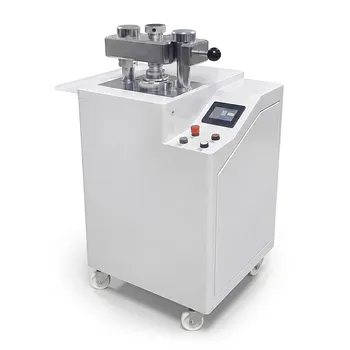
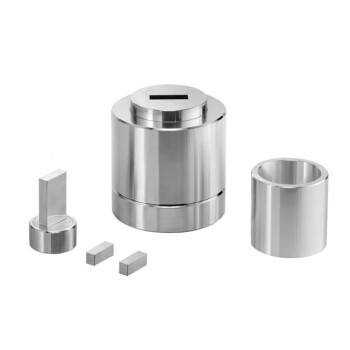
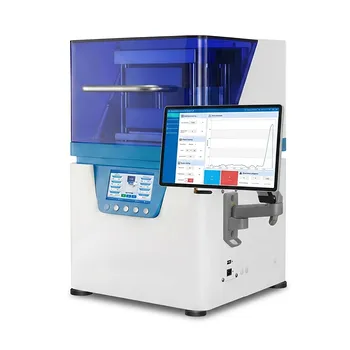
The laboratory hydraulic pellet press serves as a critical fabrication tool for transforming loose active material slurries into high-performance, integrated electrodes. By applying controlled pressure—typically ranging from 5 to 15 MPa—the press mechanically bonds 3D VNCN (Vanadium Nitride Carbon Network) materials onto current collectors like nickel foam or mesh. This process is essential for ensuring low contact resistance and structural integrity during the rigorous charging and discharging cycles of a supercapacitor.
Core Takeaway: The primary function of the hydraulic press is to establish a robust mechanical and electrical interface between the active material and the current collector. This compaction minimizes interfacial resistance and prevents material shedding, which is vital for achieving high rate performance and long-term cycle stability.
Enhancing Electrical and Mechanical Integration
Reducing Interfacial Contact Resistance
The most immediate benefit of using a hydraulic press is the reduction of contact resistance between the active 3D VNCN material and the conductive substrate. Without compaction, the gaps between the material particles and the current collector act as barriers to electron flow.
By applying precise pressure, the press forces the active material into the microscopic pores of the nickel foam or mesh. This creates a continuous pathway for electrons, significantly improving charge transfer efficiency during electrochemical testing.
Strengthening Mechanical Bonding
Supercapacitor electrodes undergo physical stress as ions move in and out of the material structure. A hydraulic press ensures that the mixture of active material, conductive agents (like acetylene black), and binders is tightly packed.
This mechanical interlocking prevents the "slurry" from delaminating or shedding from the current collector when immersed in electrolytes. High-pressure compaction is the key to maintaining structural integrity over thousands of charge-discharge cycles.
Optimization of Electrode Architecture
Controlling Electrode Density and Thickness
Precision is paramount in laboratory environments where data consistency is required. The hydraulic press allows researchers to control the final thickness of the electrode, often down to micrometer precision (e.g., 30 μm).
Uniform thickness ensures that the electrolyte can penetrate the electrode evenly. This leads to more accurate measurements of specific capacitance and prevents "dead zones" where the active material is underutilized.
Improving Rate Performance
Rate performance—the ability of a supercapacitor to deliver power quickly—depends on how fast ions and electrons can move. A compressed electrode has a more cohesive network of conductive agents.
The hydraulic press ensures that the 3D VNCN network remains in constant contact with the conductive carbon black and the current collector. This facilitates the rapid electron transport necessary for high-current operation.
Understanding the Trade-offs
The Risk of Over-Compaction
While pressure is necessary, excessive force (typically above 25–30 MPa) can be detrimental to 3D nanostructured materials like VNCN. Over-compaction can crush the internal pore structure of the material.
If the pores are collapsed, the electrolyte cannot easily access the internal surface area. This results in a significant drop in capacitance, as the "3D" advantage of the material is effectively neutralized.
Pressure Consistency and Material Sensitivity
Different current collectors require different pressure profiles. For example, nickel foam is highly porous and compressible, requiring careful calibration to avoid flattening the foam entirely, which would reduce the available surface area.
Uniformity of pressure across the entire surface of the electrode is also critical. Uneven pressing leads to localized areas of high resistance, which can cause uneven heat distribution and premature electrode failure during testing.
How to Apply This to Your Fabrication Process
Recommendations Based on Research Goals
- If your primary focus is High Power Density: Use moderate pressure (5–10 MPa) to maintain a highly porous structure that allows for rapid ion diffusion while still ensuring good electrical contact.
- If your primary focus is Long Cycle Life: Lean toward higher pressure (10–15 MPa) to maximize the mechanical bond between the VNCN material and the current collector, reducing the risk of material shedding.
- If your primary focus is Volumetric Capacitance: Utilize higher pressures to increase the packing density of the active material, allowing more energy storage in a smaller physical volume.
By carefully calibrating the laboratory hydraulic pellet press, you bridge the gap between a raw chemical synthesis and a functional, high-performance energy storage device.
Summary Table:
| Feature | Function in 3D VNCN Fabrication | Impact on Electrode Performance |
|---|---|---|
| Electrical Integration | Reduces interfacial contact resistance | Improves charge transfer efficiency |
| Mechanical Bonding | Bonds active material to current collector | Prevents shedding and delamination |
| Density Control | Optimizes electrode thickness (e.g., 30 μm) | Ensures uniform electrolyte penetration |
| Network Cohesion | Compacts conductive agents (carbon black) | Enhances high-current rate performance |
| Pressure Range | Controlled application (5–15 MPa) | Protects 3D nanostructures from crushing |
Elevate Your Energy Storage Research with KINTEK
Precision is the foundation of breakthrough energy research. At KINTEK, we specialize in providing high-performance laboratory hydraulic presses (pellet, hot, isostatic) and crushing/milling systems tailored for advanced material fabrication like 3D VNCN.
Whether you are optimizing volumetric capacitance or ensuring long-term cycle stability, our equipment delivers the uniform pressure and consistency required for high-stakes electrochemical testing. Beyond presses, our portfolio includes high-temperature furnaces, electrolytic cells, and essential consumables (PTFE, ceramics, crucibles) to support your entire lab workflow.
Achieve superior electrode integrity today. Contact our technical experts for a custom solution and see how KINTEK can bring reliability to your results.
References
- Jinghua Liu, Yudong Li. 3D Porous VOx/N-Doped Carbon Nanosheet Hybrids Derived from Cross-Linked Dicyandiamide–Chitosan Hydrogels for Superior Supercapacitor Electrode Materials. DOI: 10.3390/polym15173565
This article is also based on technical information from Kintek Solution Knowledge Base .
Related Products
- Automatic Laboratory Hydraulic Pellet Press Machine for Lab Use
- Laboratory Hydraulic Pellet Press for XRF KBR FTIR Lab Applications
- Laboratory Hydraulic Press Lab Pellet Press Machine for Glove Box
- Automatic Laboratory Hydraulic Press for XRF & KBR Pellet Press
- Laboratory Hydraulic Press Lab Pellet Press for Button Battery
People Also Ask
- What is the role of a laboratory hydraulic pellet press and stainless steel molds in the fabrication of RuO2/NbC anodes?
- What role does a laboratory pellet press play in the enhancement of biomass energy products? Optimize Fuel Efficiency
- What is the purpose of using a laboratory pellet press when evaluating the electronic conductivity of carbon powders? Guide
- How does a laboratory hydraulic pellet press contribute to SiCw/2024 aluminum composite preforms? Optimize Densification
- What is the significance of applying 200 MPa of pressure with a laboratory hydraulic pellet press for composite ceramics?