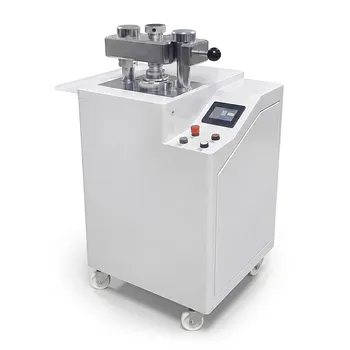
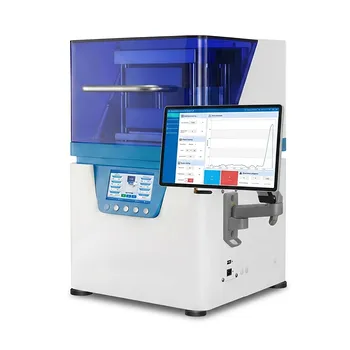
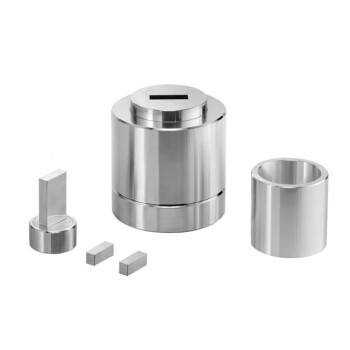
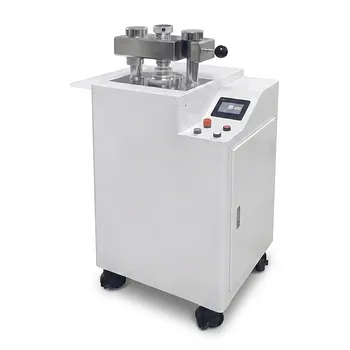
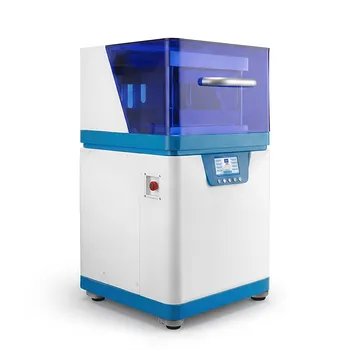
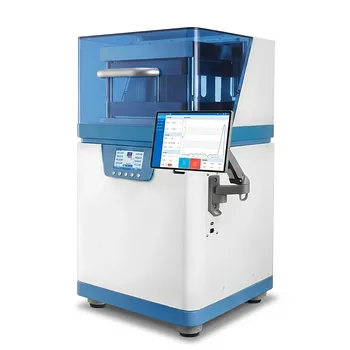
The primary role of a laboratory hydraulic press in this process is to transform loose powder into dense feed cakes or pellets through high-pressure compression. This physical consolidation ensures intimate contact between the antimony ore and sodium chloride particles while minimizing internal voids, which significantly accelerates the chemical reaction rates during subsequent high-temperature roasting.
Core Takeaway: By precisely controlling the compaction of the antimony ore and sodium chloride mixture, the laboratory hydraulic press creates a stable physical structure that optimizes mass transfer kinetics and ensures the efficiency of solid-solid and solid-gas reactions during roasting.
Optimizing Chemical Reaction Kinetics
Enhancing Particle Interconnectivity
The laboratory hydraulic press applies axial force to eliminate the large gaps naturally found in loose powder mixtures. Minimizing these voids is critical because it ensures that the antimony ore and sodium chloride are in constant, direct contact.
This tight contact is the foundation for effective solid-solid reactions. Without the pressure provided by the press, the reactants would remain isolated, leading to incomplete roasting and poor yield.
Accelerating Mass Transfer
Compression significantly shortens the diffusion paths between the reacting particles. In high-temperature roasting, the speed at which atoms move across particle boundaries determines the overall efficiency of the process.
By increasing the density of the mixture, the press facilitates faster mass transfer kinetics. This is especially important in the early stages of roasting before any liquid phases form to bridge the gaps between materials.
Structural Integrity and Gas Permeability
Achieving Mechanical Strength
The hydraulic press creates "green bodies" (pellets or cakes) that possess specific mechanical strength. This structural integrity is necessary to prevent the samples from crumbling or deforming during handling or inside the roasting furnace.
Stable pellets ensure that the material maintains its shape throughout the thermal cycle. This consistency allows for repeatable experimental data, which is vital for analyzing the kinetics of antimony recovery.
Balancing Porosity and Density
While the press increases density, it is also used to reach a target porosity. Controlled porosity is essential for solid-gas reactions, where roasting gases must penetrate the pellet to reach the internal reactants.
The press allows researchers to find the "sweet spot" where the pellet is dense enough for contact but porous enough for gas exchange. This balance prevents the core of the pellet from remaining unreacted during the roasting process.
Understanding the Trade-offs
The Risk of Over-Compaction
Excessive pressure can lead to over-compaction, which may seal off the internal pores of the pellet entirely. If the porosity is too low, reactant gases cannot enter and product gases cannot escape, potentially causing the pellet to crack or explode as internal pressure builds.
Internal Density Gradients
Manual or axial pressing can sometimes create density gradients, where the top of the pellet is denser than the bottom. These variations can lead to uneven roasting rates within a single sample, which may skew the results of the metallurgical analysis.
Equipment Limitations
The accuracy of the roasting study depends on the consistency of the pressure applied. Inconsistent force between batches can result in varying pellet densities, making it difficult to determine if changes in roasting efficiency are due to chemical variables or physical preparation errors.
How to Apply This to Your Roasting Process
To achieve the best results when preparing antimony ore and sodium chloride mixtures, consider your specific experimental objectives:
- If your primary focus is maximizing reaction speed: Use higher pressures to minimize diffusion paths, but ensure the temperature is high enough to initiate the reaction quickly.
- If your primary focus is gas-phase extraction: Optimize for higher porosity by using lower compaction pressures, allowing the roasting gases to circulate freely through the pellet structure.
- If your primary focus is industrial scalability: Focus on achieving the minimum mechanical strength required for handling to reduce the energy costs associated with high-pressure briquetting.
Properly calibrated hydraulic compression transforms a simple powder mixture into a high-performance metallurgical feed, ensuring the success of the antimony roasting process.
Summary Table:
| Key Function | Benefit to Sample | Impact on Roasting Process |
|---|---|---|
| Powder Consolidation | Eliminates voids & gaps | Accelerates solid-solid chemical reactions |
| Mass Transfer Optimization | Shortens diffusion paths | Increases reaction kinetics and recovery yield |
| Structural Strengthening | Creates durable "green bodies" | Prevents sample crumbling during thermal cycles |
| Porosity Management | Controls internal gas channels | Ensures uniform gas-solid interaction and roasting |
Elevate Your Metallurgical Research with KINTEK Precision
Achieving consistent results in antimony recovery requires more than just chemistry—it demands precise physical preparation. KINTEK specializes in high-performance laboratory equipment designed to transform your raw materials into optimized metallurgical feeds.
Our extensive portfolio includes:
- Advanced Hydraulic Presses: Manual, electric, and isostatic options for perfect pellet density.
- Sample Preparation: Crushing and milling systems for ideal particle size distribution.
- High-Temperature Solutions: Muffle, tube, and atmosphere furnaces for rigorous roasting studies.
Whether you are refining mass transfer kinetics or scaling up industrial processes, KINTEK provides the reliability and technical support you need.
Ready to optimize your lab’s efficiency and data accuracy? Contact KINTEK today to find the perfect pressing solution for your application!
References
- Corby Anderson. Mechanical Activation of Antimony Sulfide Concentrates Combined with Pyrometallurgical Chlorination. DOI: 10.54026/jmms/1071
This article is also based on technical information from Kintek Solution Knowledge Base .
Related Products
- Automatic Laboratory Hydraulic Press for XRF & KBR Pellet Press
- Automatic Laboratory Hydraulic Pellet Press Machine for Lab Use
- Laboratory Manual Hydraulic Pellet Press for Lab Use
- Laboratory Hydraulic Pellet Press for XRF KBR FTIR Lab Applications
- Laboratory Manual Hydraulic Pellet Press for Lab Use
People Also Ask
- What is the significance of applying 200 MPa of pressure with a laboratory hydraulic pellet press for composite ceramics?
- What is the role of a laboratory hydraulic pellet press and stainless steel molds in the fabrication of RuO2/NbC anodes?
- How does a laboratory hydraulic pellet press contribute to SiCw/2024 aluminum composite preforms? Optimize Densification
- What is the necessity of using a laboratory hydraulic pellet press in the preparation of biomass fuel pellets? Guide
- What is the function of a laboratory hydraulic pellet press in supercapacitor electrode fabrication? Optimize 3D VNCN.