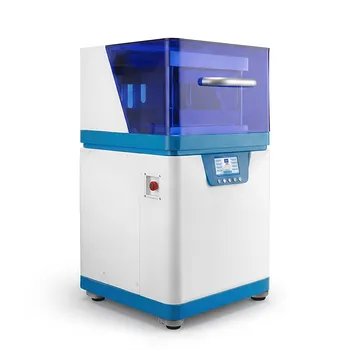
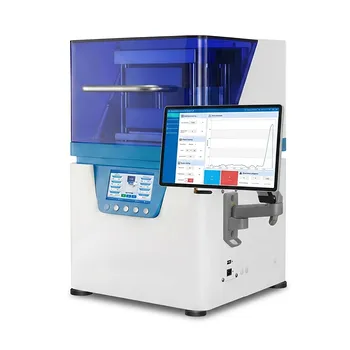
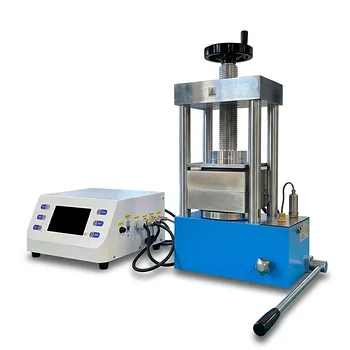
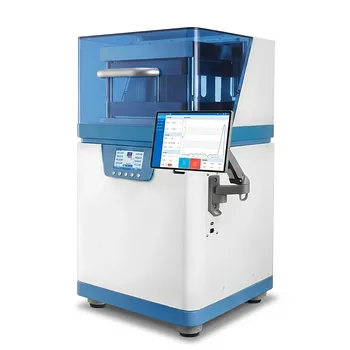
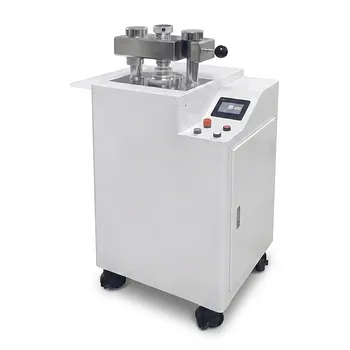
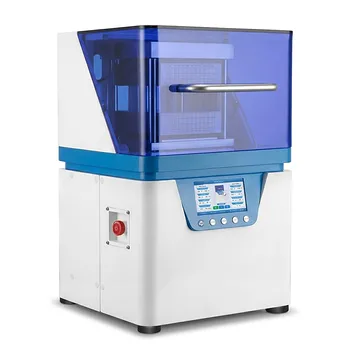
A laboratory hydraulic press is the primary tool for uniaxial compaction, transforming loose, homogenized ceramic powders into a consolidated solid known as a green body. By applying controlled axial pressure—often ranging from 10 MPa to over 100 MPa—the press forces powder particles to rearrange and bind, establishing the initial density, geometric shape, and mechanical integrity required for subsequent thermal processing.
The core role of the hydraulic press is to maximize particle-to-particle contact and eliminate large voids within the powder. This consolidation creates the necessary physical environment for diffusion-controlled solid-state reactions and uniform densification during the sintering stage.
Achieving Structural Integrity and Geometric Definition
Consolidation into Green Bodies
The press applies several tons of force to overcome the friction between loose powder particles. This process creates a green body, a pre-sintered ceramic that possesses enough initial mechanical strength to be handled, measured, or moved to a furnace without crumbling.
Precision Shaping with Molds
Using high-precision molds, the hydraulic press produces specimens with standardized dimensions, such as cylindrical pellets or disc-shaped bodies. These regular geometries are essential for accurate downstream analysis, including dilatometry and high-precision displacement measurements.
Preliminary Prototype Formation
The green body serves as a physical prototype for the final ceramic part. By establishing the basic geometric profile early in the process, the press ensures the material has a defined starting point for the significant shrinkage that occurs during high-temperature firing.
Enhancing Material Properties for Sintering
Maximizing Particle Contact
By reducing the physical distance between particles, the press facilitates diffusion-controlled solid-state chemical reactions. This close proximity is the fundamental factor that determines the final sintering density and the overall performance of the ceramic, such as its corrosion resistance.
Eliminating Voids and Ensuring Uniformity
High-pressure compaction removes large air pockets and voids that could lead to structural failure. Precise pressure control ensures a uniform internal density, which is critical for preventing deformation, cracking, or warping when the specimen is subjected to intense heat.
Preparing for Specialized Processing
In advanced techniques like Spark Plasma Sintering (SPS), the press is used to pre-compact powders into graphite dies. This step ensures continuous electrical conductivity and uniform pressure distribution, which are vital for the pulse heating process to function correctly.
Understanding the Trade-offs and Limitations
Density Gradients
Because a laboratory press typically applies uniaxial pressure (from one direction), friction between the powder and the mold walls can create internal density gradients. The top of the green body may be denser than the bottom, which can lead to uneven shrinkage during sintering.
Mold Wear and Contamination
The high pressures required for compaction—such as the 1,000 bar used for Yttria-Stabilized Zirconia—can cause significant wear on precision molds over time. Additionally, if the mold is not properly lubricated or cleaned, small amounts of metal or carbon can contaminate the ceramic green body.
Pressure Sensitivity
Applying too much pressure too quickly can trap air within the green body, leading to "capping" or laminations where the pellet splits into layers. Conversely, insufficient pressure results in a fragile green body that lacks the mechanical strength to survive the transition to the sintering furnace.
Making the Right Choice for Your Goal
How to Apply This to Your Project
Successful ceramic preparation depends on aligning your pressing parameters with your material requirements and desired final properties.
- If your primary focus is solid-state synthesis: Prioritize maximizing particle contact through higher pressures to facilitate chemical diffusion during firing.
- If your primary focus is dimensional accuracy: Use high-precision molds and ensure uniform pressure distribution to minimize warping and deformation during densification.
- If your primary focus is advanced sintering (e.g., SPS): Focus on eliminating large voids and ensuring the green body is pre-compacted to a density that supports electrical conductivity.
- If your primary focus is structural reliability: Opt for a slower pressure ramp-up to allow air to escape, reducing the risk of internal cracks and laminations.
By mastering the transition from loose powder to a high-density green body, you establish the structural foundation necessary for high-performance ceramic engineering.
Summary Table:
| Feature/Function | Impact on Green Body | Benefit for Sintering |
|---|---|---|
| Uniaxial Compaction | Establishes initial density & solid shape | Ensures uniform densification during firing |
| Geometric Shaping | Produces standardized pellets or discs | Allows for accurate shrinkage & dilatometry analysis |
| Void Removal | Eliminates air pockets & internal gaps | Prevents cracking, warping, and structural failure |
| Particle Contact | Maximizes particle-to-particle bonding | Facilitates diffusion-controlled chemical reactions |
Elevate Your Material Research with KINTEK Precision
Achieving the perfect green body is the foundation of high-performance ceramics. KINTEK specializes in providing laboratory professionals with high-precision hydraulic presses (pellet, hot, and isostatic) designed to ensure uniform density and mechanical integrity.
Beyond compaction, our comprehensive portfolio supports your entire workflow—from crushing and milling systems for powder preparation to high-temperature furnaces (muffle, tube, vacuum, and CVD) for advanced sintering. Whether you are working on solid-state synthesis or specialized battery research, KINTEK delivers the reliability and technical support you need to succeed.
Ready to optimize your ceramic processing? Contact our experts today to find the ideal equipment for your laboratory.
References
- Katarina Stare, Anton Meden. Structure Determination and Analysis of the Ceramic Material La0.987Ti1.627Nb3.307O13 by Synchrotron and Neutron Powder Diffraction and DFT Calculations. DOI: 10.3390/cryst13030439
This article is also based on technical information from Kintek Solution Knowledge Base .
Related Products
- Automatic Hydraulic Hot Press with 500x500mm Heating Plates and Multi Stage PLC Control for Material Sintering
- Fully Automatic Heated Hydraulic Lab Press for Materials Sintering and Sample Preparation
- Automatic Laboratory Hydraulic Press for XRF & KBR Pellet Press
- kbr pellet press 2t
- Laboratory Hydraulic Press Lab Pellet Press Machine for Glove Box
People Also Ask
- How do hydraulic presses facilitate material solidification in Low-Temperature LPS? Optimize Your Material Densification
- Why is 800 MPa required for TiNiPdCu alloy green bodies? Master High-Density Compaction for Superior Material Strength
- How does KBr pellet preparation facilitate FTIR of high-ash mud? Precision Sample Prep for Structural Analysis
- Why is an industrial hydraulic press with precision stainless steel molds used? For Uniform Mo-Fe Precursor Compacts.
- Purpose of Coaxial Ring Molds & Presses in EM Testing? Achieve Precise VNA Data & Fit