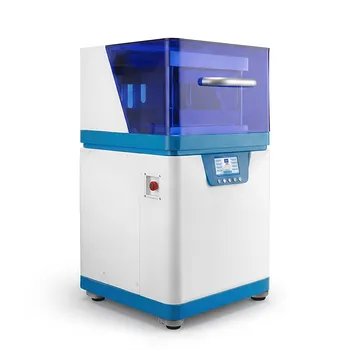
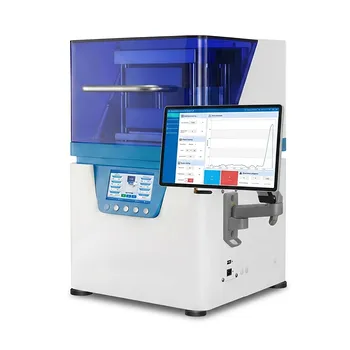
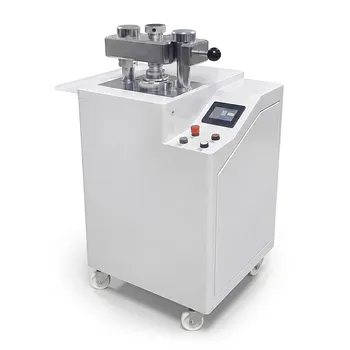
The preparation of KBr pellets using a hydraulic press converts high-ash fine mud into a transparent, uniform scanning medium that is essential for Fourier Transform Infrared (FTIR) spectroscopy. By compressing a mixture of high-purity potassium bromide and the sample under high pressure, the press eliminates air pockets and induces plastic flow, allowing infrared light to penetrate the sample and reveal critical structural transformations like aluminum coordination shifts and bond changes.
High-pressure pelletization is the definitive method for analyzing high-ash mud because it creates an infrared-transparent matrix that minimizes light scattering. This process provides the clarity needed to identify the precise molecular "fingerprints" of mineral activation and metakaolin formation.
Achieving Optical Transparency through High Pressure
The Mechanics of Plastic Flow
A hydraulic press applies substantial, constant force to a mixture of high-ash mud and potassium bromide (KBr) powder within a specialized die. This pressure causes the solid particles to undergo plastic deformation, where they bond tightly and flow into a singular, dense disk.
Elimination of Air and Scattering
The high-pressure molding process excludes air trapped between the fine particles of the mud and the KBr. By removing these voids, the press significantly reduces infrared light scattering, which would otherwise degrade the quality of the spectral data.
Creating a Uniform Scanning Medium
The resulting pellet is typically an ultra-thin, translucent disc (often around 0.5mm). This uniformity and high light transmittance are physical prerequisites for obtaining a high signal-to-noise ratio, ensuring that the detector receives a clear signal from the sample.
The Role of KBr as a Support Matrix
Infrared Transparency
Potassium bromide is chosen because it is an infrared-transparent material. It serves as a neutral support matrix that allows the infrared beam to pass through the sample without interfering with the characteristic vibrational frequencies of the mud's mineral components.
Facilitating Transmission Spectroscopy
Because the KBr pellet is transparent, it enables transmission-mode FTIR. This allows the infrared radiation to penetrate the entire thickness of the sample, capturing a comprehensive view of the molecular structure rather than just the surface characteristics.
Capturing Structural Transformations in High-Ash Mud
Monitoring Thermal Activation
For high-ash fine mud, FTIR analysis is used to evaluate the degree of thermal activation. The clarity provided by the KBr pellet allows researchers to observe the disappearance of hydroxyl (OH) groups, a primary indicator that the material has been successfully dehydroxylated.
Aluminum Coordination Shifts
A critical data point in mud analysis is the transformation of aluminum from a six-fold coordination (AlVI) to a four-fold coordination (AlIV). The high-quality spectra produced by the pelletizing method make these subtle coordination changes visible and quantifiable.
Analyzing Si-O-Si Bond Movements
The hydraulic press method allows for the detection of the red-shift of Si-O-Si bonds. These shifts are vital for identifying the formation of metakaolin, a key structural goal when processing high-ash muds for industrial applications.
Understanding the Trade-offs
Pressure Sensitivity
While high pressure is necessary for transparency, excessive or uneven pressure can lead to pellet cracking or inconsistent thickness. Precise control, often using an electric hydraulic press with specific kN settings, is required to maintain stable and repeatable results.
Moisture Interference
KBr is highly hygroscopic, meaning it absorbs moisture from the air rapidly. If the KBr is not kept perfectly dry before and during the pressing process, water peaks will appear in the FTIR spectra, potentially masking the OH stretching modes of the mud sample.
Sample Concentration Limits
There is a narrow window for the sample-to-KBr ratio; too much mud will make the pellet opaque, preventing light penetration. Conversely, too little sample may result in a signal that is too weak to identify the molecular structural fingerprints of the mineral components.
How to Apply This to Your Project
To achieve the most accurate FTIR analysis of high-ash fine mud, the preparation process must be tailored to the specific mineralogical goals of the study.
- If your primary focus is quantifying thermal activation: Ensure complete dehydroxylation of the KBr powder itself before pressing to avoid interference with the mud's OH-group signals.
- If your primary focus is identifying metakaolin formation: Use a high-pressure electric press to ensure maximum pellet density, which is necessary to resolve the subtle red-shifts in Si-O-Si bonding.
- If your primary focus is aluminum coordination (AlVI to AlIV): Focus on achieving a pellet thickness of approximately 0.5mm to maintain the high signal-to-noise ratio required to distinguish between different coordination states.
By mastering the hydraulic pressing of KBr pellets, you transform a complex, opaque raw material into a clear window for molecular discovery.
Summary Table:
| Key Feature of Preparation | Impact on FTIR Analysis of High-Ash Mud |
|---|---|
| High-Pressure Plastic Flow | Eliminates air voids to minimize light scattering and maximize signal quality. |
| KBr Support Matrix | Provides an IR-transparent medium for transmission-mode molecular fingerprinting. |
| Uniform 0.5mm Thickness | Ensures optimal light transmittance to detect subtle Al-coordination shifts. |
| Precise Load Control | Prevents pellet cracking and ensures repeatable results for Si-O-Si bond analysis. |
Elevate Your Material Research with KINTEK Precision
Achieving optical clarity in FTIR analysis starts with superior sample preparation. KINTEK specializes in high-performance laboratory equipment, offering a comprehensive range of manual and electric hydraulic presses (pellet, hot, isostatic) engineered to create flawless KBr pellets for even the most challenging high-ash samples.
Beyond pelletizing, our portfolio supports your entire lab workflow with crushing and milling systems, high-temperature furnaces, and essential consumables like PTFE products and ceramics. Whether you are monitoring thermal activation or analyzing complex mineral transformations, KINTEK provides the reliability and precision your data demands.
Ready to optimize your lab's efficiency? Contact our technical experts today to find the perfect equipment solution for your specific application!
References
- Hongfei Xue, Suling Yao. Study of Structural Transformation and Chemical Reactivity of Kaolinite-Based High Ash Slime during Calcination. DOI: 10.3390/min13040466
This article is also based on technical information from Kintek Solution Knowledge Base .
Related Products
- Automatic Hydraulic Hot Press with 500x500mm Heating Plates and Multi Stage PLC Control for Material Sintering
- Automatic High Temperature Heated Hydraulic Press Machine with Heated Plates for Lab
- Heated Hydraulic Press Machine with Heated Plates for Vacuum Box Laboratory Hot Press
- Manual High Temperature Heated Hydraulic Press Machine with Heated Plates for Lab
- 24T 30T 60T Heated Hydraulic Press Machine with Heated Plates for Laboratory Hot Press
People Also Ask
- How do hydraulic presses facilitate material solidification in Low-Temperature LPS? Optimize Your Material Densification
- Why is 800 MPa required for TiNiPdCu alloy green bodies? Master High-Density Compaction for Superior Material Strength
- Why is an industrial hydraulic press with precision stainless steel molds used? For Uniform Mo-Fe Precursor Compacts.
- Purpose of Coaxial Ring Molds & Presses in EM Testing? Achieve Precise VNA Data & Fit
- What process advantages do precision dies and hydraulic presses provide when preparing Ilmenite reduction samples?