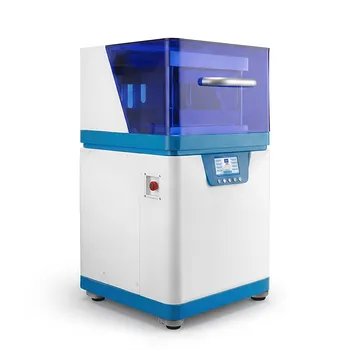
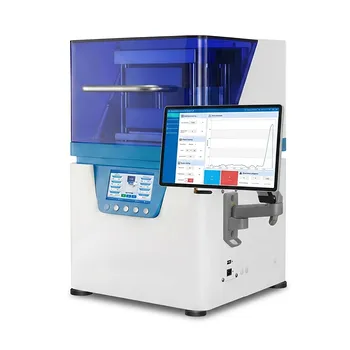
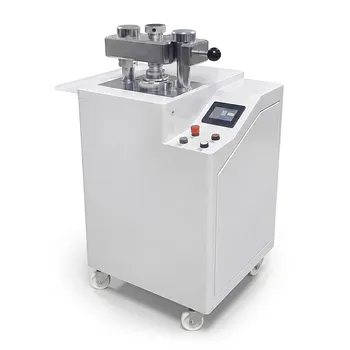
The laboratory hydraulic press is the critical link between chemical synthesis and physical characterization. It transforms sub-micron high-entropy oxide (HEO) powders into high-density bulk pellets, a process that is essential for removing large inter-particle voids.
Core Takeaway: To obtain accurate bulk physical property data, researchers must eliminate atmospheric voids that interfere with measurements. The hydraulic press ensures that data collected from systems like the MPMS or PPMS reflects the intrinsic properties of the synthesized material rather than the air trapped within a loose powder.
Enhancing Measurement Accuracy in Specialized Systems
Eliminating Voids for Magnetization Data
High-entropy oxides are often studied for their unique magnetic signatures using a Magnetic Property Measurement System (MPMS). If the material remains in a loose powder state, the presence of large voids significantly reduces the volume fraction of the actual material. Compaction via hydraulic press ensures that the resulting pellet provides a dense, continuous sample necessary for calculating accurate bulk magnetization values.
Optimizing Specific Heat Capacity Measurements
In a Physical Property Measurement System (PPMS), specific heat data is highly sensitive to the thermal contact and density of the specimen. A laboratory press applies standardized pressure to create uniform pellets that facilitate consistent thermal conductivity across the sample. This uniformity is required to distinguish the intrinsic heat capacity of the high-entropy lattice from extrinsic measurement artifacts.
Standardizing Samples for XRD and Spectroscopy
For X-ray diffraction (XRD) and infrared (IR) spectroscopy, surface uniformity is paramount. A hydraulic press, often used with specialized stainless steel molds, creates a flat, dense surface that ensures X-rays or light waves interact with the material at precise angles. This leads to higher resolution data and more reliable identification of the complex phases present in HEOs.
Structural Foundations for Advanced Characterization
Preparing Green Bodies for Sintering
Many physical property tests require a fully sintered ceramic block rather than a raw powder. The hydraulic press creates a "green body" with sufficient initial density to undergo high-temperature solid-phase sintering (often at 1400 °C or higher). High-pressure molding (sometimes reaching 0.8 GPa) ensures that the powder particles are in close enough contact for mechanical interlocking and atomic diffusion to occur efficiently during the heating process.
Impact on Electrical Resistivity Testing
When testing the conductive performance of synthesized oxides, researchers often utilize the four-probe method. Voids between particles act as insulators, artificially inflating the measured resistivity. By using a hydraulic press to achieve a high structural density, researchers can acquire data that reflects the intrinsic resistivity characteristics of the synthesized material.
Assessing Powder Flowability and Compressibility
Beyond the final pellet, the press helps characterize the synthesized powder itself. By measuring volume changes under specific loads, researchers calculate parameters like the Carr index and Hausner ratio. These metrics provide vital information on the flowability and handling properties of the HEO powder, which are critical for scaling up manufacturing processes.
Understanding the Trade-offs
Risk of Pressure-Induced Phase Transitions
While high pressure is necessary for density, extreme tonnage can occasionally trigger unintended phase changes or structural deformations in sensitive high-entropy materials. It is critical to determine the "sweet spot" where density is maximized without altering the synthesized crystal structure.
Density Gradients and Edge Effects
Friction between the powder and the mold walls can lead to non-uniform density distribution within a single pellet. This gradient can cause the pellet to warp or crack during the sintering process, potentially leading to inconsistent data during mechanical or electrical testing.
Contamination from Tooling
The use of steel or tungsten carbide molds introduces a risk of metallic contamination on the surface of the HEO sample. For high-purity research, researchers must ensure molds are meticulously cleaned or use protective liners to prevent foreign elements from skewing the chemical analysis.
How to Apply This to Your Research
Making the Right Choice for Your Goal
- If your primary focus is Magnetic or Thermal Analysis: Use the hydraulic press to achieve maximum theoretical density to ensure the volume-dependent data is accurate and reproducible.
- If your primary focus is Electrical Conductivity: Apply high-pressure loads (up to 0.8 GPa) to minimize contact resistance between particles before performing four-probe measurements.
- If your primary focus is Microstructural Evolution: Use the press to create standardized green bodies, ensuring that the sintering process produces a uniform microstructure for hardness and grain-boundary testing.
Ultimately, the laboratory hydraulic press serves as the bridge that translates synthesized chemical powders into the standardized, high-density forms required for definitive physical property characterization.
Summary Table:
| Application | Role of Hydraulic Press | Impact on Measurement |
|---|---|---|
| Magnetization (MPMS) | Compaction of HEO powders | Eliminates voids for accurate volume fraction data. |
| Thermal Analysis (PPMS) | Standardizing pellet density | Facilitates consistent contact for specific heat data. |
| XRD & Spectroscopy | Surface uniformity | Ensures precise interaction angles for phase identification. |
| Sintering Preparation | Green body creation | Enables atomic diffusion during high-temp solid-phase sintering. |
| Electrical Testing | Reducing contact resistance | Minimizes inter-particle voids for intrinsic resistivity data. |
Elevate Your Material Research with KINTEK’s Precision Hydraulic Presses
To unlock the true potential of high-entropy oxides and advanced materials, precision in sample preparation is non-negotiable. KINTEK specializes in providing researchers with the high-performance laboratory equipment needed to translate synthesized powders into reliable data.
Our extensive portfolio features state-of-the-art laboratory hydraulic presses (pellet, hot, and isostatic) capable of reaching the high pressures (up to 0.8 GPa) required for dense HEO characterization. Beyond pressing, KINTEK supports your entire workflow with:
- High-temperature furnaces (muffle, tube, and vacuum) for expert sintering.
- Crushing and milling systems for optimal powder synthesis.
- Specialized consumables, including high-purity ceramics and crucibles to prevent contamination.
Ready to achieve superior measurement accuracy?
Contact KINTEK Experts Today to find the perfect pressing solution for your laboratory’s unique needs.
References
- Yuguang Pu, Peng Cao. (Mg,Mn,Fe,Co,Ni)O: A rocksalt high-entropy oxide containing divalent Mn and Fe. DOI: 10.1126/sciadv.adi8809
This article is also based on technical information from Kintek Solution Knowledge Base .
Related Products
- Automatic Hydraulic Hot Press with 500x500mm Heating Plates and Multi Stage PLC Control for Material Sintering
- Heated Hydraulic Press Machine with Heated Plates for Vacuum Box Laboratory Hot Press
- Automatic High Temperature Heated Hydraulic Press Machine with Heated Plates for Lab
- Manual High Temperature Heated Hydraulic Press Machine with Heated Plates for Lab
- 24T 30T 60T Heated Hydraulic Press Machine with Heated Plates for Laboratory Hot Press
People Also Ask
- How do hydraulic presses facilitate material solidification in Low-Temperature LPS? Optimize Your Material Densification
- Why is 800 MPa required for TiNiPdCu alloy green bodies? Master High-Density Compaction for Superior Material Strength
- How does KBr pellet preparation facilitate FTIR of high-ash mud? Precision Sample Prep for Structural Analysis
- Why is an industrial hydraulic press with precision stainless steel molds used? For Uniform Mo-Fe Precursor Compacts.
- Purpose of Coaxial Ring Molds & Presses in EM Testing? Achieve Precise VNA Data & Fit