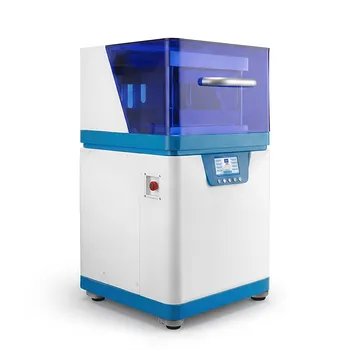
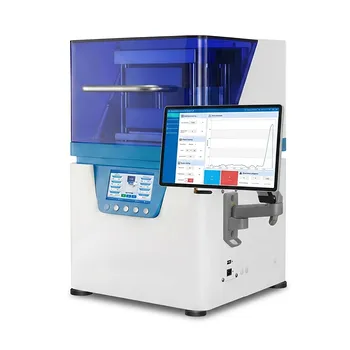
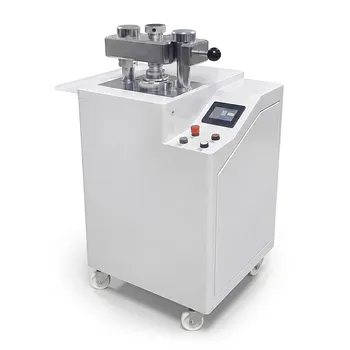
High-precision coaxial ring molds and pressing equipment transform raw microwave-absorbing materials into standardized test specimens with exacting geometric dimensions. This equipment ensures a perfect mechanical fit within the coaxial testing fixtures of a Vector Network Analyzer (VNA), which is essential for obtaining accurate measurements of complex permittivity and magnetic permeability. By eliminating physical gaps and dimensional variability, these tools remove technical artifacts that would otherwise corrupt electromagnetic calculations and reflection loss data.
Performance in electromagnetic testing depends entirely on the physical interface between the sample and the testing hardware. High-precision molds eliminate air gaps and geometric inconsistencies, ensuring that the resulting data reflects the material's true properties rather than measurement errors.
Achieving Mechanical Fit for Testing Systems
Perfecting the Coaxial Interface
Coaxial testing systems require samples with extremely specific dimensions, such as an outer diameter of 7.0 mm and an inner diameter of 3.04 mm. Using precision metal molds ensures the sample fits snugly into the fixture without the need for manual adjustment. A tight fit is mandatory to prevent electromagnetic leakage around the sample edges, which would lead to significant measurement inaccuracy.
Standardizing Sample Composition
The pressing equipment allows for the creation of composite samples by mixing active powders with binders like paraffin at specific ratios, often between 10% and 30% by weight. This standardization ensures that different materials can be compared on an equal basis under the same testing conditions. The mechanical press provides the necessary force to bond these components into a solid, handleable ring.
Enhancing Data Accuracy and Repeatability
Eliminating Internal Voids and Air Gaps
A laboratory hydraulic press applies stable, uniform pressure to remove internal voids and air pockets from the sample. Large voids within a specimen create discontinuities that scatter electromagnetic waves and distort the measured complex permittivity. High-precision molding ensures a dense, homogenous structure that yields repeatable and reliable data across multiple tests.
Ensuring Flat Surfaces and Matching Thickness
In microwave absorption testing, specimens must have perfectly flat surfaces and precise thicknesses to match theoretical models. Any physical defect on the surface causes reflection errors that are not representative of the material's chemical performance. Precise molds ensure that the sample thickness is controlled to within microns, allowing for accurate reflection loss calculations.
Building a Structural Foundation
Facilitating Phase Transitions
In materials requiring post-processing, such as Bi-2223 powders, molds create "green bodies" with a stable structural foundation. This precision is vital because complex materials undergo phase transitions and crystallization during subsequent high-temperature sintering. A well-molded initial shape minimizes internal defects and ensures the material maintains its integrity throughout the entire manufacturing process.
Uniform Density Distribution
The use of hydraulic equipment ensures that the density distribution is uniform throughout the specimen. If one side of a ring is denser than the other, the electromagnetic waves will interact with the material inconsistently. Uniformity allows researchers to accurately evaluate how specific additives, such as graphene, impact the material's barrier properties or electromagnetic response.
Understanding the Trade-offs
Pressure Sensitivity and Material Deformation
While high pressure is necessary to eliminate voids, excessive force can damage the microstructure of the active microwave-absorbing material. Certain fragile crystals or porous structures may collapse under the weight of a heavy hydraulic press. Researchers must calibrate the pressure to achieve density without compromising the material's intrinsic properties.
Mold Wear and Maintenance
Precision molds are subject to mechanical wear and tear over time, especially when used with abrasive ceramic powders. Minor scratches or deformations in the mold will eventually transfer to the samples, leading to a loose fit in the coaxial fixture. Frequent calibration and the use of high-grade hardened metals are required to maintain the necessary tolerances for electromagnetic testing.
How to Apply This to Your Project
Recommendations Based on Your Goal
- If your primary focus is Vector Network Analysis (VNA): Use molds that match the exact inner and outer diameters of your coaxial fixture to eliminate reflection errors caused by air gaps.
- If your primary focus is high-temperature sintering: Prioritize molds that produce high-density green bodies to ensure structural integrity during crystallization and phase changes.
- If your primary focus is evaluating new additives (like graphene): Ensure your pressing equipment provides a uniform thickness (e.g., within ±4 μm) to allow for a fair comparison of how dispersion affects material performance.
By utilizing high-precision molding and pressing equipment, you move from qualitative estimation to quantitative certainty in electromagnetic material characterization.
Summary Table:
| Feature | Impact on Electromagnetic Testing | Key Benefit |
|---|---|---|
| Mechanical Fit | Eliminates air gaps between sample and coaxial fixture | Prevents EM leakage and measurement artifacts |
| Void Removal | Removes internal air pockets and discontinuities | Ensures homogenous structure for repeatable data |
| Surface Precision | Controls thickness and flatness to micron levels | Accurate reflection loss and permittivity calculations |
| Density Uniformity | Ensures consistent wave interaction through the material | Reliable evaluation of additives like graphene/powders |
Elevate Your Material Characterization with KINTEK
Precision in electromagnetic testing starts with the perfect sample. KINTEK specializes in high-performance laboratory equipment designed to eliminate measurement errors and ensure quantitative certainty.
Whether you are developing advanced microwave-absorbing materials or conducting complex VNA analysis, our range of laboratory hydraulic presses (pellet, hot, and isostatic) and high-precision coaxial molds provide the uniform density and exacting dimensions your research demands.
Our portfolio for researchers includes:
- Sample Prep: Precision crushing/milling systems and hydraulic presses.
- Thermal Processing: Muffle, tube, and vacuum furnaces for sintering and phase transitions.
- Advanced Reactors: High-temperature high-pressure reactors and autoclaves.
- Consumables: High-grade ceramics, crucibles, and PTFE products.
Don't let manual sample preparation compromise your data accuracy. Contact KINTEK today to find the ideal pressing and molding solution for your lab!
References
- Xiaonong Wang, Yujie Xiong. Tunable Impedance of Cobalt Loaded Carbon for Wide‐Range Electromagnetic Wave Absorption. DOI: 10.1002/smll.202308970
This article is also based on technical information from Kintek Solution Knowledge Base .
Related Products
- Automatic Hydraulic Hot Press with 500x500mm Heating Plates and Multi Stage PLC Control for Material Sintering
- Automatic High Temperature Heated Hydraulic Press Machine with Heated Plates for Lab
- Heated Hydraulic Press Machine with Heated Plates for Vacuum Box Laboratory Hot Press
- Manual High Temperature Heated Hydraulic Press Machine with Heated Plates for Lab
- 24T 30T 60T Heated Hydraulic Press Machine with Heated Plates for Laboratory Hot Press
People Also Ask
- How do hydraulic presses facilitate material solidification in Low-Temperature LPS? Optimize Your Material Densification
- Why is 800 MPa required for TiNiPdCu alloy green bodies? Master High-Density Compaction for Superior Material Strength
- How does KBr pellet preparation facilitate FTIR of high-ash mud? Precision Sample Prep for Structural Analysis
- Why is an industrial hydraulic press with precision stainless steel molds used? For Uniform Mo-Fe Precursor Compacts.
- What process advantages do precision dies and hydraulic presses provide when preparing Ilmenite reduction samples?