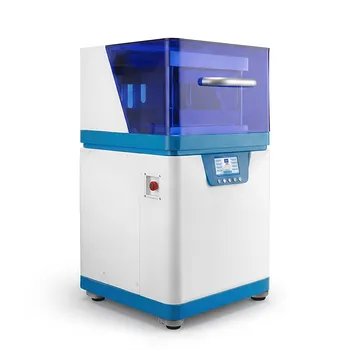
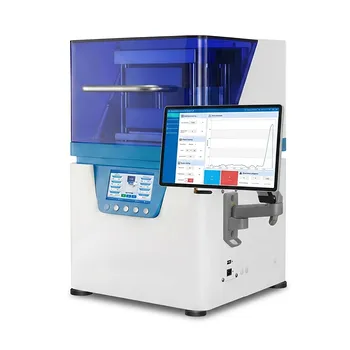
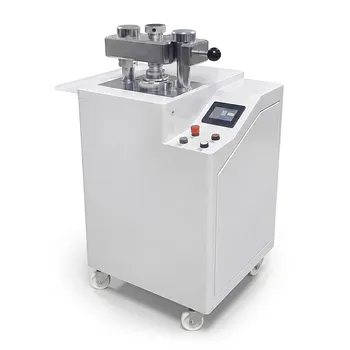
High-pressure hydraulic presses are essential for barium zirconate-based oxides because they provide the mechanical force necessary to transform loose multicomponent powders into dense, cohesive "green bodies." By applying axial pressures—often ranging from 100 MPa to 400 MPa—these presses overcome inter-particle friction and eliminate internal air voids. This intensive compaction creates a robust microstructure that is vital for successful high-temperature sintering and the prevention of structural failure.
The use of a high-pressure press is the foundational step in ceramic fabrication, establishing the initial density and particle contact required for mass transfer. Without this preliminary mechanical densification, barium zirconate ceramics cannot achieve full theoretical density or structural integrity during the sintering process.
Overcoming Physical Barriers to Density
Neutralizing Inter-particle Friction
Barium zirconate-based powders naturally resist tight packing due to friction between individual particles. High-pressure manual or electric presses apply the necessary force to overcome this resistance, allowing particles to slide and rearrange into a more compact configuration.
Expelling Entrapped Air
Loose powder contains significant amounts of air that can create internal porosity and structural "weak spots." The high axial load of a hydraulic press mechanically forces air out of the mold, significantly reducing the volume of voids before the material ever enters a furnace.
Defining Geometric Precision
Using a press in conjunction with precision steel molds allows researchers to create specific shapes, such as disc-shaped pellets or rectangular bars. This ensures the material has a uniform cross-section, which is critical for consistent heat distribution and shrinkage during subsequent processing.
Establishing the Foundation for Sintering
Maximizing Particle Contact Area
Solid-phase diffusion, the primary mechanism of sintering, occurs at the points where powder particles touch. By applying high pressure, the press increases the coordination number (the number of contact points per particle), which accelerates the rate of grain growth and densification.
Promoting Low-Temperature Densification
Dense green bodies allow for effective mass transfer at lower relative temperatures. This is particularly important for barium zirconate-based materials like BCZY5, where high initial compaction helps achieve high-density electrolyte pellets without requiring excessive thermal energy.
Minimizing Sintering Shrinkage
A green body with high initial density will experience significantly less volumetric shrinkage during the sintering process. Reducing shrinkage is vital for maintaining the dimensional accuracy of the component and preventing the development of internal stresses.
Ensuring Structural Reliability
Achieving Necessary Green Strength
The "green body" must be strong enough to be handled and moved into a sintering furnace without crumbling. High-pressure compaction provides sufficient mechanical interlocking between particles to give the pellet "green strength," even without the use of chemical binders.
Preventing Cracks and Deformation
Uniform pressure application ensures that the density is consistent throughout the entire volume of the pellet. This uniformity prevents the ceramic from warping, cracking, or suffering from severe deformation when exposed to temperatures as high as 1500°C to 1600°C.
Facilitating Research Consistency
In laboratory settings, a stable hydraulic press (manual or electric) provides reproducible results. This stability is essential for researchers to accurately study how different sintering temperatures and durations affect the material’s final thermal diffusivity and microstructural control.
Understanding the Trade-offs
Risk of Pressure-Induced Defects
While high pressure is necessary, exceeding the material's limit can lead to "capping" or lamination, where the pellet splits into layers upon release from the mold. Finding the specific pressure equilibrium—typically between 200 MPa and 350 MPa—is crucial to avoid internal stress fractures.
Uniaxial vs. Isostatic Limitations
Most laboratory hydraulic presses apply uniaxial pressure, which can lead to slight density gradients within the green body. For extremely complex shapes or parts requiring absolute uniformity, uniaxial pressing is often used only as a "pre-molding" step before secondary treatments like cold isostatic pressing.
Mold Wear and Maintenance
The high forces required to compact barium zirconate can cause significant wear on steel molds over time. Maintaining the integrity of the mold surfaces is essential to prevent particles from sticking and to ensure the pellets can be ejected without surface damage.
Applying This to Your Project
Recommendations for Success
- If your primary focus is electrolyte density: Use a pressure of at least 300 MPa to maximize particle contact and facilitate faster solid-phase diffusion during sintering.
- If your primary focus is preventing structural cracks: Ensure the pressure is applied and released slowly to allow for the gradual relaxation of internal stresses within the green body.
- If your primary focus is research repeatability: Utilize an electric hydraulic press with a digital pressure gauge to ensure every pellet is formed under identical mechanical conditions.
Proper high-pressure compaction is the critical bridge between raw chemical powders and high-performance, fully-dense barium zirconate ceramics.
Summary Table:
| Key Function | Physical Impact on Green Body | Benefit for Sintering/Final Product |
|---|---|---|
| Friction Neutralization | Overcomes inter-particle resistance for tight packing | Higher initial density and uniform microstructure |
| Air Expulsion | Eliminates internal voids and porosity | Prevents structural weak spots and cracking |
| Particle Contact | Increases coordination number (contact points) | Accelerates solid-phase diffusion and grain growth |
| Geometric Precision | Forms uniform shapes (pellets/bars) | Ensures consistent heat distribution and low shrinkage |
| Mechanical Interlocking | Provides necessary "green strength" | Allows safe handling and transport into the furnace |
Achieve Perfection in Ceramic Fabrication with KINTEK
High-performance materials like barium zirconate require uncompromising precision during the compaction phase. KINTEK provides researchers and manufacturers with state-of-the-art manual and electric hydraulic presses (pellet, hot, and isostatic) designed to deliver the consistent, high-tonnage pressure needed for defect-free green bodies.
Beyond compaction, KINTEK offers a full-ecosystem laboratory solution, including:
- Material Preparation: Crushing, milling, and sieving systems for optimal powder morphology.
- Thermal Processing: High-temperature muffle, tube, and vacuum furnaces capable of reaching 1600°C+ for sintering.
- Advanced Research Tools: High-pressure reactors, autoclaves, and specialized consumables like PTFE and ceramics.
Don’t let low green density compromise your research outcomes. Ensure structural reliability and high sintering efficiency with our expert-backed laboratory equipment.
Contact KINTEK today to find the ideal press for your laboratory!
References
- Aleksandra Mielewczyk‐Gryń, Maria Gazda. Water uptake and energetics of the formation of barium zirconate based multicomponent oxides. DOI: 10.1039/d2cp05265b
This article is also based on technical information from Kintek Solution Knowledge Base .
Related Products
- Automatic Hydraulic Hot Press with 500x500mm Heating Plates and Multi Stage PLC Control for Material Sintering
- Heated Hydraulic Press Machine with Heated Plates for Vacuum Box Laboratory Hot Press
- Automatic High Temperature Heated Hydraulic Press Machine with Heated Plates for Lab
- Manual High Temperature Heated Hydraulic Press Machine with Heated Plates for Lab
- 24T 30T 60T Heated Hydraulic Press Machine with Heated Plates for Laboratory Hot Press
People Also Ask
- How do hydraulic presses facilitate material solidification in Low-Temperature LPS? Optimize Your Material Densification
- Why is 800 MPa required for TiNiPdCu alloy green bodies? Master High-Density Compaction for Superior Material Strength
- How does KBr pellet preparation facilitate FTIR of high-ash mud? Precision Sample Prep for Structural Analysis
- Why is an industrial hydraulic press with precision stainless steel molds used? For Uniform Mo-Fe Precursor Compacts.
- Purpose of Coaxial Ring Molds & Presses in EM Testing? Achieve Precise VNA Data & Fit