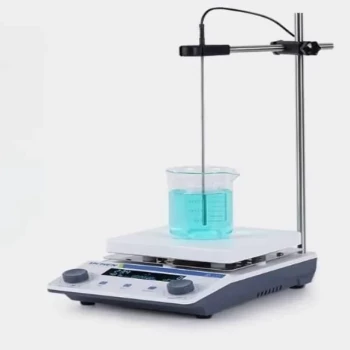
The magnetic stirrer acts as the active suspension agent in the Cu–TiO2 composite electrodeposition process. Its primary role is to provide high-speed rotation that generates intense fluid flow disturbances, which are necessary to counteract the force of gravity on the titanium dioxide (TiO2) particles.
The core function of the magnetic stirrer is to maintain the TiO2 particles in a constant, suspended state. Without this mechanical agitation, the particles would settle out of the solution, making it impossible to co-deposit them with the copper to form a composite coating.
The Mechanics of Suspension and Incorporation
Counteracting Gravitational Settling
Titanium dioxide particles are solid matter dispersed within a liquid electrolyte. Due to their density, these particles have a natural tendency to sink to the bottom of the plating bath.
The magnetic stirrer generates high-speed rotation, creating a hydrodynamic force that opposes gravity. This continuous agitation keeps the particles "afloat" and biologically active within the deposition zone.
Achieving Homogeneity
Suspension alone is not enough; the particles must be spread evenly. The stirrer ensures the uniform distribution of the dispersed phase throughout the entire volume of the electrolyte.
This prevents "dead zones" where particle concentration is low, or "hot spots" where particles might clump together.
Facilitating Co-Deposition
The ultimate goal of this process is to trap TiO2 particles inside the growing copper matrix.
By maintaining a consistent suspension, the stirrer guarantees that particles are continuously available at the cathode surface. This allows them to be evenly incorporated into the metal layer as it forms, creating a true composite material rather than a simple copper plating.
Understanding the Trade-offs
Flow Intensity vs. Surface Quality
While the primary reference emphasizes intense fluid flow disturbances, this is a variable that requires balance.
Insufficient agitation leads to particle sedimentation and a coating devoid of TiO2. However, excessive turbulence can disrupt the diffusion layer near the electrode, potentially affecting the efficiency of the copper ion reduction.
Dispersion vs. Agglomeration
The stirrer aids in dispersion, but it acts primarily on the macro scale of the fluid.
While it keeps particles suspended, it relies on the shear force of the fluid to prevent particle agglomeration. If the stirring is not optimized, particles may remain suspended but clumped, leading to roughness or defects in the final composite coating.
Making the Right Choice for Your Goal
To maximize the quality of your Cu–TiO2 composite coating, you must view the stirrer as a process control tool, not just a mixer.
- If your primary focus is Compositional Uniformity: Ensure the rotation speed is high enough to generate visible turbulence to prevent any sedimentation gradients from top to bottom.
- If your primary focus is Particle Content: Recognize that the concentration of particles in the coating is directly linked to their suspension stability; if they settle, they cannot be incorporated.
The magnetic stirrer is the mechanical guarantor of composite formation, ensuring the physical availability of particles for electrochemical incorporation.
Summary Table:
| Feature | Role in Cu–TiO2 Electrodeposition |
|---|---|
| Primary Function | Acts as an active suspension agent to counteract gravity |
| Particle State | Maintains TiO2 particles in a constant, suspended state |
| Distribution | Ensures uniform dispersion throughout the electrolyte volume |
| Process Goal | Facilitates even co-deposition of particles into the copper matrix |
| Key Variable | High-speed rotation generates necessary fluid flow disturbances |
Elevate Your Composite Research with KINTEK Precision
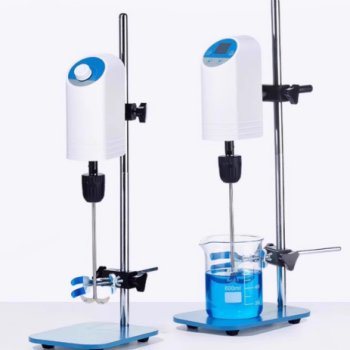
Achieving the perfect Cu–TiO2 composite coating requires more than just chemistry—it requires precise mechanical control. KINTEK specializes in high-performance laboratory equipment, including advanced magnetic stirrers, shakers, and homogenizers designed to maintain optimal particle suspension in complex electrodeposition baths.
Whether you are developing next-generation catalysts or wear-resistant coatings, our comprehensive portfolio—from electrolytic cells and electrodes to high-temperature furnaces and vacuum systems—provides the reliability your research demands.
Ready to optimize your deposition process? Contact our laboratory specialists today to find the perfect equipment solution for your specific application.
References
- Ірина Скнар, Dmitriy Gerasimenko. Development of a new suspension electrolyte based on methane-sulphonic acid for the electrodeposition of Cu–TiO2 composites. DOI: 10.15587/1729-4061.2021.224224
This article is also based on technical information from Kintek Solution Knowledge Base .
Related Products
- Laboratory Small Constant Temperature Heated Magnetic Stirrer Heater and Stirrer
- Custom PTFE Teflon Parts Manufacturer for Magnetic Stirring Bar
- High Performance Laboratory Stirrers for Diverse Applications
- Three-dimensional electromagnetic sieving instrument
- Custom PTFE Teflon Parts Manufacturer for PTFE Stirring Bar Recovery Rod
People Also Ask
- What role does a magnetic stirrer with heating play in ZnO nanoparticle synthesis? Precision Control for Quality Results
- What role does a constant temperature heating magnetic stirrer play in MFC-HAp synthesis? Achieve Material Homogeneity
- What is the function of a laboratory magnetic stirrer in Ni–Cr–P electrodeposition? Optimize Ion Transport & Coating
- Why is a laboratory magnetic stirrer required for benzoic acid esters? Boost Reaction Speed & Yield with High RPM
- What role does a laboratory magnetic stirrer play in TiO2 and TiO2-Ag sol preparation? Master Chemical Kinetics