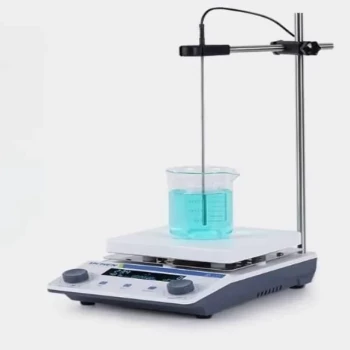
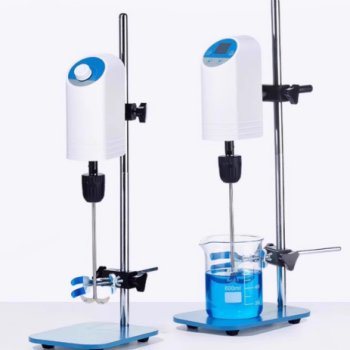
In the synthesis of Graphene Oxide (GO) via the modified Hummer method, a magnetic stirrer with precision temperature control acts as the primary regulator for both reaction kinetics and operational safety. It ensures the thorough, uniform contact of graphite flakes with strong oxidizing agents while strictly managing the volatile thermal energy released during the process.
Core Takeaway This equipment is not merely a mixing device; it is a critical process control tool. By synchronizing continuous mechanical agitation with exact thermal management at specific nodes (e.g., 0°C and 90°C), it dictates the degree of oxidation and prevents dangerous runaway reactions, directly determining the quality and safety of the final Graphene Oxide precursor.
The Mechanics of Oxidation Management
Ensuring Uniform Kinetic Energy
The modified Hummer method utilizes a viscous mixture of concentrated sulfuric acid, sodium nitrate, and potassium permanganate. A magnetic stirrer provides the necessary continuous kinetic energy to drive these reactants together.
This agitation ensures thorough contact between the graphite flakes and the oxidizing agents. Without constant motion, the reactants would settle, leading to incomplete oxidation and inconsistent material properties.
Regulating Exothermic Phases
The oxidation of graphite is a highly exothermic process, meaning it releases significant heat. Precision temperature control is essential to manage these thermal surges.
The system must maintain exact operation at specific temperature nodes. For example, keeping the reaction at 0°C during the initial addition of oxidizers is crucial to prevent overheating, while a controlled rise to 90°C is often required for subsequent reaction phases.
Preventing Thermal Runaway
Failure to manage heat generation can lead to "runaway reactions," where the temperature spikes uncontrollably.
By integrating the stirrer with a temperature feedback loop, the system can adjust heating or cooling in real-time. This prevents dangerous pressure buildups or chemical hazards associated with uncontrolled oxidation.
Why Precision Matters for Material Quality
Controlling the Degree of Oxidation
The structural integrity of Graphene Oxide is defined by its degree of oxidation. Precision thermal management ensures the reaction proceeds at a specific, controlled rate.
This control allows for the production of high-quality GO precursors with reproducible characteristics. It ensures the carbon lattice is oxidized sufficiently without being destroyed by excessive heat.
Homogeneity and Heat Distribution
Beyond chemical mixing, the magnetic stirrer ensures thermal homogeneity.
In a static solution, heat can accumulate in pockets, creating "hotspots." Continuous agitation distributes thermal energy evenly throughout the aqueous solution, ensuring that every graphite flake experiences the same temperature conditions.
Understanding the Trade-offs
Viscosity Limitations
As Graphene Oxide forms, the reaction mixture typically becomes thicker and more viscous.
A standard magnetic stirrer may struggle to maintain constant speed in high-viscosity sludge. If the magnetic coupling is weak, the stir bar may decouple or "spin out," leading to immediate loss of temperature homogeneity and potential safety risks.
Sensor Placement Sensitivity
The precision of the temperature control is entirely dependent on the placement of the thermal probe.
If the probe is placed too close to the heating element or the container walls, it may register a temperature different from the core of the mixture. Because the Hummer method relies on specific nodes (like 0°C), a false reading can compromise the entire batch.
Making the Right Choice for Your Synthesis
When setting up your synthesis station, prioritize the features that align with your specific constraints:
- If your primary focus is safety: Prioritize a unit with rapid cooling capabilities and over-temperature alarms to manage the initial, volatile exothermic spike at 0°C.
- If your primary focus is material consistency: Prioritize a unit with high-torque stirring capabilities to maintain uniform agitation speed as the mixture viscosity increases.
The magnetic stirrer is the heartbeat of the modified Hummer method, strictly enforcing the thermal and kinetic boundaries required to turn raw graphite into advanced nanomaterials.
Summary Table:
| Feature | Role in GO Synthesis | Critical Benefit |
|---|---|---|
| Mechanical Agitation | Ensures uniform contact between graphite and oxidizers | Consistent oxidation degree |
| Precision Temp Control | Manages exothermic spikes at 0°C and 90°C nodes | Prevents dangerous thermal runaway |
| High-Torque Stirring | Maintains constant speed in high-viscosity sludge | Prevents material settling and hotspots |
| Thermal Feedback | Real-time adjustment of heat/cooling cycles | Ensures batch-to-batch reproducibility |
Elevate Your Nanomaterial Synthesis with KINTEK
Precision is the difference between a successful batch and a safety hazard. KINTEK specializes in high-performance laboratory equipment designed for the rigorous demands of advanced material research. From magnetic stirrers with precise thermal feedback to high-temperature reactors, crushing systems, and cooling solutions (ULT freezers & cold traps), we provide the tools researchers need for consistent results.
Whether you are scaling up the modified Hummer method or exploring battery research, our comprehensive range of equipment—including furnaces, hydraulic presses, and specialized ceramics—is engineered for excellence.
Ready to optimize your lab's performance? Contact KINTEK today for expert guidance and tailored equipment solutions!
References
- Nuruzzaman Noor, Polly H. M. Leung. Durable Antimicrobial Behaviour from Silver-Graphene Coated Medical Textile Composites. DOI: 10.3390/polym11122000
This article is also based on technical information from Kintek Solution Knowledge Base .
Related Products
- Laboratory Small Constant Temperature Heated Magnetic Stirrer Heater and Stirrer
- Custom PTFE Teflon Parts Manufacturer for Magnetic Stirring Bar
- High Performance Laboratory Stirrers for Diverse Applications
- Custom PTFE Teflon Parts Manufacturer for PTFE Stirring Bar Recovery Rod
People Also Ask
- What role does a magnetic stirrer with heating play in ZnO nanoparticle synthesis? Precision Control for Quality Results
- What role does a constant temperature heating magnetic stirrer play in MFC-HAp synthesis? Achieve Material Homogeneity
- What is the function of a laboratory magnetic stirrer in Ni–Cr–P electrodeposition? Optimize Ion Transport & Coating
- Why is a laboratory magnetic stirrer required for benzoic acid esters? Boost Reaction Speed & Yield with High RPM
- What role does a laboratory magnetic stirrer play in TiO2 and TiO2-Ag sol preparation? Master Chemical Kinetics