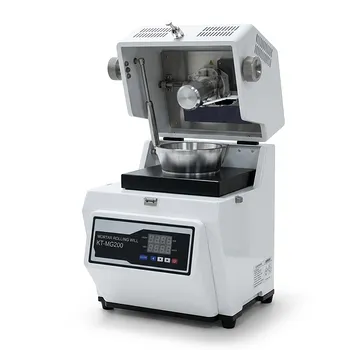
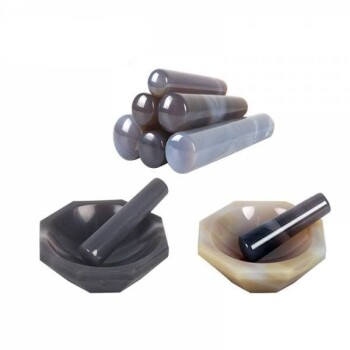
The mortar serves as a critical mechanical processing tool. Its primary role in the post-processing of carbon-coated Na3V2(PO4)2F3 (NVPF) is to physically break down the hard aggregates or dense pellets formed during synthesis. By grinding these macroscopic solids, the mortar transforms the material into a fine powder required for effective electrode fabrication.
Core Takeaway Synthesis creates the chemical compound, but the mortar renders it usable. This step bridges the gap between a raw, aggregated product and a high-quality, uniform electrode slurry.
The Physical State of Post-Synthesis NVPF
The Result of High-Energy Synthesis
Methods like solid-state synthesis or Spark Plasma Sintering (SPS) are effective for creating NVPF. However, they typically yield the product in a bulk form.
Dealing with Macroscopic Solids
The output of these synthesis techniques is not immediately ready for battery application. The material exists as hard aggregates or dense pellets. These forms are physically incompatible with standard coating processes.
The Critical Impact of Grinding
Achieving Necessary Fineness
The mortar is used for either manual or mechanical grinding. This action pulverizes the dense pellets, reducing the particle size significantly.
Enabling Slurry Uniformity
This step is not merely about size reduction; it is about homogeneity. You cannot create a consistent slurry if the starting material contains large, hard chunks. The mortar ensures the powder is fine enough to mix evenly with binders and conductive additives.
Determining Electrode Quality
The effort put into this stage directly influences the final product. The reference indicates a direct correlation between this grinding step and the quality of the resulting electrode.
Understanding the Risks of Inadequate Processing
The Pitfall of Incomplete Grinding
If the mortar is underutilized, the NVPF remains aggregated. This leads to a rough, uneven slurry.
Compromising the Final Device
An uneven slurry results in poor electrode coating. This physical inconsistency degrades the electrochemical performance of the battery, negating the benefits of the carbon coating or the synthesis method used.
Making the Right Choice for Your Goal
To maximize the performance of your NVPF cathode, consider the following based on your processing objectives:
- If your primary focus is Slurry Consistency: Ensure the grinding process is thorough enough to eliminate all visible hard aggregates before mixing.
- If your primary focus is Electrode Quality: Treat the mechanical grinding step with the same precision as the chemical synthesis, as it directly dictates the uniformity of your coating.
The mortar is the essential tool that converts a synthesized chemical into a functional battery material.
Summary Table:
| Stage | Material State | Role of Mortar | Impact on Result |
|---|---|---|---|
| Post-Synthesis | Hard aggregates / Dense pellets | Physical breakdown & pulverization | Bridges synthesis to application |
| Processing | Coarse chunks | Manual or mechanical grinding | Achieves necessary particle fineness |
| Pre-Coating | Fine powder | Homogenization with binders/additives | Ensures slurry uniformity |
| Final Device | Uniform electrode | Consistent surface coating | Optimizes electrochemical performance |
Elevate Your Battery Research with KINTEK Precision Equipment
Don't let inadequate processing compromise your electrochemical performance. KINTEK specializes in providing high-performance crushing and milling systems, including premium mortars and pestles, designed to transform your synthesized NVPF into the high-quality, uniform powders required for superior electrode fabrication.
Beyond sample preparation, we offer a comprehensive suite of tools for energy research, including:
- High-temperature furnaces (muffle, vacuum, and CVD) for precise NVPF synthesis.
- Advanced battery research tools and consumables.
- Hydraulic pellet presses and high-precision sieving equipment.
Ready to optimize your lab's efficiency and material quality? Contact KINTEK today to discover how our specialized laboratory solutions can enhance your research outcomes!
Related Products
- Laboratory Grinding Mill Mortar Grinder for Sample Preparation
- Nature Agate Mortar and Pestle for Grinding and Mixing
People Also Ask
- What laboratory apparatus is used for grinding? Match the Right Mill to Your Sample Material
- What is the function of a laboratory grinding mill? Achieve Precise Sample Preparation for Accurate Results
- What is the purpose of using a laboratory grinder and standard sieves? Unlock Precise Rice Husk Pretreatment
- What is the role of laboratory-grade grinders and sieves in sample prep? Ensure High-Precision Corrosion Analysis
- What is the purpose of using a laboratory grinder with specific mesh sieves for oat straw? Optimize Pellet Quality