Knowledge What is the role of a two-stage rotary vane vacuum pump in magnesium alloy sublimation? Enhance Efficiency and Purity
Author avatar

Tech Team · Kintek Solution

Updated 2 days ago

What is the role of a two-stage rotary vane vacuum pump in magnesium alloy sublimation? Enhance Efficiency and Purity


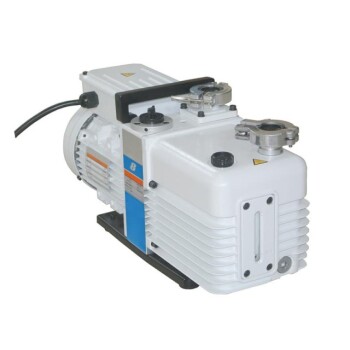
The primary role of a two-stage rotary vane vacuum pump in magnesium alloy sublimation experiments is to establish and maintain a critical low-pressure environment, specifically between 1 and 10 Pa. This evacuation is necessary to alter the thermodynamic conditions inside the furnace, allowing magnesium to sublime at feasible temperatures while simultaneously protecting the highly reactive metal from oxidation.

Core Takeaway: In this specific application, the vacuum pump serves as a thermodynamic enabler. By lowering the chamber pressure to the 1–10 Pa range, it forces the Gibbs free energy change ($\Delta G$) to become negative, making the sublimation reaction spontaneous and energetically favorable.

The Thermodynamic Function

Lowering the Sublimation Threshold

The central challenge in magnesium sublimation is generating vapor without requiring excessive heat. The two-stage rotary vane pump resolves this by drastically reducing the system pressure.

By maintaining a pressure between 1 and 10 Pa, the pump effectively lowers the sublimation temperature of the magnesium. This allows the solid-to-vapor transition to occur efficiently without subjecting the equipment or the alloy to unnecessary thermal stress.

Driving the Reaction Kinetics

Sublimation is governed by thermodynamic laws. For the reaction to occur spontaneously, the Gibbs free energy change ($\Delta G$) must be less than zero.

The vacuum environment created by the pump is the variable that ensures this condition is met. Without the continuous evacuation provided by the pump, the vapor pressure would rise, $\Delta G$ would shift, and the sublimation process would stall.

Ensuring Material Integrity

Preventing High-Temperature Oxidation

Magnesium is extremely reactive, particularly when heated. If oxygen is present during the heating phase, the magnesium will oxidize rather than sublime.

The pump removes atmospheric gases, ensuring the chamber is void of oxygen before heating begins. This protective vacuum barrier is the primary defense against the formation of unwanted magnesium oxide.

Minimizing Atmospheric Interference

Beyond oxygen, standard air contains moisture and other contaminants that can interfere with the purity of the sublimed material.

By evacuating the chamber to a base pressure (often approaching $10^{-2}$ mbar or lower before the process stabilizes), the pump ensures a clean vacuum environment. This minimizes residual air interference, ensuring the chemical composition of the final product remains pure.

Understanding the Trade-offs

The Risk of Oil Backstreaming

While effective, rotary vane pumps rely on oil for lubrication and sealing. If the pump is turned off while under vacuum, or if the trap fails, oil vapor can migrate back into the clean chamber.

This "backstreaming" can contaminate the magnesium source or the condensed product. Proper isolation valves and operation protocols are essential to prevent this.

Handling Reactive Vapors

Magnesium vapor that reaches the pump can potentially react with the pump oil or internal components.

It is critical to ensure that condensation traps are working correctly upstream of the pump. The pump is designed to move gas, not to digest solidifying metal vapors.

Making the Right Choice for Your Goal

To maximize the effectiveness of your vacuum system in magnesium sublimation, consider these operational priorities:

  • If your primary focus is Process Efficiency: Ensure your pump can sustain the 1–10 Pa range under load; if pressure rises above this, sublimation rates will plummet.
  • If your primary focus is Material Purity: Prioritize the initial evacuation stage to remove all residual air and moisture before heating the source material.

Success in this experiment relies not just on reaching a vacuum, but on stabilizing the specific pressure window where thermodynamics favors pure sublimation.

Summary Table:

Feature Role in Magnesium Sublimation Impact on Experiment
Pressure Control Maintains 1–10 Pa environment Lowers sublimation temperature & enables spontaneous reaction
Atmosphere Removal Eliminates O2 and moisture Prevents magnesium oxidation and ensures material purity
Thermodynamic Driver Ensures negative Gibbs free energy (ΔG < 0) Maintains continuous, efficient solid-to-vapor transition
System Stability Provides high-speed evacuation Minimizes thermal stress on equipment and alloys

Optimize Your Sublimation Research with KINTEK Precision

Achieving the perfect thermodynamic window for magnesium alloy experiments requires reliable vacuum technology. KINTEK specializes in high-performance laboratory equipment, including specialized two-stage rotary vane vacuum pumps, high-temperature vacuum and atmosphere furnaces, and high-pressure reactors designed for the most demanding material science applications.

Whether you need robust crushing and milling systems or precision cooling solutions like cold traps to prevent oil backstreaming, our team is ready to equip your lab with the tools for success. Contact KINTEK today to discover how our comprehensive range of equipment and consumables can enhance your process efficiency and material integrity.

Related Products

People Also Ask

Related Products

Laboratory Rotary Vane Vacuum Pump for Lab Use

Laboratory Rotary Vane Vacuum Pump for Lab Use

Experience high vacuum pumping speed and stability with our UL-certified Rotary Vane Vacuum Pump. Two-shift gas ballast valve and dual oil protection. Easy maintenance and repair.

Circulating Water Vacuum Pump for Laboratory and Industrial Use

Circulating Water Vacuum Pump for Laboratory and Industrial Use

Efficient circulating water vacuum pump for labs - oil-free, corrosion-resistant, quiet operation. Multiple models available. Get yours now!

Laboratory Benchtop Water Circulating Vacuum Pump for Lab Use

Laboratory Benchtop Water Circulating Vacuum Pump for Lab Use

Need a water circulating vacuum pump for your lab or small-scale industry? Our Benchtop Water Circulating Vacuum Pump is perfect for evaporation, distillation, crystallization, and more.

Oil Free Diaphragm Vacuum Pump for Laboratory and Industrial Use

Oil Free Diaphragm Vacuum Pump for Laboratory and Industrial Use

Oil-free diaphragm vacuum pump for labs: clean, reliable, chemical-resistant. Ideal for filtration, SPE, and rotary evaporation. Maintenance-free operation.

Variable Speed Peristaltic Pump

Variable Speed Peristaltic Pump

KT-VSP Series Smart Variable Speed Peristaltic Pumps offer precise flow control for labs, medical, and industrial applications. Reliable, contamination-free liquid transfer.

Heated Hydraulic Press Machine with Heated Plates for Vacuum Box Laboratory Hot Press

Heated Hydraulic Press Machine with Heated Plates for Vacuum Box Laboratory Hot Press

Enhance your lab's precision with our lab press for vacuum box. Press pills and powders with ease and precision in a vacuum environment, reducing oxidation and improving consistency. Compact and easy to use with a digital pressure gauge.

Electric Heated Hydraulic Vacuum Heat Press for Lab

Electric Heated Hydraulic Vacuum Heat Press for Lab

The Electric Vacuum Heat Press is a specialized heat press equipment that operates in a vacuum environment, utilizing advanced infrared heating and precise temperature control for high quality, rugged and reliable performance.

Laboratory Hydraulic Press Lab Pellet Press for Button Battery

Laboratory Hydraulic Press Lab Pellet Press for Button Battery

Efficiently prepare samples with our 2T Button Battery Press. Ideal for material research labs and small-scale production. Small footprint, lightweight, and vacuum-compatible.

Small Vacuum Heat Treat and Tungsten Wire Sintering Furnace

Small Vacuum Heat Treat and Tungsten Wire Sintering Furnace

The small vacuum tungsten wire sintering furnace is a compact experimental vacuum furnace specially designed for universities and scientific research institutes. The furnace features a CNC welded shell and vacuum piping to ensure leak-free operation. Quick-connect electrical connections facilitate relocation and debugging, and the standard electrical control cabinet is safe and convenient to operate.

30T 40T Split Automatic Heated Hydraulic Press Machine with Heated Plates for Laboratory Hot Press

30T 40T Split Automatic Heated Hydraulic Press Machine with Heated Plates for Laboratory Hot Press

Discover our split automatic heated lab press 30T/40T for precise sample preparation in material research, pharmacy, ceramics, and electronics industries. With a small footprint and heating up to 300°C, it's perfect for processing under vacuum environment.

Vacuum Hot Press Furnace Machine for Lamination and Heating

Vacuum Hot Press Furnace Machine for Lamination and Heating

Experience clean and precise lamination with Vacuum Lamination Press. Perfect for wafer bonding, thin-film transformations, and LCP lamination. Order now!

Lab Scale Rotary Single Punch Tablet Press Machine TDP Tablet Punching Machine

Lab Scale Rotary Single Punch Tablet Press Machine TDP Tablet Punching Machine

This machine is a single-pressure automatic rotating, continuous tableting machine that compresses granular raw materials into various tablets. It is mainly used for tablet production in the pharmaceutical industry, and is also suitable for chemical, food, electronics and other industrial sectors.

Vacuum Cold Mounting Machine for Sample Preparation

Vacuum Cold Mounting Machine for Sample Preparation

Vacuum Cold Mounting Machine for precise sample prep. Handles porous, fragile materials with -0.08MPa vacuum. Ideal for electronics, metallurgy, and failure analysis.

Graphite Vacuum Furnace Bottom Discharge Graphitization Furnace for Carbon Materials

Graphite Vacuum Furnace Bottom Discharge Graphitization Furnace for Carbon Materials

Bottom-out graphitization furnace for carbon materials, ultra-high temperature furnace up to 3100°C, suitable for graphitization and sintering of carbon rods and carbon blocks. Vertical design, bottom discharging, convenient feeding and discharging, high temperature uniformity, low energy consumption, good stability, hydraulic lifting system, convenient loading and unloading.

Graphite Vacuum Furnace High Thermal Conductivity Film Graphitization Furnace

Graphite Vacuum Furnace High Thermal Conductivity Film Graphitization Furnace

The high thermal conductivity film graphitization furnace has uniform temperature, low energy consumption and can operate continuously.

Graphite Vacuum Continuous Graphitization Furnace

Graphite Vacuum Continuous Graphitization Furnace

High-temperature graphitization furnace is a professional equipment for graphitization treatment of carbon materials. It is a key equipment for the production of high-quality graphite products. It has high temperature, high efficiency and uniform heating. It is suitable for various high-temperature treatments and graphitization treatments. It is widely used in metallurgy, electronics, aerospace, etc. industry.

Vacuum Cold Trap Chiller Indirect Cold Trap Chiller

Vacuum Cold Trap Chiller Indirect Cold Trap Chiller

Boost vacuum system efficiency and prolong pump life with our Indirect Cold Trap. Built-in chilling system with no need for fluid or dry ice. Compact design and easy to use.

Vacuum Heat Treat Sintering Brazing Furnace

Vacuum Heat Treat Sintering Brazing Furnace

A vacuum brazing furnace is a type of industrial furnace used for brazing, a metalworking process that joins two pieces of metal using a filler metal that melts at a lower temperature than the base metals. Vacuum brazing furnaces are typically used for high-quality applications where a strong, clean joint is required.

2200 ℃ Graphite Vacuum Heat Treat Furnace

2200 ℃ Graphite Vacuum Heat Treat Furnace

Discover the power of the KT-VG Graphite Vacuum Furnace - with a maximum working temperature of 2200℃, it's perfect for vacuum sintering of various materials. Learn more now.

304 316 Stainless Steel Vacuum Ball Valve Stop Valve for High Vacuum Systems

304 316 Stainless Steel Vacuum Ball Valve Stop Valve for High Vacuum Systems

Discover 304/316 stainless steel vacuum ball valves, Ideal for high vacuum systems, Ensure precise control and durability. Explore now!


Leave Your Message