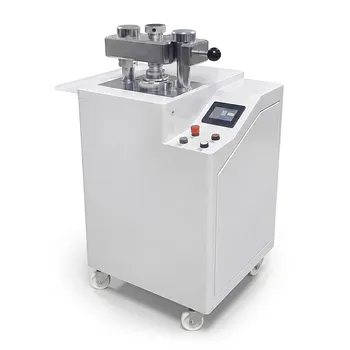
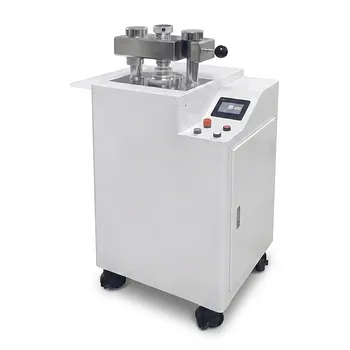
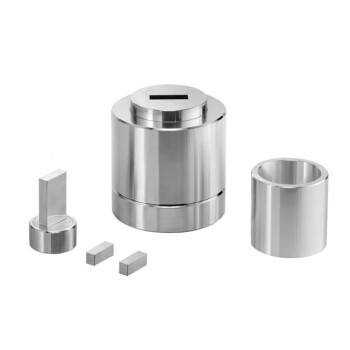
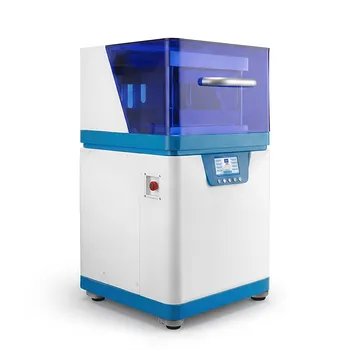
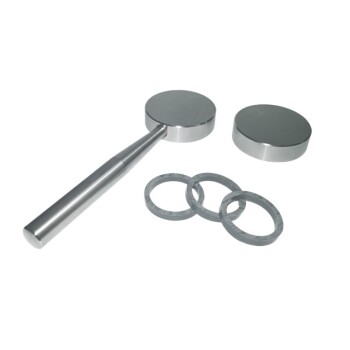
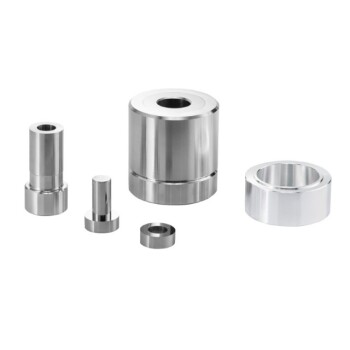
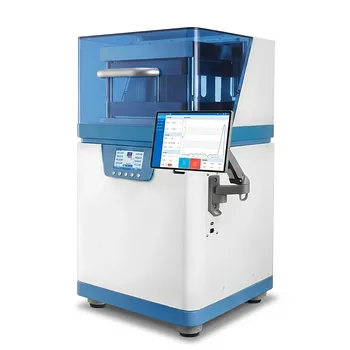
The hydraulic pellet press is the critical hardware used to integrate active materials, additives, and binders onto a current collector to form a functional electrode. This equipment applies precise, uniform pressure to transform loose powders and binders into a cohesive layer, typically achieving a controlled thickness of approximately 700 μm. By managing this compression, the press dictates the cathode's gas permeability and electronic conductivity, which are essential for the battery's electrochemical performance.
Core Takeaway: An industrial-grade hydraulic pellet press is essential for balancing the structural and functional requirements of a Zinc-Air cathode. It ensures high volumetric energy density and low ohmic resistance by optimizing the physical contact between the catalyst and the current collector.
Optimizing the Triple-Phase Interface
Balancing Gas Diffusion and Liquid Penetration
The primary role of the pellet press is to manage the porosity of the air cathode. In a Zinc-Air battery, the reaction occurs at the triple-phase interface where the solid catalyst, liquid electrolyte, and gaseous oxygen meet.
Precise pressure control allows the operator to create a structure that is hydrophobic enough to prevent electrolyte leakage while remaining permeable enough to allow oxygen to reach the catalyst sites.
Uniformity of the Active Layer
Industrial-grade presses provide a level of linear pressure stability that manual methods cannot replicate. This ensures that the mixture of active material (such as 3D-NPOC) and PTFE is distributed evenly across the nickel mesh current collector.
A uniform thickness, specifically around 700 μm as defined in standard protocols, prevents "hot spots" of high current density. This uniformity is vital for extending the operational lifespan of the air cathode.
Enhancing Electrical and Structural Performance
Reducing Ohmic Resistance
High-pressure molding is used to compact cathode materials into dense layers, which significantly enhances electronic contact paths. By forcing particles into closer proximity, the press reduces the internal resistance of the electrode.
Lowering this resistance is critical for reducing energy loss during discharge. It ensures that electrons can flow efficiently from the active reaction sites to the nickel mesh current collector.
Increasing Volumetric Energy Density
By eliminating excessive voids between material particles, the hydraulic press increases the area loading of the electrode. This densification allows for more active material to be packed into the same physical volume.
The result is a higher volumetric energy density for the overall battery. This makes the final product more competitive for applications where space is limited but power requirements are high.
Understanding the Trade-offs
The Compression Paradox
There is a definitive trade-off between electrical conductivity and gas transport. While higher pressure reduces ohmic resistance by increasing particle contact, it also reduces internal porosity.
If the pressure is too high, the cathode becomes overly dense, "choking" the oxygen flow and hindering the battery’s power output. Conversely, insufficient pressure leads to a fragile electrode with poor electronic contact and high resistance.
Material Stress and Deformation
Applying excessive force can also damage the current collector, such as distorting the nickel mesh. This can lead to structural failure of the cathode or uneven thickness across the electrode surface, undermining the stability of the triple-phase interface.
How to Apply This to Your Fabrication Process
Choosing Your Pressure Strategy
- If your primary focus is High Power Density: Use moderate pressure to maintain a higher degree of porosity, ensuring that oxygen can diffuse rapidly to the catalyst sites during high-drain operation.
- If your primary focus is Long-Term Stability: Prioritize higher compaction to ensure the PTFE binder is thoroughly integrated, creating a robust hydrophobic barrier that prevents "flooding" of the cathode over time.
- If your primary focus is Maximizing Conductivity: Utilize maximum recommended pressure to eliminate voids and optimize the solid-solid contact between the active materials and the current collector.
The industrial-grade hydraulic pellet press is not merely a compaction tool, but a precision instrument that defines the fundamental performance limits of the Zinc-Air battery.
Summary Table:
| Feature | Role in Fabrication | Impact on Battery Performance |
|---|---|---|
| Pressure Control | Manages electrode porosity | Balances oxygen diffusion vs. electrolyte leakage |
| High Compaction | Reduces ohmic resistance | Enhances electronic flow and discharge efficiency |
| Linear Stability | Ensures uniform thickness (~700 μm) | Prevents hot spots and extends cathode lifespan |
| Densification | Increases active material loading | Maximizes volumetric energy density |
Elevate Your Battery Research with Precision Engineering
Achieving the perfect balance of porosity and conductivity in Zinc-Air cathodes requires absolute precision. KINTEK specializes in high-performance hydraulic pellet presses (pellet, hot, and isostatic) designed to deliver the exact pressure stability needed for superior electrode fabrication.
Beyond our industry-leading presses, KINTEK offers a comprehensive ecosystem for battery innovation, including:
- High-Temperature Furnaces: Muffle, tube, and vacuum furnaces for material synthesis.
- Electrolytic Cells & Electrodes: Specialized tools for precise electrochemical testing.
- Crushing & Milling Systems: For uniform powder preparation before pressing.
- Advanced Consumables: High-quality ceramics, crucibles, and PTFE components.
Whether you are optimizing for high power density or long-term stability, our equipment ensures your results are reproducible and reliable.
Contact a KINTEK Specialist Today to Find Your Ideal Solution
References
- Lulu Chen, Xien Liu. Three-dimensional N, P, and O tri-doped porous carbon for multifunctional electrocatalytic reactions. DOI: 10.1039/d3ya00493g
This article is also based on technical information from Kintek Solution Knowledge Base .
Related Products
- kbr pellet press 2t
- Laboratory Hydraulic Press Lab Pellet Press for Button Battery
- Automatic Laboratory Hydraulic Pellet Press Machine for Lab Use
- Automatic Laboratory Hydraulic Press for XRF & KBR Pellet Press
- Laboratory Manual Hydraulic Pellet Press for Lab Use
People Also Ask
- How do you prepare samples for IR spectroscopy? A Step-by-Step Guide for Solids, Liquids, and Gases
- What measurement methods are commonly used for powder samples in infrared spectroscopy? Optimize Your FTIR Analysis
- Why KBr is used in IR spectrophotometry? A Key to Transparent Sample Analysis
- How are a KBr pellet press and mortar utilized in FTIR analysis of activated carbon? Expert Sample Prep Guide
- How do you prepare KBr pellets for FTIR analysis? Master the Technique for High-Quality IR Spectra