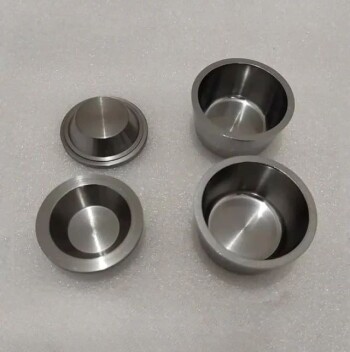
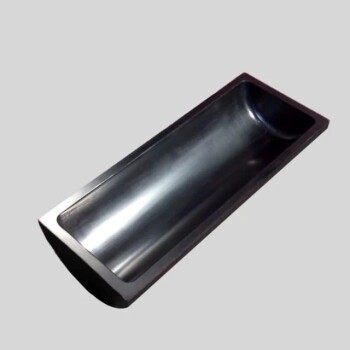
In the vacuum melting of AM60 magnesium alloy, the stainless steel crucible functions as a critical geometric constant that defines the physical interface between the molten metal and the inert atmosphere. Its specific dimensions determine the cross-sectional area of the gas/liquid interface. This fixed area is the foundational variable required to calculate the magnesium evaporation rate and the apparent mass transfer coefficient.
The crucible is not merely a vessel; its geometry dictates the specific surface area exposed to the vacuum or Argon atmosphere, which is the essential data point needed to perform a quantitative analysis of the magnesium evaporation mechanism.
The Geometric Influence on Process Parameters
Defining the Gas/Liquid Interface
The primary technical role of the stainless steel crucible is to establish the boundaries of the melt. The crucible's internal geometry dictates the specific surface area where the liquid magnesium interacts with the environment.
Calculating Evaporation Rates
To quantify how much magnesium is lost during melting, you must know the surface area of the melt. The crucible provides the fixed cross-sectional area used as a constant in the evaporation rate formula. Without this precise geometric parameter, accurate calculation of the evaporation rate is impossible.
The Apparent Mass Transfer Coefficient
Beyond simple evaporation, the crucible's dimensions allow for the calculation of the apparent mass transfer coefficient. This coefficient is vital for a deep quantitative analysis, helping engineers understand the kinetics of how magnesium moves from the liquid phase to the vapor phase under specific pressure conditions.
Contextualizing the Vacuum Environment
The Role of the Inert Atmosphere
While the crucible defines the area, the environment dictates the chemical reaction potential. The system typically operates by evacuating air to $10^{-3}$ Pa and backfilling with high-purity Argon gas to roughly 150 Pa.
Isolating the Melt
This Argon atmosphere works in tandem with the crucible to prevent oxidation. The crucible holds the melt, while the gas pressure suppresses the volatility of the magnesium and shields it from oxygen. This eliminates the need for traditional flux or SF6 protection, resulting in a cleaner process with fewer inclusions.
Understanding the Trade-offs
Geometry vs. Evaporation Control
A crucible with a wider opening increases the gas/liquid interface area. While this might be necessary for volume, a larger surface area directly correlates to a higher total mass of evaporated magnesium, even under Argon protection.
Fixed Parameters vs. Variable Conditions
The crucible provides a static parameter (area) in a dynamic system. If you change the crucible size or shape, all previous baselines for the mass transfer coefficient become invalid and must be recalculated. You cannot compare evaporation rates between two different furnace setups without normalizing for the crucible's specific surface area.
Optimizing Your Melting Strategy
To ensure accurate process control and data analysis during AM60 alloy melting:
- If your primary focus is Quantitative Analysis: Precisely measure the internal diameter of the crucible to determine the exact cross-sectional area for your evaporation equations.
- If your primary focus is Process Efficiency: Minimize the ratio of the melt surface area to the total volume to reduce magnesium evaporation loss while maintaining the protective Argon overpressure.
By treating the crucible as a geometric variable rather than just a container, you gain the ability to model and predict magnesium loss with mathematical precision.
Summary Table:
| Parameter | Role of the Crucible | Impact on Technical Process |
|---|---|---|
| Geometric Area | Defines the gas/liquid interface | Essential for calculating evaporation rates. |
| Mass Transfer | Provides fixed cross-sectional data | Required to determine the apparent mass transfer coefficient. |
| Atmosphere Control | Interfaces with Argon backfill | Eliminates the need for flux or SF6 protection. |
| Process Stability | Static physical boundary | Normalizes data across different furnace setups. |
Elevate Your Metallurgy with KINTEK’s Precision Solutions
Unlock the full potential of your magnesium alloy research with KINTEK. Whether you are conducting quantitative analysis on AM60 evaporation mechanisms or optimizing industrial production, our high-performance vacuum melting systems and stainless steel crucibles provide the geometric precision your data demands.
From high-temperature induction melting furnaces and vacuum systems to specialized PTFE and ceramic consumables, KINTEK delivers the tools needed to eliminate inclusions and suppress volatility without the use of harmful fluxes.
Ready to refine your melting strategy? Contact our laboratory specialists today to discover how our comprehensive range of high-temperature furnaces and crushing systems can streamline your process.
Related Products
- Electron Beam Evaporation Coating Tungsten Crucible and Molybdenum Crucible for High Temperature Applications
- Custom Machined and Molded PTFE Teflon Parts Manufacturer with PTFE Crucible and Lid
- Electron Beam Evaporation Coating Gold Plating Tungsten Molybdenum Crucible for Evaporation
- High Purity Pure Graphite Crucible for Electron Beam Evaporation
- High Purity Pure Graphite Crucible for Evaporation
People Also Ask
- What is the container that holds the metal source material called in e-beam evaporation? Ensure Purity and Quality in Your Thin-Film Deposition
- What materials are used in electron beam evaporation? Master High-Purity Thin Film Deposition
- What is the voltage of e-beam evaporation? Achieve Precise Thin-Film Deposition
- What are the applications of e-beam evaporation? Achieve High-Purity Coatings for Optics & Electronics
- What is e-beam evaporation? Achieve High-Purity Thin Film Deposition for Your Lab