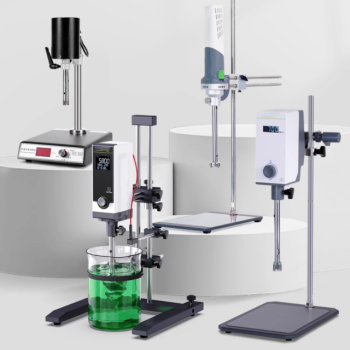
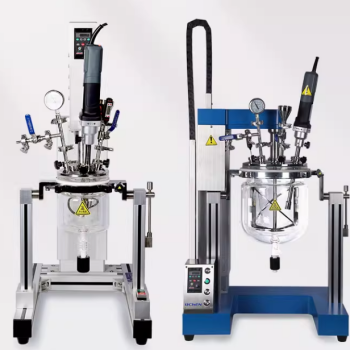
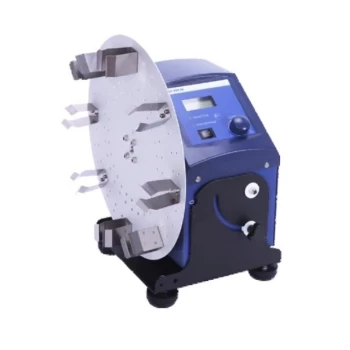
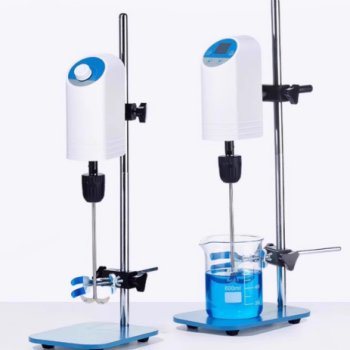
High-shear homogenization is the pivotal processing step that dictates the ultimate quality of polymer filtration and ion exchange membranes. It utilizes intense mechanical force to thoroughly blend polymer resins, solvents, and additives into a highly uniform casting solution, ensuring the material is chemically and structurally consistent before the casting process begins.
Core Takeaway By aggressively breaking down swollen polymer aggregates, high-shear homogenization prevents microscopic structural defects that compromise membrane integrity. This process creates the uniform distribution of functional groups necessary for consistent filtration performance, mechanical strength, and chemical stability.
The Mechanism of Action
Breaking Down Swollen Aggregates
When polymer resins are introduced to solvents, they often swell and form gelatinous clumps rather than dissolving immediately.
Standard mixing is often insufficient to disperse these clusters. High-shear homogenizers apply intense shear force to physically break apart these swollen polymer aggregates. This ensures the casting solution is a homogeneous liquid rather than a mixture containing undissolved solids.
Ensuring Uniformity
The goal of the casting solution is absolute consistency.
The homogenizer ensures that additives and solvents are blended indistinguishably with the polymer resin. This creates a highly uniform casting solution, which is the prerequisite for a defect-free membrane.
Impact on Membrane Properties
Distribution of Functional Groups
For ion exchange membranes, the location of functional groups is critical to performance.
High-shear mixing guarantees the even distribution of functional groups throughout the solution. This uniformity ensures that the final membrane has consistent ion-exchange capabilities across its entire surface area, rather than having "hot spots" or dead zones.
Preventing Microporous Defects
Inconsistencies in the casting solution lead to physical flaws in the solid membrane.
If aggregates remain in the solution, they create weak points that manifest as microporous defects during the casting process. Homogenization eliminates these precursors, resulting in a continuous, flawless membrane structure.
The Consequences of Inadequate Mixing
Compromised Mechanical Strength
A membrane is only as strong as its weakest point.
Without the intense mixing provided by high shear, the polymer matrix will contain structural inconsistencies. These inconsistencies significantly reduce the mechanical strength of the membrane, making it prone to physical failure under pressure.
Reduced Chemical Stability
Uniformity is also linked to chemical resistance.
A well-homogenized solution results in a membrane with enhanced chemical stability. By ensuring all components are fully integrated, the membrane is better equipped to withstand harsh chemical environments without degrading.
Making the Right Choice for Your Goal
To maximize the performance of your polymer membranes, consider the following regarding your mixing process:
- If your primary focus is Ion Exchange Efficiency: Ensure your process prioritizes the complete dispersion of functional groups to guarantee consistent selectivity across the membrane.
- If your primary focus is Durability and Lifespan: Rely on high-shear processing to eliminate the swollen aggregates that cause microporous defects and mechanical weakness.
Invest in thorough homogenization to transform raw polymer ingredients into a casting solution capable of delivering high-performance results.
Summary Table:
| Feature | Impact of High-Shear Homogenization | Resulting Membrane Benefit |
|---|---|---|
| Aggregate Control | Breaks down swollen gelatinous clumps | Eliminates microporous defects |
| Functional Groups | Evenly disperses active sites throughout | Consistent ion-exchange efficiency |
| Mixing Intensity | Intense mechanical shear force | High structural & chemical stability |
| Solution State | Creates a perfectly uniform casting solution | Enhanced mechanical strength & lifespan |
Elevate Your Membrane Research with KINTEK Precision
Maximize the performance of your polymer filtration and ion exchange membranes by ensuring absolute homogeneity. KINTEK specializes in advanced homogenizers and shakers, as well as high-performance high-temperature high-pressure reactors and autoclaves, designed to meet the rigorous demands of laboratory research and industrial development.
Whether you are scaling up battery research or developing high-performance membranes, our expert team provides the comprehensive equipment and consumables (including PTFE products and ceramics) necessary for defect-free results. Contact KINTEK today to optimize your mixing process and secure superior material integrity!
References
- John R. Varcoe, Lin Zhuang. Anion-exchange membranes in electrochemical energy systems. DOI: 10.1039/c4ee01303d
This article is also based on technical information from Kintek Solution Knowledge Base .
Related Products
- High Shear Homogenizer for Pharmaceutical and Cosmetic Applications
- High Performance Lab Homogenizer for Pharma Cosmetics and Food R&D
- Laboratory High Throughput Tissue Grinding Mill Grinder
- Lab Sterile Slapping Type Homogenizer for Tissue Mashing and Dispersing
- Laboratory Disc Rotary Mixer for Efficient Sample Mixing and Homogenization
People Also Ask
- Why Use a High Shear Homogenizer for Cathode Slurries? Optimize Double-Layer Solid-State Battery Production
- What is the function of high-shear dispersion equipment in corona-resistant nanocomposites? Elevate Your Insulation
- What is the necessity of using an industrial-grade high-shear homogenizer for biomass washing? Ensure Process Efficiency
- What are the advantages of using a high-shear homogenizer for BED/GMA coatings? Achieve Superior Nano-Dispersion
- What role does a high-shear homogenizer play in ODC catalyst suspensions? Unlock Superior Electrochemical Efficiency