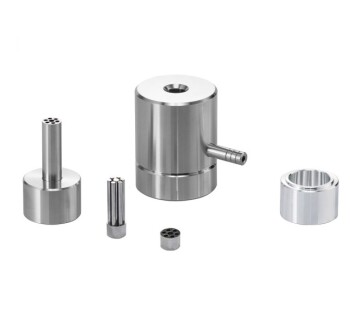
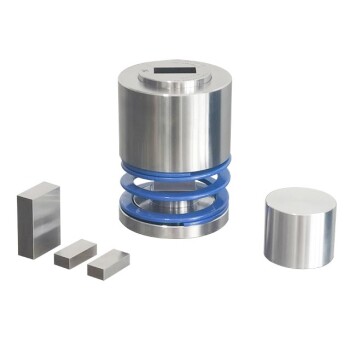
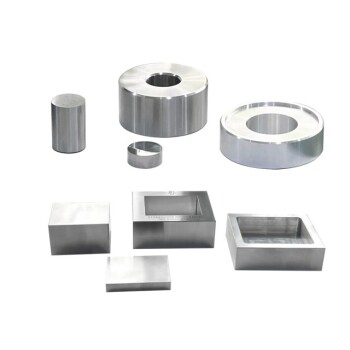
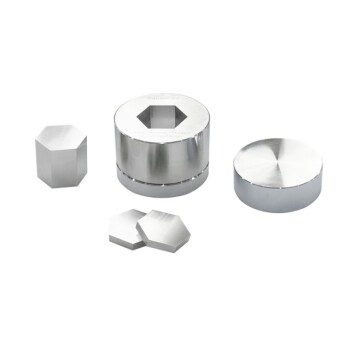
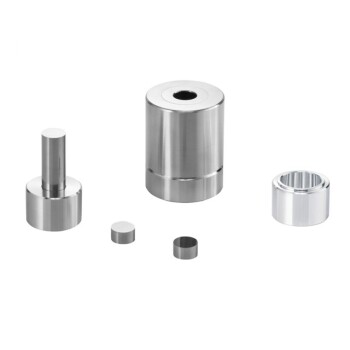
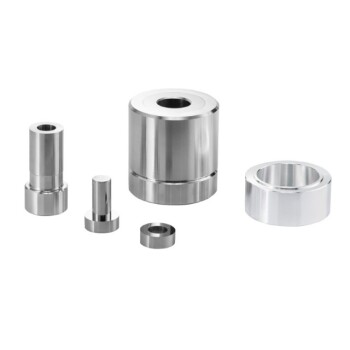
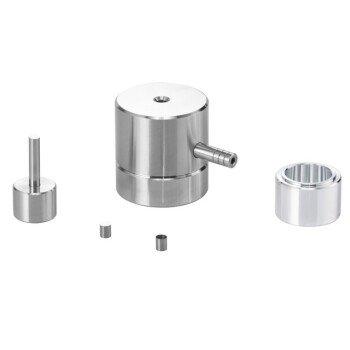
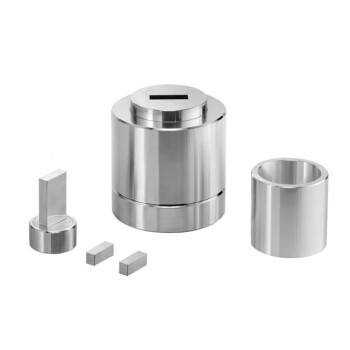
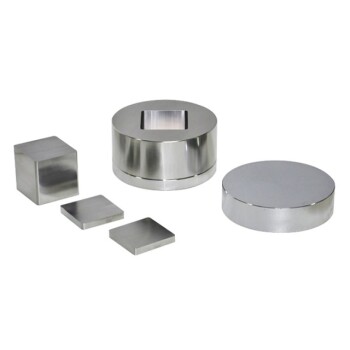
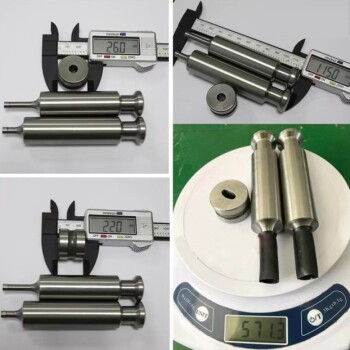
High-strength pressure molds are the critical structural interface required to transform loose powder into solid bulk amorphous alloy disks. These components serve as more than simple containers; they must withstand and transfer immense mechanical loads—often reaching 1.2 GPa—to define the sample's geometry without undergoing deformation.
The reliability of your fabrication process depends entirely on the mold's structural rigidity and surface precision. If the mold yields under gigapascal-level pressure or lacks inner smoothness, the geometric accuracy and surface quality of the final alloy will be compromised.
The Mechanics of High-Pressure Fabrication
Transferring Extreme Mechanical Loads
The primary function of the mold is to act as a vessel for powder molding capable of sustaining extreme pressure. In the fabrication of bulk amorphous alloys, the mold must endure loads as high as 1.2 GPa.
If the mold lacks the structural integrity to handle this stress, it will deform. Deformation during the process results in a loss of applied pressure to the powder, preventing the successful formation of a dense, solid disk.
Defining Geometric Precision
The mold is responsible for strictly defining the geometric shape of the final sample. For standard experimental setups, this often involves producing a precise 10mm diameter disk.
The mold ensures that the loose precursor materials are confined to this exact volume. Any variance in the mold's dimensions translates directly to dimensional errors in the final sample.
Critical Surface Factors
Impact on Surface Quality
The quality of the mold's interior directly dictates the quality of the sample's exterior. The smoothness of the inner wall is imprinted onto the alloy during the high-pressure phase.
A mold with surface imperfections or roughness will produce a sample with corresponding defects. For applications requiring optical or mechanical precision, the mold's internal finish is non-negotiable.
Facilitating the Demolding Process
The precision of the mold's fit is the deciding factor in the post-process workflow. High fit precision is required to ensure the sample is tightly contained under pressure but remains removable later.
If the inner walls are rough or the fit is poor, the sample may bind to the mold. This complicates the demolding process and risks damaging the fragile amorphous disk during extraction.
Understanding the Trade-offs
Rigidity vs. Brittleness
While molds must possess extreme hardness to resist deformation at 1.2 GPa, this often comes with increased brittleness. Materials hard enough to withstand these pressures may be susceptible to catastrophic fracture if subjected to sudden shock or uneven loading.
Maintenance of Precision
The inner wall smoothness is a degrading asset. Over repeated cycles of high-pressure loading and abrasive demolding, the surface quality can deteriorate.
Ignoring the gradual wear of the inner wall will lead to a subtle but progressive decline in sample quality. Regular inspection of the mold's bore is essential to maintain consistency across batches.
Making the Right Choice for Your Goal
To ensure successful fabrication, you must prioritize specific mold characteristics based on your experimental or production needs.
- If your primary focus is achieving maximum density: Prioritize a mold with verified structural integrity capable of exceeding 1.2 GPa without elastic deformation.
- If your primary focus is surface finish and ease of handling: Prioritize a mold with superior inner wall smoothness and high-tolerance fit precision to ensure clean demolding.
Ultimately, the mold is not a passive accessory; it is the defining constraint that determines the physical viability of your bulk amorphous alloy.
Summary Table:
| Key Feature | Importance in Fabrication | Benefit |
|---|---|---|
| Structural Rigidity | Withstands loads up to 1.2 GPa | Prevents deformation & ensures full pressure transfer |
| Geometric Precision | Defines sample shape (e.g., 10mm disk) | Guarantees dimensional accuracy of the alloy |
| Inner Wall Smoothness | Dictates sample surface finish | Reduces defects and improves optical/mechanical quality |
| High Fit Precision | Ensures tight containment | Facilitates clean demolding without sample damage |
Elevate Your Material Research with KINTEK Precision Engineering
Don't let mold deformation or surface defects compromise your bulk amorphous alloy research. KINTEK specializes in high-performance laboratory equipment, providing the structural integrity and precision your projects demand. Whether you are utilizing our high-pressure hydraulic presses (pellet, hot, or isostatic) or requiring custom crushing and milling systems, we deliver the durability and surface quality essential for successful material synthesis.
From high-temperature high-pressure reactors to specialized ceramic and metallic molds, KINTEK empowers laboratories to achieve dense, defect-free samples every time.
Ready to optimize your fabrication process? Contact KINTEK today to discuss our range of laboratory solutions and see how our expertise can drive your results.
Related Products
- Anti-Cracking Press Mold for Lab Use
- Special Shape Press Mold for Lab
- Round Bidirectional Press Mold for Lab
- Square Bidirectional Pressure Mold for Lab Use
- Ball Press Mold for Lab
People Also Ask
- What is the press mould method? A Guide to Consistent, Detailed Ceramic Forms
- How to use a press mold? Master the Art of Creating Consistent Ceramic Forms
- What is the function of press molds during the preparation of SiCf/Ti-43Al-9V composites? Achieve Structural Precision
- What is a press mold used for? Achieve Repeatable Precision and Efficiency
- What is the purpose of specialized pressure devices in sulfide solid-state batteries? Ensure Chemo-Mechanical Stability