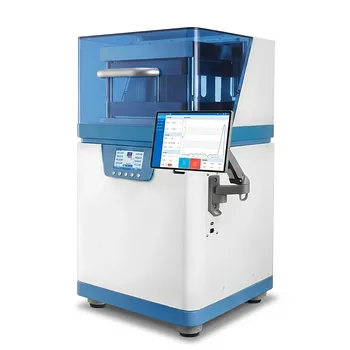
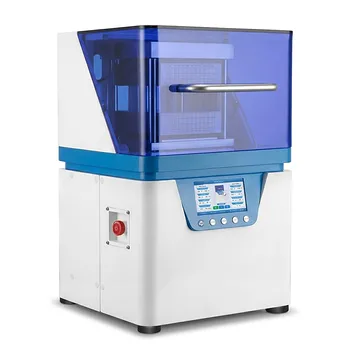
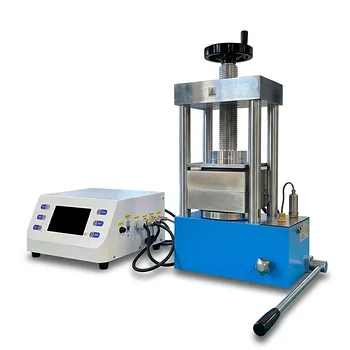
High pressure is the essential catalyst for transforming loose perovskite powders into robust, high-density green bodies. In the fabrication of $Sr_{0.8}La_{0.1}Ca_{0.1}Ti_{0.94}Ni_{0.06}O_{3-\delta}$ ceramics, a laboratory uniaxial hydraulic press applying up to 5000 bar (500 MPa) is necessary to overcome inter-particle friction and force a tight rearrangement of grains. This process establishes the high initial density required for the ceramic to survive high-temperature sintering at 1500°C without cracking or developing macroscopic defects.
The use of extreme uniaxial pressure serves two primary functions: it provides the mechanical strength necessary for handling the fragile "green" samples and creates the inter-particle contact area required for efficient mass transfer and diffusion during final sintering.
Overcoming Physical Barriers to Densification
Overcoming Inter-particle Friction
The primary role of high pressure is to counteract the natural friction between individual ceramic powder particles. By applying up to 5000 bar, the press forces these particles to slide and rearrange into a more compact configuration than gravity or low-pressure methods allow.
Eliminating Voids and Porosity
High-pressure compaction forces powder particles to undergo plastic deformation and rearrangement within the mold. This effectively fills internal voids and minimizes the presence of air pockets, which is critical for achieving a dense microstructure in the final ceramic block.
Establishing Geometric Integrity
The precision molds used in a hydraulic press ensure that the powder consolidates into a specific, uniform geometric shape. This pre-designed profile is maintained throughout the subsequent processing steps, ensuring the final tool or component meets required dimensional tolerances.
Facilitating the Sintering Process
Creating Driving Force for Diffusion
Sintering is a diffusion-controlled process where atoms move across particle boundaries. By increasing the green density, high pressure reduces the physical distance between particles, significantly enhancing the contact area and providing the necessary driving force for mass transfer during heating.
Enabling High-Temperature Stability
$Sr_{0.8}La_{0.1}Ca_{0.1}Ti_{0.94}Ni_{0.06}O_{3-\delta}$ requires sintering temperatures as high as 1500°C. High initial compaction ensures the body is dense enough to resist severe deformation, warping, or total collapse when the material reaches these extreme temperatures in a tube furnace.
Enhancing Electromagnetic and Chemical Properties
In complex perovskite structures, tight contact between grains promotes better mechanical coupling and element diffusion. This leads to more significant electromagnetic correlation effects and ensures that the solid-state chemical reactions required for the specific $O_{3-\delta}$ stoichiometry occur uniformly.
Understanding the Trade-offs and Pitfalls
The Risk of Density Gradients
Because uniaxial presses apply force from a single direction (or along a single axis), friction against the mold walls can lead to non-uniform density. The top of the pellet may be denser than the center, which can cause uneven shrinkage or "hour-glassing" during the sintering phase.
Capping and Delamination
Applying excessive pressure beyond the material's limits can lead to a defect known as capping, where the top layers of the pellet shear off. This occurs when trapped air or elastic energy is released too quickly after the pressure is removed, compromising the structural integrity of the green body.
Mold Wear and Contamination
The use of high-precision hard alloy or carbide dies is necessary to withstand 5000 bar of pressure. Over time, the extreme friction between the ceramic powder and the die can lead to tool wear, potentially introducing trace contaminants into the perovskite sample.
How to Apply High Pressure to Your Ceramic Project
Achieving the perfect green body depends on balancing the pressure applied with the specific requirements of your material's final application.
- If your primary focus is mechanical handling: Prioritize higher pressures (approaching 5000 bar) to maximize the "green strength," allowing the samples to be moved or measured without crumbling.
- If your primary focus is preventing sintering cracks: Ensure precise control over the holding time at peak pressure to allow air to escape and particles to settle, reducing internal stresses that lead to firing defects.
- If your primary focus is microstructural purity: Use high-quality carbide dies and consider lubricants or binders to minimize friction and prevent the "capping" effect during de-molding.
The strategic application of high uniaxial pressure is the fundamental bridge between a raw chemical powder and a high-performance, fully densified perovskite ceramic.
Summary Table:
| Key Function | Role in Ceramic Processing | Impact on Final Quality |
|---|---|---|
| Particle Rearrangement | Overcomes inter-particle friction at 5000 bar | High green density & handling strength |
| Void Elimination | Minimizes internal air pockets & porosity | Prevents cracking during 1500°C sintering |
| Geometric Precision | Consolidation within high-precision dies | Ensures strict dimensional tolerances |
| Mass Transfer Enhancement | Increases contact area between grains | Facilitates faster diffusion & stoichiometry |
Master Your Ceramic Fabrication with KINTEK Precision
Achieving the perfect green body requires more than just force—it requires precision. KINTEK specializes in high-performance laboratory equipment designed to meet the rigorous demands of advanced material science. Whether you are pressing complex perovskites or developing next-gen energy materials, our solutions ensure consistency and durability.
Why partner with KINTEK?
- Versatile Hydraulic Presses: Achieve up to 5000 bar for superior pellet density with our manual and automated hydraulic systems.
- High-Temperature Expertise: Pair your green bodies with our precision muffle or tube furnaces for sintering up to 1500°C and beyond.
- End-to-End Solutions: From crushing and milling systems to essential consumables like carbide dies, ceramics, and crucibles.
Ready to elevate your lab's efficiency and material performance? Contact KINTEK experts today to find the ideal setup for your research!
References
- Willis O’Leary, Jennifer L. M. Rupp. Tuning reduction conditions to understand and control Ni exsolution from Sr<sub>0.8</sub>La<sub>0.1</sub>Ca<sub>0.1</sub>Ti<sub>0.94</sub>Ni<sub>0.06</sub>O<sub>3−<i>δ</i></sub>. DOI: 10.1039/d3ta04817a
This article is also based on technical information from Kintek Solution Knowledge Base .
Related Products
- Automatic Hydraulic Hot Press with 500x500mm Heating Plates and Multi Stage PLC Control for Material Sintering
- Laboratory Hydraulic Press Split Electric Lab Pellet Press
- Automatic Laboratory Hydraulic Press for XRF & KBR Pellet Press
- Laboratory Hydraulic Pellet Press for XRF KBR FTIR Lab Applications
- Fully Automatic Heated Hydraulic Lab Press for Materials Sintering and Sample Preparation
People Also Ask
- How do hydraulic presses facilitate material solidification in Low-Temperature LPS? Optimize Your Material Densification
- Why is 800 MPa required for TiNiPdCu alloy green bodies? Master High-Density Compaction for Superior Material Strength
- How does KBr pellet preparation facilitate FTIR of high-ash mud? Precision Sample Prep for Structural Analysis
- Why is an industrial hydraulic press with precision stainless steel molds used? For Uniform Mo-Fe Precursor Compacts.
- Purpose of Coaxial Ring Molds & Presses in EM Testing? Achieve Precise VNA Data & Fit