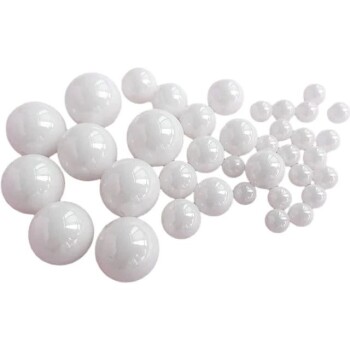
The use of 1mm diameter zirconia beads in Low-energy Wet Milling (LWM) represents a calculated balance between efficient particle reduction and structural preservation. By utilizing this specific bead size, you increase the number of contact points within the milling jar, allowing for a gentle refinement of the solid-state electrolyte powder that avoids damaging the material's essential crystal structure.
The specific choice of 1mm zirconia beads allows for the removal of impurity layers and reduction of particle size without shattering the crystal lattice, ultimately creating the surface area necessary for superior battery performance.
Optimizing Particle Morphology
The primary goal of the LWM step is not just to crush material, but to refine it for integration into a functional battery. The 1mm bead size is the critical variable in achieving this.
Increasing Contact Frequency
The 1mm diameter offers a geometric advantage by significantly increasing the number of contact points between the beads and the powder.
This high frequency of contact ensures that the milling action is distributed evenly throughout the batch. It allows for efficient reduction of particle size through attrition rather than high-impact collisions.
Preserving the Crystal Lattice
A major risk in milling solid-state electrolytes is destroying the crystal structure, which ruins ionic conductivity.
Because the 1mm beads operate within a low-energy regime, they refine the particles gently. This ensures the crystal lattice remains intact even as the average particle size decreases.
Maximizing Active Material Interface
The direct outcome of this gentle milling is a powder composed of much finer particles.
Finer electrolyte particles possess a larger specific surface area. This allows for a more comprehensive contact area with active materials during battery assembly, which is a prerequisite for high-performance solid-state batteries.
The Strategic Value of Zirconia Material
While the 1mm size dictates the mechanics of the milling, the zirconia material dictates the purity of the result.
Kinetic Energy and Impurity Removal
Zirconia is selected for its high hardness and density.
This density provides the beads with sufficient kinetic energy to break through tough impurity layers on the raw electrolyte particles. This "cleaning" action occurs simultaneously with size reduction.
Preventing Process Contamination
Impurity control is the single most critical factor for maintaining high ionic conductivity.
Zirconia is chemically inert and possesses high wear resistance. This minimizes the risk of the beads degrading and introducing foreign contaminants into the electrolyte mixture during the grinding process.
Understanding the Trade-offs
While 1mm zirconia beads are highly effective, the process requires strict parameter control to avoid diminishing returns.
The Risk of Over-Milling
Even with "gentle" beads, extending the milling time beyond necessary limits can eventually degrade the crystal structure.
You must monitor the process to ensure you stop once the target particle size is achieved, rather than assuming the low-energy input makes the process inherently safe indefinitely.
Balancing Size vs. Impact
If beads were significantly smaller than 1mm, they might lack the mass required to generate the kinetic energy needed to strip impurity layers.
Conversely, significantly larger beads would reduce the number of contact points and potentially introduce impact forces high enough to damage the crystal lattice. The 1mm size sits in the "Goldilocks" zone for this specific application.
Making the Right Choice for Your Goal
To maximize the efficacy of your solid-state electrolyte preparation, align your milling parameters with your specific performance targets.
- If your primary focus is Ionic Conductivity: Ensure you utilize high-density zirconia to minimize wear-induced contamination that blocks ion flow.
- If your primary focus is Interface Stability: Rely on the 1mm bead size to produce fine particles that maximize contact area with the active material.
- If your primary focus is Structural Integrity: Adhere strictly to the Low-energy Wet Milling (LWM) protocol to refine size without shattering the crystal lattice.
By combining the geometric precision of 1mm beads with the material resilience of zirconia, you ensure your solid-state electrolyte is chemically pure and physically optimized for assembly.
Summary Table:
| Feature | 1mm Zirconia Beads Benefit |
|---|---|
| Particle Morphology | Refines size through attrition while preserving crystal structure |
| Contact Points | High contact frequency ensures uniform milling distribution |
| Energy Level | Provides the 'Goldilocks' energy to remove impurities without damage |
| Purity Control | High wear resistance prevents contamination of electrolytes |
| Battery Impact | Maximizes surface area for superior ionic conductivity |
Elevate Your Battery Research with KINTEK Precision
High-performance solid-state electrolytes require the perfect balance of purity and particle morphology. KINTEK specializes in advanced laboratory equipment and consumables designed for precision material processing. From our high-density zirconia crushing and milling systems to specialized planetary ball mills and sieving equipment, we provide the tools necessary to preserve your material's crystal lattice while maximizing active interface areas.
Whether you are refining electrolyte powders or assembling cells using our hydraulic pellet presses, KINTEK's comprehensive portfolio—including high-temperature furnaces, vacuum systems, and battery research consumables—ensures your lab achieves consistent, scalable results.
Ready to optimize your milling process? Contact our technical experts today to find the ideal milling media and equipment for your next breakthrough.
Related Products
- Laboratory Jar Ball Mill with Alumina Zirconia Grinding Jar and Balls
- Precision Machined Zirconia Ceramic Ball for Engineering Advanced Fine Ceramics
- Engineering Advanced Fine Ceramics Head Tweezers with Pointed Elbow Zirconia Ceramic Tip
- Laboratory Jar Mill with Agate Grinding Jar and Balls
- Precision Machined Yttrium Stabilized Zirconia Ceramic Rod for Engineering Advanced Fine Ceramics
People Also Ask
- What are the primary functions of using a ball mill for BZCY72 powder? Achieve High Purity and Enhanced Sintering
- In what way does a laboratory ball mill affect material properties when modifying PHBV/pulp fiber composites?
- Why is a laboratory ball mill required for ultra-fine fly ash? Unlock Nano-Scale Adsorption Power
- What is the function of a laboratory ball mill in the preparation of AMMCs? Optimize Dispersion & Grain Refinement
- What is the function of a laboratory ball mill in the pretreatment of waste tire char (WTC)? Optimize Material Reactivity