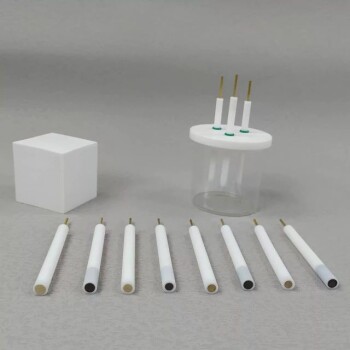
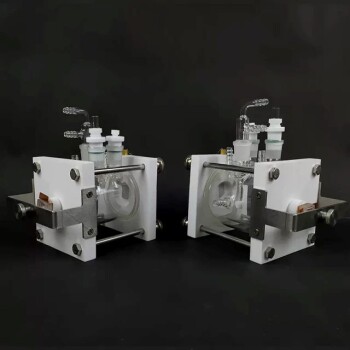
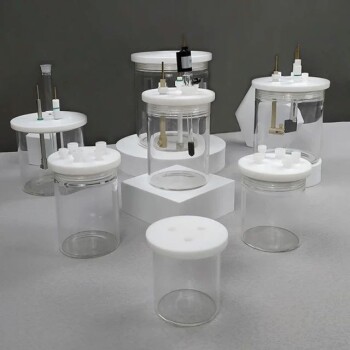
The Ag/AgCl reference electrode acts as the fundamental standard against which all electrochemical activity in your hexavalent chromium experiment is measured. Its primary significance is providing a highly stable, known potential that allows your electrochemical workstation to control the working electrode with extreme precision. Without this stable reference, accurate data regarding reduction potential and energy efficiency cannot be gathered.
By establishing a constant half-cell potential, the Ag/AgCl electrode enables the precise isolation of the working electrode's behavior. This accuracy is essential for optimizing energy efficiency and understanding the specific mechanisms driving hexavalent chromium reduction.
The Necessity of a Fixed Reference Point
Overcoming Measurement Limitations
It is currently impossible to measure the absolute potential of an electrode in isolation. Potential is always a relative difference between two points.
The Ag/AgCl electrode serves as a stable "half-cell" with a known chemical composition. This allows the electrochemical cell to function, providing a baseline against which the potential of the other half-cell (the working electrode) can be determined.
Ensuring Stability
In an electrochemical experiment, the working electrode's environment changes constantly as reactions occur.
The Ag/AgCl electrode remains chemically stable throughout the process. This stability ensures that any change in voltage observed by your workstation is due to the reduction of hexavalent chromium at the working electrode, not fluctuations in your reference point.
Optimizing the Reduction Process
Precise Potential Control
The electrochemical workstation uses the Ag/AgCl electrode to lock the working electrode to a specific voltage.
This control is vital for hexavalent chromium reduction. It allows researchers to maintain the exact conditions required to drive the reaction forward without drifting into unwanted side reactions.
Determining Optimal Ranges
Successful reduction depends on identifying the specific potential window where the reaction is most efficient.
Using a precise reference allows you to scan potentials and identify exactly where the reduction peaks. This data helps define the optimal operational parameters for the system.
Studying Reaction Mechanisms
The Ag/AgCl electrode is critical for studying indirect electrochemical reduction mechanisms.
By maintaining a stable baseline, researchers can isolate specific electrochemical signals. This clarity is required to understand the step-by-step process of how hexavalent chromium is chemically altered during the experiment.
Understanding Operational Trade-offs
The Requirement for Conversion
While Ag/AgCl is a practical standard, it is not the universal standard (Standard Hydrogen Electrode, or SHE).
Data collected against an Ag/AgCl reference is relative to that specific electrode. When comparing your results to theoretical thermodynamic data (often listed vs. SHE), you must mathematically convert your values based on the known potential difference between Ag/AgCl and SHE.
Dependency on Maintenance
The "known potential" of the Ag/AgCl electrode relies on the integrity of its internal solution.
If the internal chloride concentration changes or the porous frit becomes clogged with chromium precipitates, the reference potential will drift. A drifting reference renders the "precision control" of the workstation useless, leading to erroneous data regarding the reduction process.
Making the Right Choice for Your Experiment
To maximize the value of your hexavalent chromium research, align your use of the reference electrode with your specific objectives:
- If your primary focus is Energy Efficiency: Use the reference to pinpoint the minimum potential required for reduction, ensuring you avoid the excessive energy consumption associated with over-potential.
- If your primary focus is Mechanism Analysis: Rely on the stability of the reference to produce clean cyclic voltammetry data, allowing you to distinguish between direct and indirect reduction pathways.
A stable reference is the difference between guessing the conditions of your reaction and strictly controlling them.
Summary Table:
| Feature | Significance in Cr(VI) Reduction |
|---|---|
| Potential Stability | Provides a fixed baseline to accurately measure reduction potential changes. |
| Precision Control | Enables electrochemical workstations to maintain exact voltage for efficient reduction. |
| Mechanism Analysis | Isolates signals to distinguish between direct and indirect reduction pathways. |
| Energy Optimization | Helps identify the minimum over-potential required, reducing overall energy costs. |
| Data Reliability | Ensures observed voltage shifts are due to reactions, not reference drift. |
Elevate Your Electrochemical Research with KINTEK
Precision in hexavalent chromium reduction starts with high-quality instrumentation. KINTEK specializes in advanced laboratory equipment designed for rigorous electrochemical analysis. Whether you are optimizing energy efficiency or studying complex reaction mechanisms, our comprehensive range of electrolytic cells, high-performance electrodes, and precision workstations provides the stability your data demands.
From high-temperature reactors to specialized consumables like PTFE components and ceramics, KINTEK delivers the tools necessary for breakthroughs in battery research and environmental science.
Ready to achieve superior accuracy in your lab? Contact our specialists today to find the perfect solution for your application.
References
- Wenqing Ma, Shaohui Zhang. Electrochemical reduction of Cr (VI) using a palladium/graphene modified stainless steel electrode. DOI: 10.2166/wst.2022.348
This article is also based on technical information from Kintek Solution Knowledge Base .
Related Products
- Reference Electrode Calomel Silver Chloride Mercury Sulfate for Laboratory Use
- Copper Sulfate Reference Electrode for Laboratory Use
- Electrolytic Electrochemical Cell Gas Diffusion Liquid Flow Reaction Cell
- Glassy Carbon Electrochemical Electrode
- Graphite Disc Rod and Sheet Electrode Electrochemical Graphite Electrode
People Also Ask
- What is the function of a reference electrode? Master Precision in Three-Electrode Reactor Reconstruction
- What is the recommended maintenance for the filling solution of a reference electrode? A Guide to Stable & Accurate Readings
- Which electrode is used as a ground reference? Master the Key to Accurate Electrochemical Measurements
- What is the reference electrode in potentiometry? The Key to Stable & Accurate Measurements
- Which electrode is used as a reference? A Guide to Accurate Electrochemical Measurements