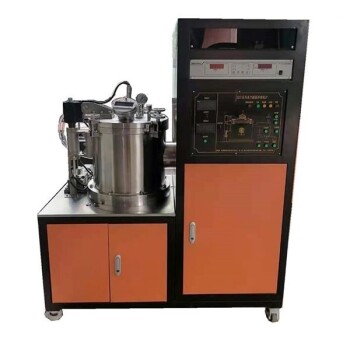
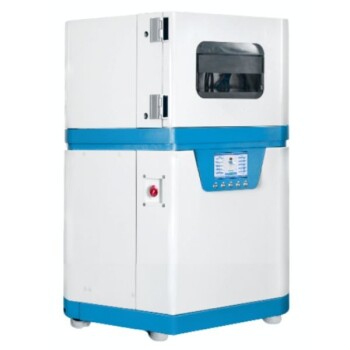
Vacuum heating serves as a critical purification step primarily designed to achieve deep dehydration of lithium-ion ionic liquid (Li-IL) mixtures. By subjecting the liquid to heat under reduced pressure, you effectively strip away trace moisture that would otherwise compromise the structural integrity and electrochemical performance of the final system.
Water acts as a competitive contaminant that occupies the porous structure of Metal-Organic Frameworks (MOFs) and destabilizes lithium battery chemistry. Vacuum heating ensures the ionic liquid is chemically pure and dry, preventing water-induced degradation and ensuring the electrolyte functions as intended.
The Mechanics of Dehydration
Removing Trace Moisture
Ionic liquid mixtures, such as those containing LiTFSI and [EMIM][TFSI], are often prone to retaining moisture.
Standard heating is frequently insufficient to remove water trapped at the molecular level. Vacuum heating lowers the boiling point of water, facilitating deep dehydration even at temperatures safe for the ionic liquid.
Ensuring Chemical Purity
This process acts as a mandatory pretreatment step.
Before the ionic liquid can be introduced to the MOF, it must meet strict purity standards. Eliminating moisture is the most significant factor in establishing this purity.
Why Moisture Control is Critical for MOFs
Preserving Pore Volume
The primary value of a Metal-Organic Framework lies in its highly porous structure.
If water molecules are present in the mixture, they can physically occupy these pores. This blocks the ionic liquid from filling the MOF, reducing the effectiveness of the host material.
Preventing Structural Competition
You need the Li-IL to fill the structure, not water.
Vacuum heating ensures that the MOF pores remain available exclusively for the electrolyte mixture. This maximizes the loading of the active ionic liquid into the framework.
Impact on Battery Performance
Maintaining Electrochemical Stability
Water is chemically detrimental to the operation of lithium batteries.
The presence of even trace amounts of water can trigger side reactions. These reactions narrow the electrochemical stability window, limiting the voltage range and power of the battery.
Preventing Degradation
Moisture does not just occupy space; it actively degrades the system.
By eliminating water, you prevent water-induced degradation of both the ionic liquid and the interface with the MOF. This is essential for the long-term reliability of the solid-state electrolyte.
Understanding the Trade-offs
Process Time vs. Purity
Achieving "deep" dehydration is not instantaneous.
It requires a sustained application of vacuum and heat. Rushing this process to save time creates a high risk of residual moisture, which will ruin the downstream filling process.
Equipment Dependencies
This process relies heavily on the quality of your vacuum equipment.
If the vacuum pressure is not sufficiently low, you may fail to remove bound water molecules. Inadequate equipment can lead to a false sense of security regarding the dryness of the material.
Optimizing Your Preparation Protocol
To ensure the success of your solid-state electrolyte project, apply the following principles:
- If your primary focus is Electrochemical Stability: Prioritize extended vacuum heating times to eliminate every trace of water that could cause voltage breakdown.
- If your primary focus is MOF Loading Efficiency: Ensure the liquid is completely dry to prevent water molecules from stealing pore volume meant for the ionic liquid.
Treat vacuum heating not as a formality, but as the foundational step that dictates the integrity of your entire solid-state electrolyte system.
Summary Table:
| Feature | Impact of Vacuum Heating | Benefit to MOF/Battery System |
|---|---|---|
| Moisture Content | Deep dehydration of LiTFSI/[EMIM][TFSI] | Prevents water-induced chemical degradation |
| Pore Accessibility | Removes competitive water molecules | Maximizes Li-IL loading efficiency in MOF pores |
| Stability Window | Eliminates trace contaminants | Maintains a wide electrochemical stability window |
| Structural Integrity | Prevents pore blockage | Ensures long-term reliability of solid-state electrolytes |
Elevate Your Battery Research with Precision Engineering
To achieve the deep dehydration and chemical purity required for advanced solid-state electrolytes, high-performance equipment is non-negotiable. KINTEK specializes in providing state-of-the-art laboratory solutions tailored for researchers working with Metal-Organic Frameworks and ionic liquids.
Our extensive portfolio features the tools you need for success, including:
- High-Temperature Vacuum Furnaces: For precise dehydration and pretreatment.
- Advanced Crushing & Milling: To prepare uniform MOF powders.
- High-Pressure Reactors & Autoclaves: For robust material synthesis.
- Battery Research Tools: Including specialized consumables and electrolytic cells.
Don't let trace moisture compromise your innovation. Contact KINTEK today to discover how our comprehensive range of high-temperature systems and laboratory consumables can enhance your material integrity and experimental efficiency.
Related Products
- Vacuum Heat Treat Furnace and Levitation Induction Melting Furnace
- Vacuum Hot Press Furnace Machine for Lamination and Heating
- Electric Heated Hydraulic Vacuum Heat Press for Lab
- Vacuum Cold Mounting Machine for Sample Preparation
- Vacuum Heat Treat and Pressure Sintering Furnace for High Temperature Applications
People Also Ask
- What are the advantages of a vacuum induction melting furnace? Achieve High-Purity Alloys with Precision VIM
- What is the function of a vacuum induction melting furnace? Essential Guide for High-Purity FeCrAl Alloy Production
- What are the key components inside the vacuum chamber of a vacuum induction melting furnace? A Guide to the Core Melting Assembly
- Why use VIM for rare earth steel? Essential Precision for Melting Reactive Lanthanum and Cerium
- What is the primary function of a vacuum induction melting furnace in Ni-Mo-Cr-Fe master alloy prep? Ensure High Purity