Knowledge What is the size reduction mechanism in a ball mill? Master Impact vs. Attrition for Precise Grinding
Author avatar

Tech Team · Kintek Solution

Updated 1 week ago

What is the size reduction mechanism in a ball mill? Master Impact vs. Attrition for Precise Grinding


In a ball mill, size reduction is achieved through two distinct physical mechanisms. As the mill cylinder rotates, the grinding media (the balls) inside are lifted and then fall, converting the rotational energy into forces that break down the material. This process is a dynamic interplay between forceful collisions and grinding friction.

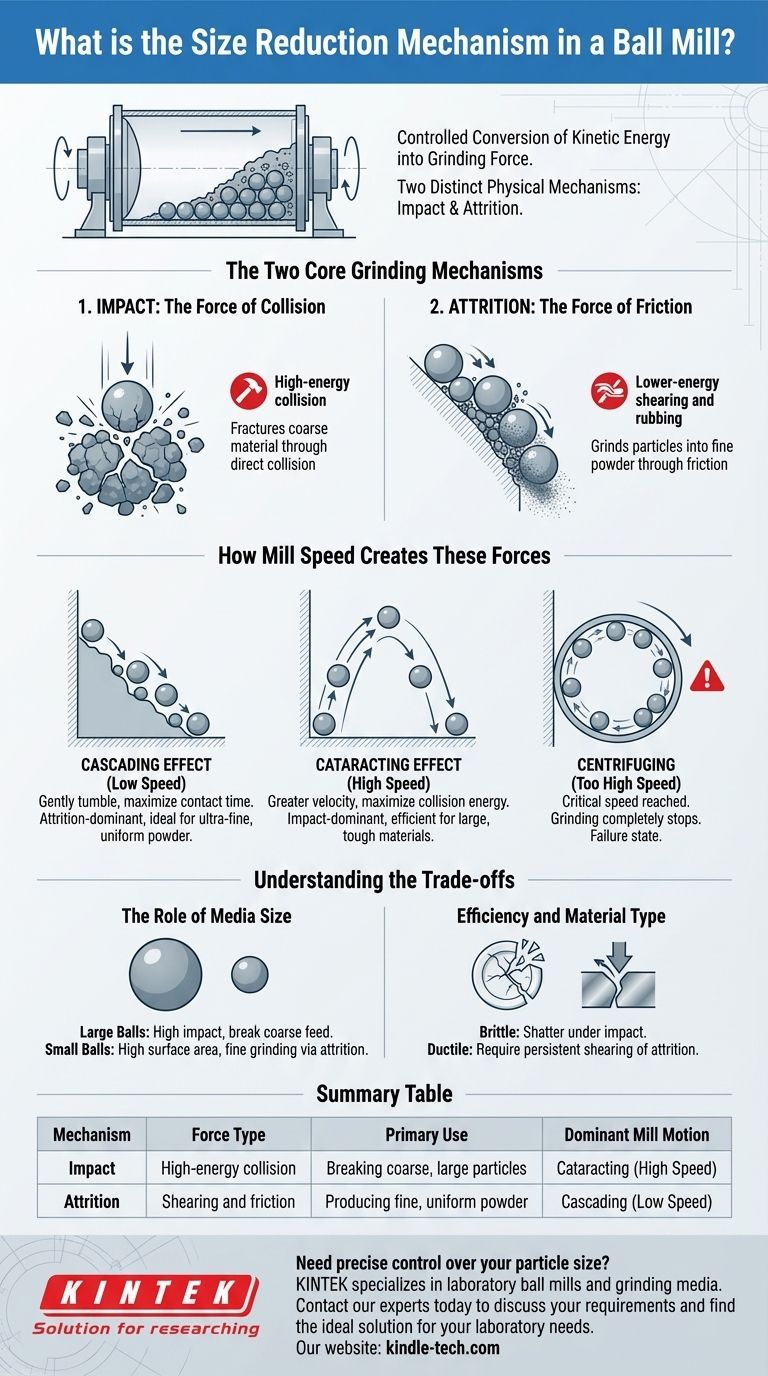
The core principle of a ball mill is the controlled conversion of kinetic energy into grinding force. This is accomplished through two primary actions: impact, which fractures coarse material through direct collision, and attrition, which grinds particles into a fine powder through friction and shear.
What is the size reduction mechanism in a ball mill? Master Impact vs. Attrition for Precise Grinding

The Two Core Grinding Mechanisms

The effectiveness of a ball mill comes from its ability to apply two different types of force simultaneously. The balance between these forces is what determines the final particle size and the efficiency of the grinding process.

Impact: The Force of Collision

Impact is a high-energy event where a grinding ball falls and strikes the material. This is the primary mechanism for breaking down large, coarse feed particles.

As the mill's cylinder rotates, it lifts the balls up the side. At a certain height, gravity overcomes the forces holding the balls to the wall, and they detach, falling onto the material at the bottom of the mill. This action is like a hammer blow, causing brittle fracture in the target particles.

Attrition: The Force of Friction

Attrition is a lower-energy shearing and rubbing action. This mechanism is responsible for the fine grinding that reduces already small particles into a smooth powder.

This occurs when balls cascade and tumble over one another, trapping material between them. The resulting friction and shear forces rub the surfaces of the particles, gradually wearing them down and polishing them into a finer state.

How Mill Speed Creates These Forces

The rotational speed of the mill is the most critical operational parameter because it directly controls which grinding mechanism—impact or attrition—is dominant.

The Cascading Effect (Low Speed)

At lower speeds, the balls are not lifted very high up the cylinder wall. They gently tumble over each other in a continuous cascade down the face of the material.

This motion minimizes impact force but maximizes the contact time and rubbing action between the balls and the material. A cascading mill is attrition-dominant, ideal for producing an extremely fine, uniform powder.

The Cataracting Effect (High Speed)

As the rotational speed increases, centrifugal force carries the balls higher up the cylinder wall before they break free. They then follow a more parabolic path, falling with much greater velocity and force onto the material.

This cataracting motion maximizes collision energy, making the process impact-dominant. This is the most efficient way to quickly fracture larger, tougher materials.

Centrifuging (Too High Speed)

If the mill rotates too fast, it will reach a "critical speed." At this point, centrifugal force is so strong that it pins the grinding media and the material to the cylinder wall.

When this happens, there is no tumbling or falling, and therefore no relative motion. Grinding completely stops. This is a failure state that must be avoided.

Understanding the Trade-offs

Achieving the desired result requires balancing several key factors, not just the speed.

The Role of Media Size

The size of the grinding media is crucial. Large balls have more mass and generate significantly higher impact forces, making them effective for breaking down coarse feed.

Small balls, conversely, have a much higher total surface area and create more contact points. This makes them more effective at fine grinding through attrition and allows them to fill the void spaces between larger balls for a more uniform grind.

Efficiency and Material Type

The optimal balance of impact and attrition depends on the properties of the material being processed. Brittle materials like ceramics may shatter easily under impact, while more ductile materials may require the persistent shearing of attrition to be reduced effectively.

Matching the Mechanism to Your Goal

To operate a ball mill effectively, you must align its operating parameters with your desired outcome.

  • If your primary focus is breaking down large, coarse particles: Run the mill at a higher speed to encourage a cataracting motion and use larger grinding media to maximize impact forces.
  • If your primary focus is producing a very fine, uniform powder: Run the mill at a lower speed to create a cascading motion and use smaller grinding media to maximize attrition.

By mastering the interplay between speed, media, and material, you gain precise control over your final particle size.

Summary Table:

Mechanism Force Type Primary Use Dominant Mill Motion
Impact High-energy collision Breaking coarse, large particles Cataracting (High Speed)
Attrition Shearing and friction Producing fine, uniform powder Cascading (Low Speed)

Need precise control over your particle size?

KINTEK specializes in laboratory ball mills and grinding media, helping you achieve the perfect balance between impact and attrition for your specific materials. Whether you need to crush coarse samples or create ultra-fine powders, our expertise ensures optimal efficiency and results for your lab.

Contact our experts today to discuss your grinding requirements and find the ideal solution for your laboratory needs.

Visual Guide
What is the size reduction mechanism in a ball mill? Master Impact vs. Attrition for Precise Grinding Visual Guide

Related Products

People Also Ask

Related Products

Stainless Steel Laboratory Ball Mill for Dry Powder and Liquid with Ceramic Polyurethane Lining

Stainless Steel Laboratory Ball Mill for Dry Powder and Liquid with Ceramic Polyurethane Lining

Discover the versatile stainless steel dry powder/liquid horizontal ball mill with ceramic/polyurethane lining. Ideal for ceramic, chemical, metallurgical, and building materials industries. High grinding efficiency and uniform particle size.

Laboratory Planetary Ball Mill Rotating Ball Milling Machine

Laboratory Planetary Ball Mill Rotating Ball Milling Machine

KT-P400E is a desktop multi-directional planetary ball mill with unique grinding and mixing capabilities. It offers continuous and intermittent operation, timing, and overload protection, making it ideal for various applications.

Laboratory Horizontal Planetary Ball Mill Milling Machine

Laboratory Horizontal Planetary Ball Mill Milling Machine

Improve sample uniformity with our Horizontal Planetary Ball Mills. KT-P400H reduces sample deposition and KT-P400E has multi-directional capabilities. Safe, convenient and efficient with overload protection.

High-Energy Omnidirectional Planetary Ball Mill Milling Machine for Laboratory

High-Energy Omnidirectional Planetary Ball Mill Milling Machine for Laboratory

The KT-P4000E is a new product derived from the vertical high-energy planetary ball mill with a 360° swivel function. Experience faster, uniform, and smaller sample output results with 4 ≤1000ml ball mill jars.

High-Energy Omnidirectional Planetary Ball Mill Machine for Laboratory

High-Energy Omnidirectional Planetary Ball Mill Machine for Laboratory

The KT-P2000E is a new product derived from the vertical high-energy planetary ball mill with a 360°rotation function. The product not only has the characteristics of the vertical high-energy ball mill, but also has a unique 360°rotation function for the planetary body.

High Energy Planetary Ball Mill Milling Machine for Laboratory

High Energy Planetary Ball Mill Milling Machine for Laboratory

Experience fast and effective sample processing with the F-P2000 high-energy planetary ball mill. This versatile equipment offers precise control and excellent grinding capabilities. Perfect for laboratories, it features multiple grinding bowls for simultaneous testing and high output. Achieve optimal results with its ergonomic design, compact structure, and advanced features. Ideal for a wide range of materials, it ensures consistent particle size reduction and low maintenance.

High Energy Planetary Ball Mill Milling Machine for Laboratory

High Energy Planetary Ball Mill Milling Machine for Laboratory

The biggest feature is that the high energy planetary ball mill can not only perform fast and effective grinding, but also has good crushing ability

Laboratory Single Horizontal Jar Mill

Laboratory Single Horizontal Jar Mill

KT-JM3000 is a mixing and grinding instrument for placing a ball milling tank with a volume of 3000ml or less. It adopts frequency conversion control to realize timing, constant speed, direction change, overload protection and other functions.

Laboratory Ball Mill Jar Mill with Metal Alloy Grinding Jar and Balls

Laboratory Ball Mill Jar Mill with Metal Alloy Grinding Jar and Balls

Grind and mill with ease using metal alloy grinding jars with balls. Choose from 304/316L stainless steel or tungsten carbide and optional liner materials. Compatible with various mills and features optional functions.

High Energy Vibratory Laboratory Ball Mill Double Tank Type

High Energy Vibratory Laboratory Ball Mill Double Tank Type

High-energy vibration ball mill is a small desktop laboratory grinding instrument. It uses 1700r/min high-frequency three-dimensional vibration to make the sample achieve the result of grinding or mixing.

Laboratory Planetary Ball Mill Cabinet Planetary Ball Milling Machine

Laboratory Planetary Ball Mill Cabinet Planetary Ball Milling Machine

The vertical cabinet structure combined with ergonomic design enables users to obtain the best comfortable experience in standing operation. The maximum processing capacity is 2000ml, and the speed is 1200 revolutions per minute.

Laboratory Four-Body Horizontal Jar Mill

Laboratory Four-Body Horizontal Jar Mill

The four-body horizontal tank mill ball mill can be used with four horizontal ball mill tanks with a volume of 3000ml. It is mostly used for mixing and grinding laboratory samples.

High Energy Planetary Ball Mill for Laboratory Horizontal Tank Type Milling Machine

High Energy Planetary Ball Mill for Laboratory Horizontal Tank Type Milling Machine

KT-P4000H uses the unique Y-axis planetary motion trajectory, and utilizes the collision, friction and gravity between the sample and the grinding ball to have a certain anti-sinking ability, which can obtain better grinding or mixing effects and further improve the sample output.

Hybrid High Energy Vibratory Ball Mill for Lab Use

Hybrid High Energy Vibratory Ball Mill for Lab Use

KT-BM400 is used for rapid grinding or mixing of dry, wet and frozen small amount of samples in the laboratory. It can be configured with two 50ml ball mill jars

Laboratory Jar Mill with Agate Grinding Jar and Balls

Laboratory Jar Mill with Agate Grinding Jar and Balls

Grind your materials with ease using Agate Grinding Jars with Balls. Sizes from 50ml to 3000ml, perfect for planetary and vibration mills.

High Energy Vibratory Laboratory Ball Mill Grinding Mill Single Tank Type

High Energy Vibratory Laboratory Ball Mill Grinding Mill Single Tank Type

High-energy vibration ball mill is a small desktop laboratory grinding instrument.It can be ball-milled or mixed with different particle sizes and materials by dry and wet methods.

Laboratory Micro Tissue Grinding Mill Grinder

Laboratory Micro Tissue Grinding Mill Grinder

KT-MT10 is a miniature ball mill with a compact structure design. The width and depth are only 15X21 cm, and the total weight is only 8 kg. It can be used with a minimum 0.2ml centrifuge tube or a maximum 15ml ball mill jar.

Laboratory Ten-Body Horizontal Jar Mill for Lab Use

Laboratory Ten-Body Horizontal Jar Mill for Lab Use

The Ten-body horizontal jar mill is for 10 ball mill pots (3000ml or less). It has frequency conversion control, rubber roller movement, and PE protective cover.

Laboratory Micro Horizontal Jar Mill for Precision Sample Preparation in Research and Analysis

Laboratory Micro Horizontal Jar Mill for Precision Sample Preparation in Research and Analysis

Discover the Micro Horizontal Jar Mill for precise sample preparation in research and analysis. Ideal for XRD, geology, chemistry, and more.

Laboratory Grinding Mill Mortar Grinder for Sample Preparation

Laboratory Grinding Mill Mortar Grinder for Sample Preparation

KT-MG200 mortar grinder can be used for mixing and homogenizing powder, suspension, paste and even viscous samples. It can help users realize the ideal operation of sample preparation with more regularization and higher repeatability.


Leave Your Message