Knowledge engineering ceramics What is the specific heat of alumina? It's a range from 451 to 955 J/kg·K
Author avatar

Tech Team · Kintek Solution

Updated 2 months ago

What is the specific heat of alumina? It's a range from 451 to 955 J/kg·K


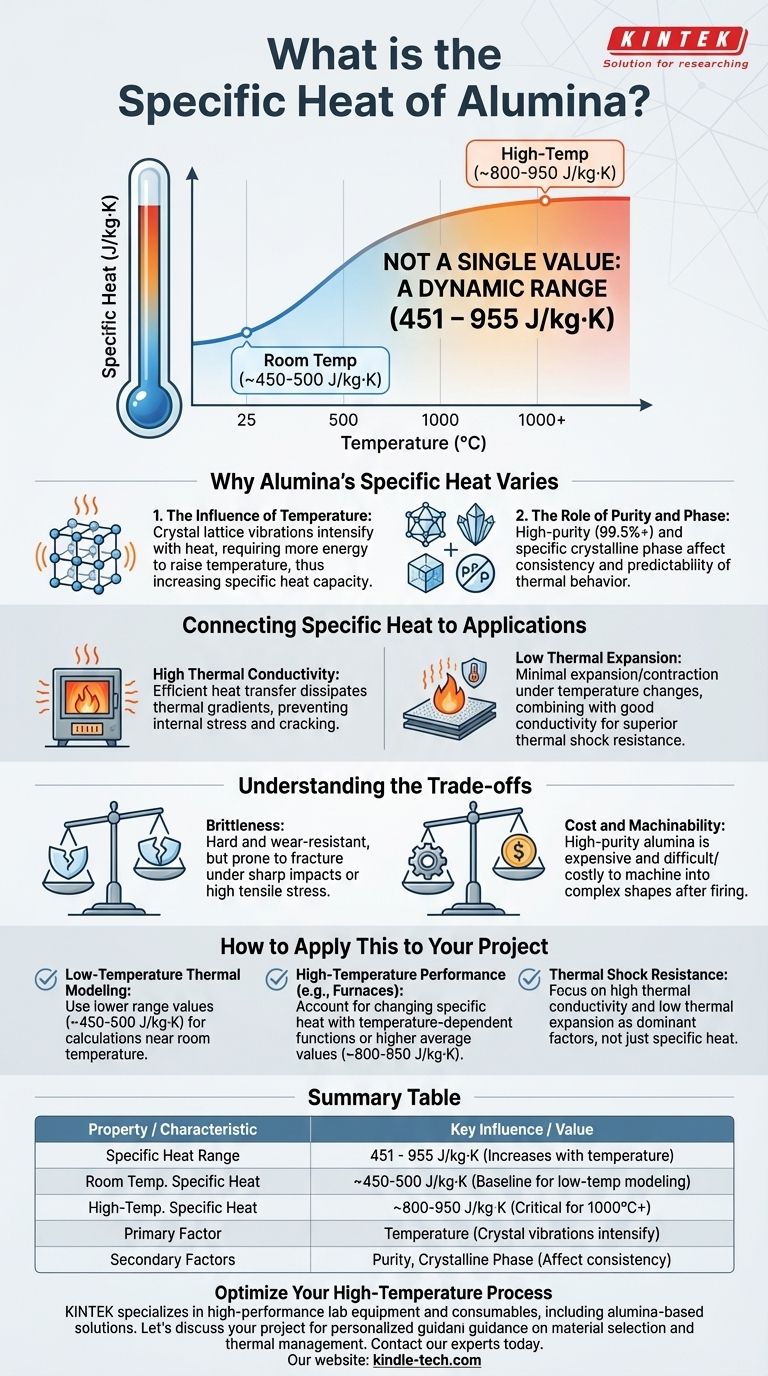
The specific heat of alumina is not a single value but falls within a range, typically between 451 and 955 J/kg·K (Joules per kilogram Kelvin). This variation is primarily because specific heat is dependent on temperature; it increases as the material gets hotter. Purity and the specific crystalline phase of the alumina also play a role.

The core issue isn't finding a single number for specific heat, but understanding that alumina's thermal properties—including its ability to absorb and store heat—change significantly with temperature. This dynamic behavior is what defines its performance in high-temperature applications.
What is the specific heat of alumina? It's a range from 451 to 955 J/kg·K

Why Alumina's Specific Heat is a Range

Specific heat capacity measures the amount of energy required to raise the temperature of a material by one degree. For a material like alumina, this is not a static property.

The Influence of Temperature

As alumina heats up, its crystal lattice vibrates more intensely. More energy is required to increase these vibrations further, which translates directly to a higher specific heat capacity.

The lower value in the range (around 450 J/kg·K) corresponds to room temperature, while the upper value (around 950 J/kg·K) is typical for much higher temperatures, approaching 1000°C or more.

The Role of Purity and Phase

The term "alumina" refers to aluminum oxide (Al₂O₃), but its exact properties depend on its purity and crystalline structure (phase).

High-purity alumina (99.5%+) is prized for its thermal stability. While the references don't explicitly link purity to a specific heat value, higher purity generally leads to more predictable and consistent thermal behavior, which is critical for demanding applications.

Connecting Specific Heat to Alumina's Applications

The provided data highlights alumina's use in extreme environments, capable of withstanding temperatures up to 1800°C. Its thermal properties are key to this performance.

High Thermal Conductivity

Alumina exhibits superior thermal conductivity. This means it can transfer heat efficiently rather than holding onto it, which contributes to its excellent thermal shock resistance.

A material that conducts heat well can dissipate thermal gradients quickly, preventing the buildup of internal stress that causes cracking when temperatures change rapidly.

Low Thermal Expansion

Alumina expands and contracts very little with changes in temperature. This low coefficient of thermal expansion is another crucial factor in its ability to resist thermal shock.

When combined with good thermal conductivity, it means the material experiences minimal physical stress even under rapid heating or cooling cycles.

Understanding the Trade-offs

While alumina's properties are exceptional, it's important to recognize its operational context. Its strengths in one area are balanced by its characteristics in another.

Brittleness

Like most ceramics, alumina is hard and wear-resistant but also brittle. It has very high compressive strength but can fracture under sharp impacts or high tensile stress.

This means that while it can handle extreme heat and chemical attack, mechanical shock is a primary failure mode that must be managed in any design.

Cost and Machinability

High-purity alumina is more expensive than many metals and polymers. Due to its extreme hardness, it is also very difficult and costly to machine into complex shapes after it has been fired.

Components are often formed into their final or near-final shape before the final high-temperature sintering process.

How to Apply This to Your Project

Your interpretation of alumina's specific heat should depend entirely on your engineering goal.

  • If your primary focus is thermal modeling at low temperatures: Use a value near the lower end of the range, approximately 450-500 J/kg·K, for calculations around room temperature.
  • If your primary focus is high-temperature performance (e.g., furnace linings, insulators): You must account for the changing specific heat. Use a temperature-dependent function or an average value closer to 800-950 J/kg·K for high-temperature calculations.
  • If your primary focus is thermal shock resistance: Remember that specific heat is only part of the equation; high thermal conductivity and low thermal expansion are the more dominant properties ensuring alumina's survival.

Ultimately, understanding that specific heat is a dynamic variable is the key to correctly predicting alumina's behavior in any thermal system.

Summary Table:

Property Value / Characteristic Key Influence
Specific Heat Range 451 - 955 J/kg·K Increases significantly with temperature
Room Temp. Specific Heat ~450-500 J/kg·K Baseline for low-temperature modeling
High-Temp. Specific Heat ~800-950 J/kg·K Critical for applications near 1000°C+
Primary Factor Temperature Crystal lattice vibrations intensify with heat
Secondary Factors Purity, Crystalline Phase Affect consistency and predictability

Optimize Your High-Temperature Process with the Right Materials

Understanding the dynamic thermal properties of materials like alumina is crucial for the success and safety of your high-temperature applications, whether you're designing furnace linings, insulators, or custom components.

KINTEK specializes in providing high-performance lab equipment and consumables, including alumina-based solutions, to meet the demanding needs of laboratories and industrial settings. We can help you select the right materials based on your specific temperature requirements and operational goals.

Let's discuss your project: Contact our experts today for personalized guidance on material selection and thermal management solutions.

Visual Guide
What is the specific heat of alumina? It's a range from 451 to 955 J/kg·K Visual Guide

Related Products

People Also Ask

Related Products

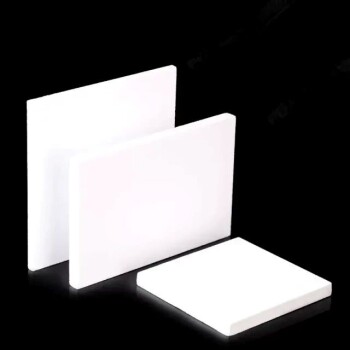
High Temperature Wear-Resistant Alumina Al2O3 Plate for Engineering Advanced Fine Ceramics

High Temperature Wear-Resistant Alumina Al2O3 Plate for Engineering Advanced Fine Ceramics

High temperature wear-resistant insulating alumina plate has excellent insulation performance and high temperature resistance.

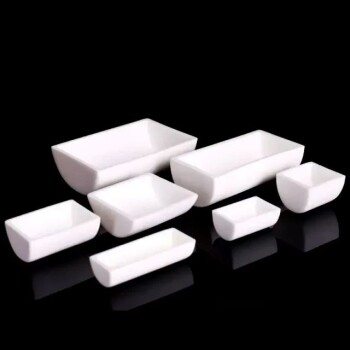
Alumina Al2O3 Ceramic Crucible Semicircle Boat with Lid for Engineering Advanced Fine Ceramics

Alumina Al2O3 Ceramic Crucible Semicircle Boat with Lid for Engineering Advanced Fine Ceramics

Crucibles are containers widely used for melting and processing various materials, and semicircular boat-shaped crucibles are suitable for special smelting and processing requirements. Their types and uses vary by material and shape.

High Purity Alumina Granulated Powder for Engineering Advanced Fine Ceramics

High Purity Alumina Granulated Powder for Engineering Advanced Fine Ceramics

Ordinary alumina granulated powder is alumina particles prepared by traditional processes, with a wide range of applications and good market adaptability. This material is known for its high purity, excellent thermal stability and chemical stability, and is suitable for a variety of high-temperature and conventional applications.

Advanced Engineering Fine Ceramics Low Temperature Alumina Granulation Powder

Advanced Engineering Fine Ceramics Low Temperature Alumina Granulation Powder

Low temperature alumina granulation powder is a kind of alumina particles produced by a special low temperature process, designed to meet the needs of temperature sensitive applications. This material has excellent low temperature performance and good processing characteristics, suitable for a variety of industries that require low temperature processing and treatment.

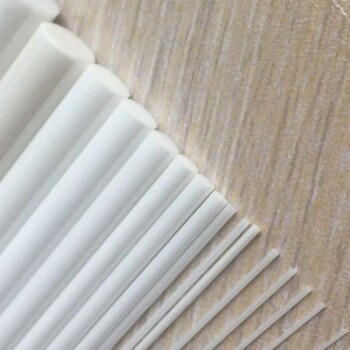
Engineering Advanced Fine Alumina Al2O3 Ceramic Rod Insulated for Industrial Applications

Engineering Advanced Fine Alumina Al2O3 Ceramic Rod Insulated for Industrial Applications

Insulated alumina rod is a fine ceramic material. Alumina rods have excellent electrical insulating properties, high chemical resistance and low thermal expansion.

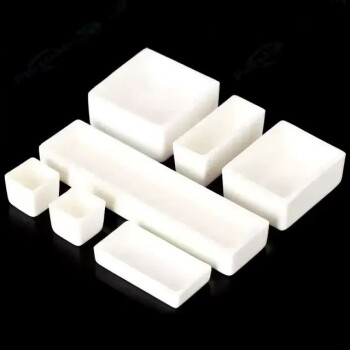
Engineering Advanced Fine Alumina Al2O3 Ceramic Crucible for Laboratory Muffle Furnace

Engineering Advanced Fine Alumina Al2O3 Ceramic Crucible for Laboratory Muffle Furnace

Alumina ceramic crucibles are used in some materials and metal melting tools, and flat-bottomed crucibles are suitable for melting and processing larger batches of materials with better stability and uniformity.

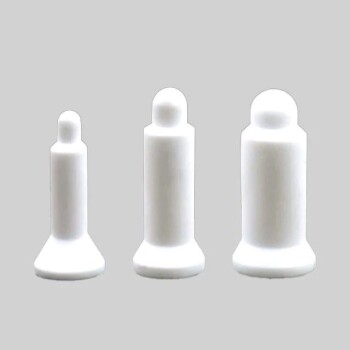
Engineering Advanced Fine Alumina (Al₂O₃) Ceramic Positioning Pin Straight Bevel for Precision Applications

Engineering Advanced Fine Alumina (Al₂O₃) Ceramic Positioning Pin Straight Bevel for Precision Applications

Alumina ceramic positioning pin has the characteristics of high hardness, wear resistance and high temperature resistance.

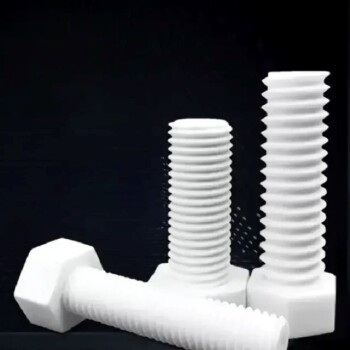
High Quality Alumina Ceramic Screw for Engineering Advanced Fine Ceramics with High Temperature Resistance and Insulation

High Quality Alumina Ceramic Screw for Engineering Advanced Fine Ceramics with High Temperature Resistance and Insulation

Alumina ceramic screws are fastening components made of 99.5% alumina, ideal for extreme applications requiring excellent thermal resistance, electrical insulation and chemical resistance.

Custom-Made Alumina Zirconia Special-Shaped Ceramic Plates for Engineering Advanced Fine Ceramics Processing

Custom-Made Alumina Zirconia Special-Shaped Ceramic Plates for Engineering Advanced Fine Ceramics Processing

Alumina ceramics have good electrical conductivity, mechanical strength and high temperature resistance, while zirconia ceramics are known for their high strength and high toughness and are widely used.

Advanced Engineering Fine Ceramics Alumina Ceramic Saggar for Fine Corundum

Advanced Engineering Fine Ceramics Alumina Ceramic Saggar for Fine Corundum

Alumina sagger products have the characteristics of high temperature resistance, good thermal shock stability, small expansion coefficient, anti-stripping, and good anti-powdering performance.

High Temperature Alumina (Al2O3) Furnace Tube for Engineering Advanced Fine Ceramics

High Temperature Alumina (Al2O3) Furnace Tube for Engineering Advanced Fine Ceramics

High temperature alumina furnace tube combines the advantages of high hardness of alumina, good chemical inertness and steel, and has excellent wear resistance, thermal shock resistance and mechanical shock resistance.

Engineering Advanced Fine Ceramics Alumina Al2O3 Crucible With Lid Cylindrical Laboratory Crucible

Engineering Advanced Fine Ceramics Alumina Al2O3 Crucible With Lid Cylindrical Laboratory Crucible

Cylindrical Crucibles Cylindrical crucibles are one of the most common crucible shapes, suitable for melting and processing a wide variety of materials, and are easy to handle and clean.

Arc-Shaped Alumina Ceramic Crucible High Temperature Resistant for Engineering Advanced Fine Ceramics

Arc-Shaped Alumina Ceramic Crucible High Temperature Resistant for Engineering Advanced Fine Ceramics

In the journey of scientific exploration and industrial production, every detail is crucial. Our arc-shaped alumina ceramic crucibles, with their excellent high temperature resistance and stable chemical properties, have become a powerful assistant in laboratories and industrial fields. They are made of high-purity alumina materials and manufactured through precision processes to ensure excellent performance in extreme environments.

Engineering Advanced Fine Ceramics Aluminium Oxide Al2O3 Ceramic Washer for Wear-Resistant Applications

Engineering Advanced Fine Ceramics Aluminium Oxide Al2O3 Ceramic Washer for Wear-Resistant Applications

Alumina wear-resistant ceramic washer are used for heat dissipation, which can replace aluminum heat sinks, with high temperature resistance and high thermal conductivity.

Engineering Advanced Fine Ceramics Alumina Crucibles (Al2O3) for Thermal Analysis TGA DTA

Engineering Advanced Fine Ceramics Alumina Crucibles (Al2O3) for Thermal Analysis TGA DTA

TGA/DTA thermal analysis vessels are made of aluminum oxide (corundum or aluminum oxide). It can withstand high temperature and is suitable for analyzing materials that require high temperature testing.

Ceramic Evaporation Boat Set Alumina Crucible for Laboratory Use

Ceramic Evaporation Boat Set Alumina Crucible for Laboratory Use

It can be used for vapor deposition of various metals and alloys. Most metals can be evaporated completely without loss. Evaporation baskets are reusable.1

Aluminized Ceramic Evaporation Boat for Thin Film Deposition

Aluminized Ceramic Evaporation Boat for Thin Film Deposition

Vessel for depositing thin films; has an aluminum-coated ceramic body for improved thermal efficiency and chemical resistance. making it suitable for various applications.

Engineering Advanced Fine Ceramics Aluminum Oxide Al2O3 Heat Sink for Insulation

Engineering Advanced Fine Ceramics Aluminum Oxide Al2O3 Heat Sink for Insulation

The hole structure of the ceramic heat sink increases the heat dissipation area in contact with the air, which greatly enhances the heat dissipation effect, and the heat dissipation effect is better than that of super copper and aluminum.

Advanced Engineering Fine Ceramics Aluminum Nitride (AlN) Ceramic Sheet

Advanced Engineering Fine Ceramics Aluminum Nitride (AlN) Ceramic Sheet

Aluminum nitride (AlN) has the characteristics of good compatibility with silicon. It is not only used as a sintering aid or reinforcing phase for structural ceramics, but its performance far exceeds that of alumina.

Boron Nitride (BN) Ceramic Plate

Boron Nitride (BN) Ceramic Plate

Boron nitride (BN) ceramic plates do not use aluminum water to wet, and can provide comprehensive protection for the surface of materials that directly contact molten aluminum, magnesium, zinc alloys and their slag.


Leave Your Message