Knowledge Resources What is the sputtering voltage of a magnetron? Optimize Your Thin Film Deposition Process
Author avatar

Tech Team · Kintek Solution

Updated 2 months ago

What is the sputtering voltage of a magnetron? Optimize Your Thin Film Deposition Process


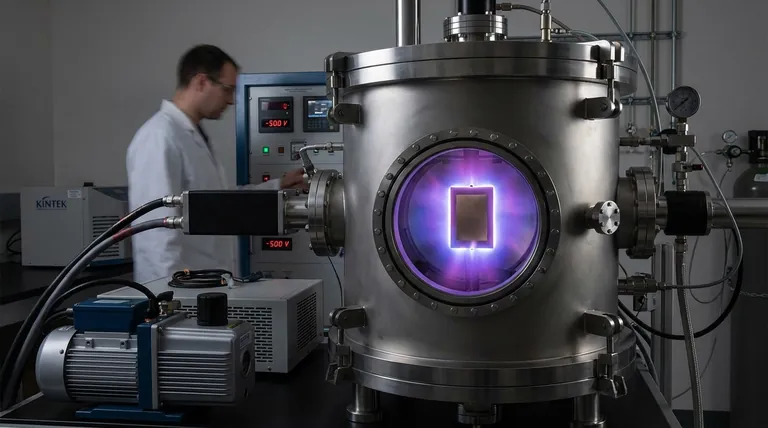
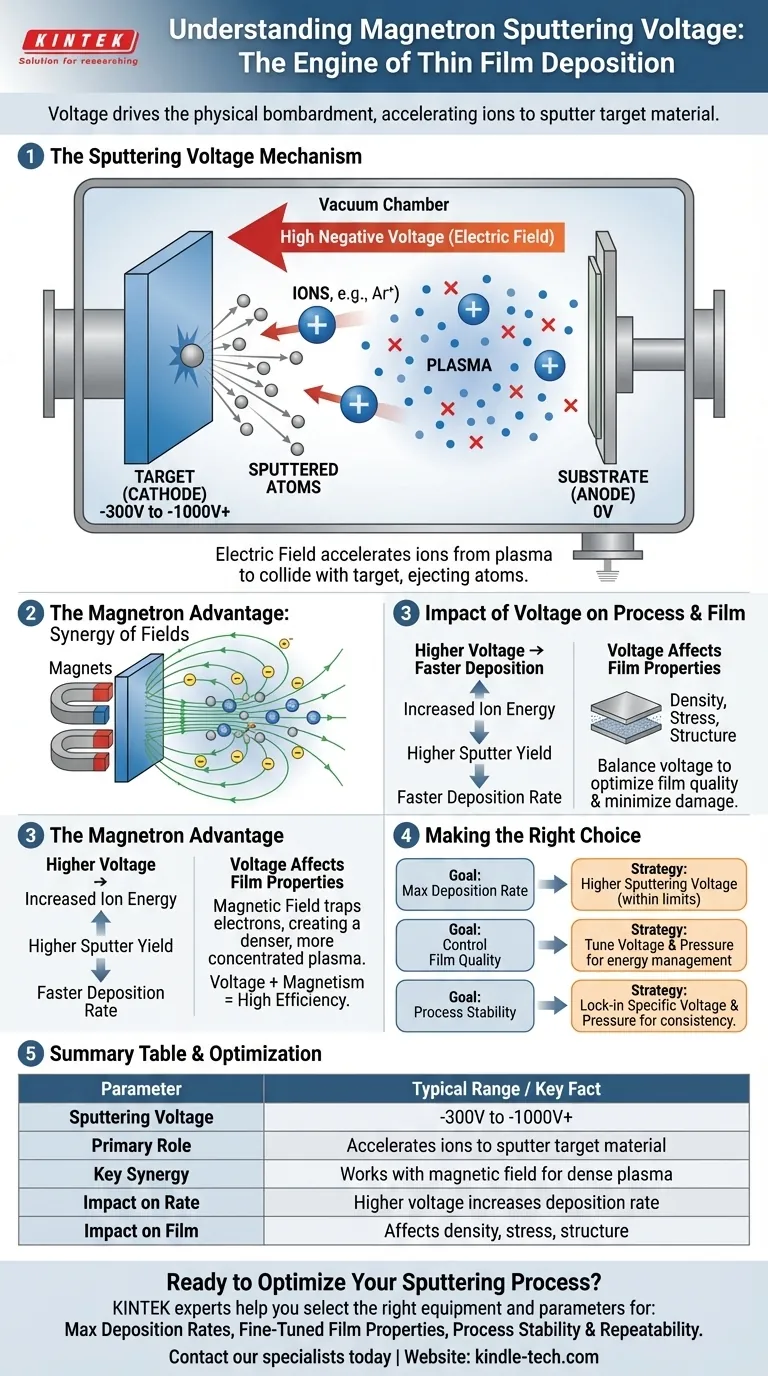
In magnetron sputtering, the process is driven by a high negative voltage applied to the target material, typically in the range of -300 volts to several kilovolts (-300V to -1000V+). This voltage creates a powerful electric field that attracts and accelerates positive ions from a generated plasma, causing them to collide with the target with enough force to eject, or "sputter," atoms from its surface.

The sputtering voltage is not just a static number; it is the primary accelerator in the deposition process. Its role is to give plasma ions the kinetic energy needed to physically dislodge material from a target, a process made vastly more efficient by a complementary magnetic field.
What is the sputtering voltage of a magnetron? Optimize Your Thin Film Deposition Process

The Role of Voltage in Igniting the Sputtering Process

To understand magnetron sputtering, you must see the voltage as the engine that drives the physical bombardment at the heart of the process. Without it, there is no sputtering.

Establishing the Electric Field

The target material, from which the film will be made, functions as a cathode. When a high negative voltage is applied to this target within the vacuum chamber, it creates a strong electric field between the target and the chamber walls or substrate holder (which act as the anode).

Accelerating the Ions

This electric field is the crucial force-imparting element. Positively charged ions, typically from an inert gas like Argon that has been introduced into the chamber, are drawn irresistibly from the plasma and accelerated directly toward the negatively charged target surface.

The Collision and Sputtering Event

Upon impact, an ion transfers its kinetic energy to the atoms on the target's surface. If the energy transferred is greater than the surface binding energy of the target material, a target atom is physically ejected. This liberated atom then travels through the vacuum and deposits onto the substrate, building the thin film one atom at a time.

Why Voltage Isn't the Whole Story: The 'Magnetron' Advantage

While voltage provides the force for sputtering, the "magnetron" part of the name points to the innovation that makes the process so efficient: a magnetic field.

The Function of the Magnetic Field

Powerful magnets are placed behind the target. This magnetic field is designed to trap electrons near the face of the target, forcing them into long, spiral paths instead of allowing them to escape directly to the anode.

Creating a Dense Plasma

By trapping these electrons, the magnetic field dramatically increases the probability that they will collide with and ionize neutral gas atoms (e.g., Argon). This action creates a much denser, more concentrated plasma directly in front of the target where it is most needed.

The Synergy of Fields

The electric field (from the voltage) and the magnetic field work in perfect synergy.

  • The magnetic field acts as a multiplier, efficiently creating a large supply of positive ions.
  • The electric field acts as the accelerator, giving those ions the high velocity required for an effective sputtering collision.

Understanding the Key Variables

The sputtering voltage is a critical control parameter, but it does not exist in isolation. Adjusting it has direct consequences on the deposition process and the final product.

Impact of Voltage on Deposition Rate

As a general rule, a higher sputtering voltage results in ions striking the target with greater energy. This increases the "sputter yield"—the number of target atoms ejected per incident ion—which directly leads to a faster deposition rate.

Impact on Film Properties

However, simply maximizing voltage for speed is not always the goal. The energy of the sputtered atoms affects the properties of the resulting thin film, including its density, internal stress, and crystalline structure. Very high voltages can sometimes lead to film damage or undesirable stress levels.

The Pressure-Voltage Relationship

Magnetron sputtering operates in a low-pressure (vacuum) environment. The voltage and chamber pressure are codependent variables. A certain minimum voltage is required to ignite and sustain the plasma at a given pressure, a relationship described by Paschen's Law.

Making the Right Choice for Your Goal

Controlling the sputtering voltage is about balancing competing priorities. Your ideal voltage setting depends entirely on what you want to achieve with your thin film.

  • If your primary focus is maximizing deposition rate: Employ a higher sputtering voltage within the limits of your material and power supply to increase sputter yield.
  • If your primary focus is controlling film quality: Carefully tune the voltage, often starting lower, in conjunction with gas pressure to manage the energy of deposited atoms and minimize film stress.
  • If your primary focus is process stability and repeatability: Lock in a specific voltage and pressure combination that provides a stable plasma and consistent film properties across multiple runs.

Ultimately, mastering sputtering voltage is about understanding its role as the accelerator in a system made efficient by magnetism.

Summary Table:

Parameter Typical Range / Key Fact
Sputtering Voltage -300 V to -1000 V+
Primary Role Accelerates ions to sputter target material
Key Synergy Works with a magnetic field to create dense plasma
Impact on Rate Higher voltage generally increases deposition rate
Impact on Film Affects film density, stress, and structure

Ready to Optimize Your Sputtering Process?

Understanding the precise control of sputtering voltage is key to achieving high-quality, consistent thin films. The experts at KINTEK specialize in lab equipment and consumables for all your deposition needs.

We can help you select the right equipment and parameters to:

  • Maximize deposition rates without compromising film integrity.
  • Fine-tune film properties like density and stress for your specific application.
  • Ensure process stability and repeatability for reliable results run after run.

Contact our specialists today to discuss how KINTEK's solutions can enhance your laboratory's capabilities and drive your research forward.

Visual Guide
What is the sputtering voltage of a magnetron? Optimize Your Thin Film Deposition Process Visual Guide

Related Products

People Also Ask

Related Products

Microwave Plasma Chemical Vapor Deposition MPCVD Machine System Reactor for Lab and Diamond Growth

Microwave Plasma Chemical Vapor Deposition MPCVD Machine System Reactor for Lab and Diamond Growth

Get high-quality diamond films with our Bell-jar Resonator MPCVD machine designed for lab and diamond growth. Discover how Microwave Plasma Chemical Vapor Deposition works for growing diamonds using carbon gas and plasma.

Chemical Vapor Deposition CVD Equipment System Chamber Slide PECVD Tube Furnace with Liquid Gasifier PECVD Machine

Chemical Vapor Deposition CVD Equipment System Chamber Slide PECVD Tube Furnace with Liquid Gasifier PECVD Machine

KT-PE12 Slide PECVD System: Wide power range, programmable temp control, fast heating/cooling with sliding system, MFC mass flow control & vacuum pump.

Molybdenum Tungsten Tantalum Special Shape Evaporation Boat

Molybdenum Tungsten Tantalum Special Shape Evaporation Boat

Tungsten Evaporation Boat is ideal for vacuum coating industry and sintering furnace or vacuum annealing. we offers tungsten evaporation boats that are designed to be durable and robust, with long operating lifetimes and to ensure consistent smooth and even spreading of the molten metals.

Inclined Rotary Plasma Enhanced Chemical Vapor Deposition PECVD Equipment Tube Furnace Machine

Inclined Rotary Plasma Enhanced Chemical Vapor Deposition PECVD Equipment Tube Furnace Machine

Introducing our inclined rotary PECVD furnace for precise thin film deposition. Enjoy automatic matching source, PID programmable temperature control, and high accuracy MFC mass flowmeter control. Built-in safety features for peace of mind.

Inclined Rotary Plasma Enhanced Chemical Vapor Deposition PECVD Equipment Tube Furnace Machine

Inclined Rotary Plasma Enhanced Chemical Vapor Deposition PECVD Equipment Tube Furnace Machine

Upgrade your coating process with PECVD coating equipment. Ideal for LED, power semiconductors, MEMS and more. Deposits high-quality solid films at low temps.

Hemispherical Bottom Tungsten Molybdenum Evaporation Boat

Hemispherical Bottom Tungsten Molybdenum Evaporation Boat

Used for gold plating, silver plating, platinum, palladium, suitable for a small amount of thin film materials. Reduce the waste of film materials and reduce heat dissipation.

915MHz MPCVD Diamond Machine Microwave Plasma Chemical Vapor Deposition System Reactor

915MHz MPCVD Diamond Machine Microwave Plasma Chemical Vapor Deposition System Reactor

915MHz MPCVD Diamond Machine and its multi-crystal effective growth, the maximum area can reach 8 inches, the maximum effective growth area of single crystal can reach 5 inches. This equipment is mainly used for the production of large-size polycrystalline diamond films, the growth of long single crystal diamonds, the low-temperature growth of high-quality graphene, and other materials that require energy provided by microwave plasma for growth.

Boron Nitride (BN) Ceramic Plate

Boron Nitride (BN) Ceramic Plate

Boron nitride (BN) ceramic plates do not use aluminum water to wet, and can provide comprehensive protection for the surface of materials that directly contact molten aluminum, magnesium, zinc alloys and their slag.

Electron Beam Evaporation Coating Oxygen-Free Copper Crucible and Evaporation Boat

Electron Beam Evaporation Coating Oxygen-Free Copper Crucible and Evaporation Boat

Electron Beam Evaporation Coating Oxygen-Free Copper Crucible enables precise co-deposition of various materials. Its controlled temperature and water-cooled design ensure pure and efficient thin film deposition.

Vacuum Arc Induction Melting Furnace

Vacuum Arc Induction Melting Furnace

Discover the power of Vacuum Arc Furnace for melting active & refractory metals. High-speed, remarkable degassing effect, and free of contamination. Learn more now!

Vacuum Induction Melting Spinning System Arc Melting Furnace

Vacuum Induction Melting Spinning System Arc Melting Furnace

Develop metastable materials with ease using our Vacuum Melt Spinning System. Ideal for research and experimental work with amorphous and microcrystalline materials. Order now for effective results.

Vacuum Heat Treat and Molybdenum Wire Sintering Furnace for Vacuum Sintering

Vacuum Heat Treat and Molybdenum Wire Sintering Furnace for Vacuum Sintering

A vacuum molybdenum wire sintering furnace is a vertical or bedroom structure, which is suitable for withdrawal, brazing, sintering and degassing of metal materials under high vacuum and high temperature conditions. It is also suitable for dehydroxylation treatment of quartz materials.

Customer Made Versatile CVD Tube Furnace Chemical Vapor Deposition Chamber System Equipment

Customer Made Versatile CVD Tube Furnace Chemical Vapor Deposition Chamber System Equipment

Get your exclusive CVD furnace with KT-CTF16 Customer Made Versatile Furnace. Customizable sliding, rotating, and tilting functions for precise reactions. Order now!

E Beam Crucibles Electron Gun Beam Crucible for Evaporation

E Beam Crucibles Electron Gun Beam Crucible for Evaporation

In the context of electron gun beam evaporation, a crucible is a container or source holder used to contain and evaporate the material to be deposited onto a substrate.

Vacuum Heat Treat and Pressure Sintering Furnace for High Temperature Applications

Vacuum Heat Treat and Pressure Sintering Furnace for High Temperature Applications

Vacuum pressure sintering furnaces are designed for high temperature hot pressing applications in metal and ceramic sintering. Its advanced features ensure precise temperature control, reliable pressure maintenance, and a robust design for seamless operation.

High Energy Planetary Ball Mill Milling Machine for Laboratory

High Energy Planetary Ball Mill Milling Machine for Laboratory

Experience fast and effective sample processing with the F-P2000 high-energy planetary ball mill. This versatile equipment offers precise control and excellent grinding capabilities. Perfect for laboratories, it features multiple grinding bowls for simultaneous testing and high output. Achieve optimal results with its ergonomic design, compact structure, and advanced features. Ideal for a wide range of materials, it ensures consistent particle size reduction and low maintenance.

HFCVD Machine System Equipment for Drawing Die Nano-Diamond Coating

HFCVD Machine System Equipment for Drawing Die Nano-Diamond Coating

The nano-diamond composite coating drawing die uses cemented carbide (WC-Co) as the substrate, and uses the chemical vapor phase method ( CVD method for short ) to coat the conventional diamond and nano-diamond composite coating on the surface of the inner hole of the mold.

Laboratory CVD Boron Doped Diamond Materials

Laboratory CVD Boron Doped Diamond Materials

CVD boron-doped diamond: A versatile material enabling tailored electrical conductivity, optical transparency, and exceptional thermal properties for applications in electronics, optics, sensing, and quantum technologies.

600T Vacuum Induction Hot Press Furnace for Heat Treat and Sintering

600T Vacuum Induction Hot Press Furnace for Heat Treat and Sintering

Discover the 600T Vacuum Induction Hot Press Furnace, designed for high-temperature sintering experiments in vacuum or protected atmospheres. Its precise temperature and pressure control, adjustable working pressure, and advanced safety features make it ideal for nonmetal materials, carbon composites, ceramics, and metal powders.

Liquid Nitrogen Cryogenic Grinder Mill Cryomill with Screw Feeder

Liquid Nitrogen Cryogenic Grinder Mill Cryomill with Screw Feeder

Discover the Liquid Nitrogen Cryogenic Pulverizer with Screw Feeder, perfect for fine material processing. Ideal for plastics, rubber, and more. Boost your lab efficiency now!


Leave Your Message