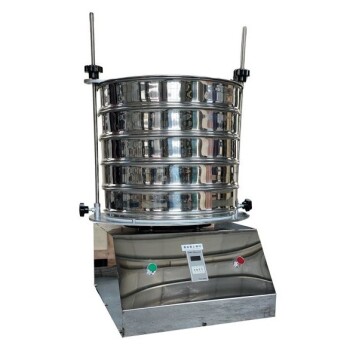
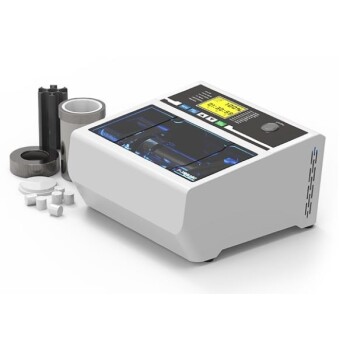
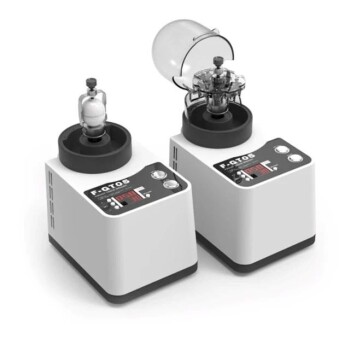
The technical significance lies in the precise isolation of high-activity particulate matter. Micron-level particle screening equipment, such as aerodynamic grading samplers, allows researchers to physically separate welding fume particles with diameters of 1 micron or less ($\le$ 1 $\mu$m). By isolating this specific fraction, you exclude larger, less reactive aggregates and focus exclusively on the fine components that drive physicochemical reactivity and biological impact.
Core Takeaway Screening for micron-level particles is essential because fine particles possess a vastly higher specific surface area than coarse dust. Isolating this fraction ensures that characterization data and catalytic tests accurately reflect the severe health risks and true environmental reactivity of the welding fumes.
The Physics of Particle Isolation
Targeting the Fine Fraction
Welding aerosols are a complex mixture of various particle sizes. Screening equipment is technically critical because it filters out coarse materials to yield a sample consisting strictly of particles $\le$ 1 $\mu$m. This step transforms a heterogeneous mix into a uniform sample suitable for high-precision analysis.
The Role of Aerodynamic Grading
This isolation is typically achieved using aerodynamic grading samplers. Rather than relying on simple physical barriers, these devices separate particles based on their aerodynamic behavior in an airflow. This ensures a more accurate "cut-off" at the 1-micron threshold compared to traditional sieving methods.
Why Micron-Level Precision Matters
Maximizing Specific Surface Area
The primary technical justification for this screening is the specific surface area. Fine particles ($\le$ 1 $\mu$m) have a much larger surface area relative to their mass compared to larger particles. This physical characteristic is the primary driver of chemical interactions and adsorption capabilities.
Assessing True Physicochemical Activity
For applications like environmental air purification, the surface area determines performance. By screening the sample, researchers ensure that subsequent tests—such as ozone decomposition—reflect the activity of the fine solid components. This prevents the results from being diluted by inert, coarse material.
Unveiling Health Risks
From a toxicology perspective, particle size dictates how deep aerosols penetrate the human respiratory system. Focusing on the micron-level fraction allows researchers to characterize the specific particles that pose the greatest health risks. This leads to more relevant safety data than analyzing bulk dust.
Understanding the Trade-offs
Representation vs. Totality
While screening provides deep insight into the most dangerous and reactive particles, it essentially ignores the bulk mass of the fume. This approach is excellent for reactivity studies but does not represent the total volume of waste generated during the welding process.
Analytical Complexity
Using aerodynamic grading samplers adds a layer of technical complexity compared to analyzing raw bulk samples. The equipment requires precise operation to ensure the aerodynamic cut-off point remains stable at exactly 1 micron throughout the sampling period.
Optimizing Your Characterization Strategy
To determine if micron-level screening is strictly necessary for your analysis, evaluate the specific end-goal of your research.
- If your primary focus is Health Risk Assessment: Prioritize micron-level screening, as the $\le$ 1 $\mu$m fraction poses the greatest respiratory and physiological risks.
- If your primary focus is Environmental Catalysis: Use screening to isolate fine particles, ensuring your ozone decomposition tests reflect the true potential of the material's active surface area.
By isolating the micron-level fraction, you transform generic dust analysis into precise data regarding the most chemically active and biologically potent components of welding aerosols.
Summary Table:
| Feature | Micron-Level Screening (≤ 1 µm) | Bulk Sample Analysis |
|---|---|---|
| Particle Focus | High-activity fine particles | Heterogeneous mixture (coarse & fine) |
| Surface Area | Maximized specific surface area | Low relative surface area |
| Primary Goal | Reactivity & Toxicology studies | Total volume & mass assessment |
| Separation Method | Aerodynamic grading samplers | Raw collection / Simple sieving |
| Health Relevance | Deep respiratory penetration risks | General occupational exposure |
Elevate Your Aerosol Research with KINTEK Precision
Ensure the highest accuracy in your welding fume characterization and health risk assessments. KINTEK specializes in advanced laboratory equipment designed for the most demanding research environments. From high-precision sieving equipment and crushing systems to our comprehensive range of high-temperature furnaces, reactors, and cooling solutions, we provide the tools you need to isolate and analyze fine particles with absolute confidence.
Ready to optimize your lab's characterization strategy? Contact our technical experts today to find the perfect solution for your research requirements.
References
- Т. L. Rakitskaya, V. Ya. Volkova. Physicochemical and Catalytic Properties of the Solid Component of Welding Aerosol. DOI: 10.15407/hftp05.04.396
This article is also based on technical information from Kintek Solution Knowledge Base .
Related Products
- Laboratory Test Sieves and Vibratory Sieve Shaker Machine
- Laboratory Test Sieves and Sieving Machines
- Laboratory manual slicer
- Laboratory Micro Horizontal Jar Mill for Precision Sample Preparation in Research and Analysis
- Laboratory Micro Tissue Grinding Mill Grinder
People Also Ask
- How does a laboratory vibratory sieve shaker facilitate the microstructural study of gas-atomized alloy powders?
- What role does a laboratory vibrating sieve shaker play in the LiFePO4 powder processing workflow? Ensure Batch Quality
- What is the use of vibratory sieve shaker? Achieve Precise Particle Size Analysis for Your Lab
- How is a vibratory sieve shaker used in the particle size analysis of mechanically alloyed powders? Expert Guide
- Why use a vibratory sieve shaker for PET powder? Achieve Precise Particle Size Control for Chemical Research