Knowledge What is the temperature of a lab oven? A Guide to Selecting the Right Type for Your Application
Author avatar

Tech Team · Kintek Solution

Updated 6 days ago

What is the temperature of a lab oven? A Guide to Selecting the Right Type for Your Application


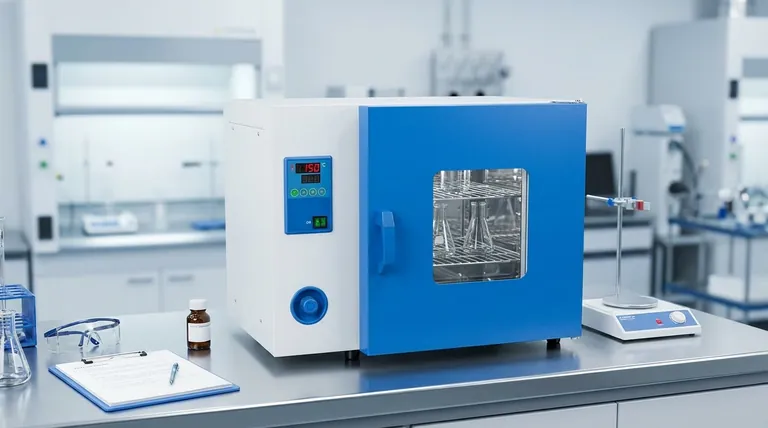
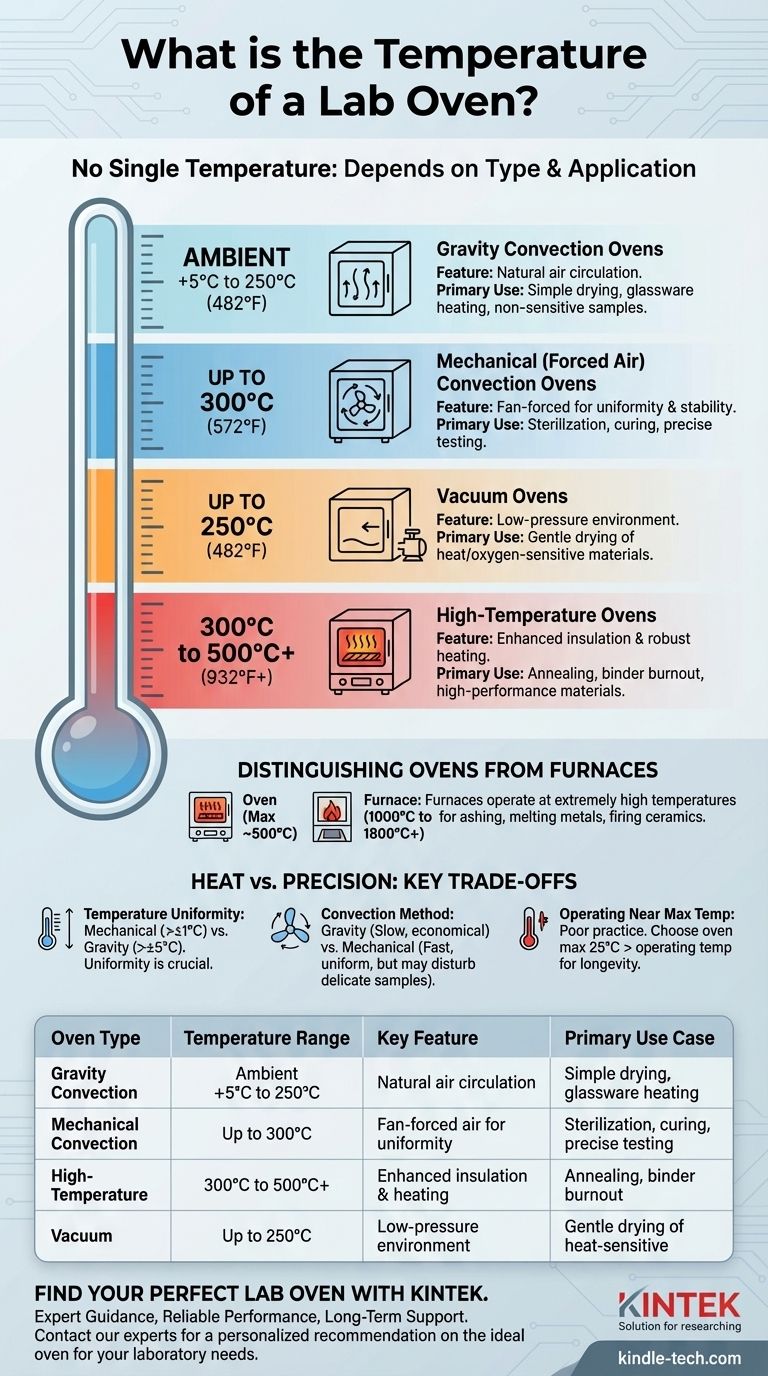
There is no single temperature for a lab oven. The operating temperature is entirely dependent on the oven's specific type and its intended application. A standard laboratory oven can typically range from just above ambient room temperature to around 300°C (572°F), but specialized models are designed for much higher or more controlled conditions.

The critical question is not "What is the temperature of a lab oven?" but rather "Which type of oven provides the specific temperature range, stability, and uniformity required for my scientific process?" Understanding the different classifications is key to selecting the right tool.
What is the temperature of a lab oven? A Guide to Selecting the Right Type for Your Application

Classifying Ovens by Temperature and Function

The term "lab oven" is a broad category. Equipment is designed with different heating methods and temperature capabilities to serve distinct scientific needs, from simple drying to complex materials testing.

General Purpose & Gravity Convection Ovens

These are the most common and economical types of lab ovens. They rely on natural convection, where hot air rises and cooler air sinks to circulate heat.

Their typical temperature range is from ambient +5°C to 250°C (482°F). They are best suited for applications where precise temperature uniformity is not critical, such as drying glassware or performing simple heating processes.

Mechanical (Forced Air) Convection Ovens

These ovens use an internal fan to actively circulate hot air throughout the chamber. This mechanical convection results in far greater temperature uniformity and stability.

The temperature range is often similar to or slightly higher than gravity ovens, typically up to 300°C (572°F). They are the standard for applications requiring repeatable and precise thermal conditions, such as sterilization, component testing, and curing.

High-Temperature Ovens

For processes that exceed the limits of general-purpose ovens, high-temperature models are required. These feature enhanced insulation, more robust heating elements, and advanced controls.

Their operational range typically starts around 300°C and can exceed 500°C (932°F). They are used for demanding applications like annealing, binder burnout, or testing high-performance materials.

Vacuum Ovens

Vacuum ovens are highly specialized. Their primary feature is the ability to heat samples in a low-pressure environment, which allows moisture and solvents to be removed at a much lower temperature.

This prevents damage to heat-sensitive materials and eliminates oxidation during heating. While their temperature range can be up to 250°C (482°F), their main purpose is gentle, non-oxidative drying.

Distinguishing Ovens from Furnaces

It is crucial not to confuse a high-temperature oven with a laboratory furnace. Furnaces operate at extremely high temperatures, often from 1000°C to 1800°C (1832°F to 3272°F), and are used for processes like ashing, melting metals, and firing ceramics.

Understanding the Trade-offs: Heat vs. Precision

Choosing an oven involves balancing performance requirements with practical limitations. The highest temperature is not always the most important factor.

Temperature Range vs. Uniformity

An oven's maximum temperature rating is only part of the story. Temperature uniformity—the variation in temperature at different points within the chamber—is often more critical for reliable results.

A gravity convection oven may have hot and cold spots of ±5°C or more, while a high-quality mechanical convection oven can maintain uniformity of ±1°C.

The Impact of Convection Method

Gravity convection is simple and cost-effective, but the slow air movement can lead to long drying times and inconsistent heating.

Mechanical convection provides speed and uniformity but can be problematic for delicate samples. The airflow can disturb fine powders or dry out biological samples too quickly.

Operating Near Maximum Temperature

It is poor practice to continuously run an oven at its absolute maximum rated temperature. This puts significant strain on the heating elements and control systems, potentially reducing the equipment's lifespan and compromising its stability.

A good rule of thumb is to choose an oven with a maximum temperature at least 25°C higher than your regular operating temperature.

How to Select the Right Oven for Your Application

Now that you understand the different capabilities, you can select the correct tool based on your primary objective.

  • If your primary focus is drying simple glassware or non-sensitive samples: A standard gravity convection oven (up to 250°C) is a cost-effective choice.
  • If your primary focus is precise temperature control for testing, sterilization, or curing: A mechanical (forced air) convection oven (up to 300°C) is essential for its uniformity and stability.
  • If your primary focus is drying heat-sensitive, hygroscopic, or oxygen-sensitive materials: A vacuum oven is the correct tool, as it allows for effective drying at lower temperatures.
  • If your primary focus is high-heat material processing like annealing or ashing: You need a dedicated high-temperature oven (300°C+) or a laboratory furnace (1000°C+).

Choosing the right lab oven begins with clearly defining your process requirements, then selecting the equipment that meets those needs with precision and reliability.

Summary Table:

Oven Type Typical Temperature Range Key Feature Primary Use Case
Gravity Convection Ambient +5°C to 250°C (482°F) Natural air circulation Simple drying, glassware heating
Mechanical Convection Up to 300°C (572°F) Fan-forced air for uniformity Sterilization, curing, precise testing
High-Temperature 300°C to 500°C+ (932°F+) Enhanced insulation & heating Annealing, binder burnout
Vacuum Up to 250°C (482°F) Low-pressure environment Gentle drying of heat-sensitive materials

Find Your Perfect Lab Oven with KINTEK

Selecting the right oven is critical for your lab's accuracy and efficiency. Whether you need a standard drying oven, a high-temperature model for materials testing, or a vacuum oven for sensitive samples, KINTEK has the solution.

We provide:

  • Expert Guidance: Our specialists will help you match the oven type, temperature range, and convection method to your specific application.
  • Reliable Performance: Our lab equipment ensures the temperature uniformity and stability your scientific processes demand.
  • Long-Term Support: We are your partner in maintaining optimal lab performance.

Don't compromise on your results. Contact our experts today for a personalized recommendation on the ideal oven for your laboratory needs.

Visual Guide
What is the temperature of a lab oven? A Guide to Selecting the Right Type for Your Application Visual Guide

Related Products

People Also Ask

Related Products

Laboratory Scientific Electric Heating Blast Drying Oven

Laboratory Scientific Electric Heating Blast Drying Oven

The desktop fast autoclave sterilizer is a compact and reliable device used for rapid sterilization of medical, pharmaceutical, and research items.

1200℃ Muffle Furnace Oven for Laboratory

1200℃ Muffle Furnace Oven for Laboratory

Upgrade your lab with our 1200℃ Muffle Furnace. Achieve fast, precise heating with Japan alumina fibers and Molybdenum coils. Features TFT touch screen controller for easy programming and data analysis. Order now!

Automatic Laboratory Heat Press Machine

Automatic Laboratory Heat Press Machine

Precision automatic heat press machines for labs—ideal for material testing, composites, and R&D. Customizable, safe, and efficient. Contact KINTEK today!

Silicon Carbide SiC Thermal Heating Elements for Electric Furnace

Silicon Carbide SiC Thermal Heating Elements for Electric Furnace

Experience the advantages of Silicon Carbide (SiC) Heating Element: Long service life, high corrosion and oxidation resistance, fast heating speed, and easy maintenance. Learn more now!

Vacuum Heat Treat and Pressure Sintering Furnace for High Temperature Applications

Vacuum Heat Treat and Pressure Sintering Furnace for High Temperature Applications

Vacuum pressure sintering furnaces are designed for high temperature hot pressing applications in metal and ceramic sintering. Its advanced features ensure precise temperature control, reliable pressure maintenance, and a robust design for seamless operation.

Custom PTFE Teflon Parts Manufacturer for PTFE Mesh F4 Sieve

Custom PTFE Teflon Parts Manufacturer for PTFE Mesh F4 Sieve

PTFE mesh sieve is a specialized test sieve designed for particle analysis in various industries, featuring a non-metallic mesh woven from PTFE filament. This synthetic mesh is ideal for applications where metal contamination is a concern . PTFE sieves are crucial for maintaining the integrity of samples in sensitive environments, ensuring accurate and reliable results in particle size distribution analysis.

Laboratory Vibratory Sieve Shaker Machine Slap Vibrating Sieve

Laboratory Vibratory Sieve Shaker Machine Slap Vibrating Sieve

KT-T200TAP is a slapping and oscillating sieving instrument for laboratory desktop use, with 300 rpm horizontal circular motion and 300 vertical slapping motions to simulate manual sieving to help sample particles pass through better.

Lab Internal Rubber Mixer Rubber Kneader Machine for Mixing and Kneading

Lab Internal Rubber Mixer Rubber Kneader Machine for Mixing and Kneading

Lab internal rubber mixer is suitable for mixing, kneading and dispersing various chemical raw materials such as plastics, rubber, synthetic rubber, hot melt adhesive and various low-viscosity materials.

Electric Rotary Kiln Pyrolysis Furnace Plant Machine Calciner Small Rotary Kiln Rotating Furnace

Electric Rotary Kiln Pyrolysis Furnace Plant Machine Calciner Small Rotary Kiln Rotating Furnace

Electric rotary kiln - precisely controlled, it's ideal for calcination and drying of materials like lithium cobalate, rare earths, and non-ferrous metals.

Horizontal High Temperature Graphite Vacuum Graphitization Furnace

Horizontal High Temperature Graphite Vacuum Graphitization Furnace

Horizontal Graphitization Furnace: This type of furnace is designed with the heating elements placed horizontally, allowing for uniform heating of the sample. It's well-suited for graphitizing large or bulky samples that require precise temperature control and uniformity.

Graphite Vacuum Furnace Bottom Discharge Graphitization Furnace for Carbon Materials

Graphite Vacuum Furnace Bottom Discharge Graphitization Furnace for Carbon Materials

Bottom-out graphitization furnace for carbon materials, ultra-high temperature furnace up to 3100°C, suitable for graphitization and sintering of carbon rods and carbon blocks. Vertical design, bottom discharging, convenient feeding and discharging, high temperature uniformity, low energy consumption, good stability, hydraulic lifting system, convenient loading and unloading.

Large Vertical Graphite Vacuum Graphitization Furnace

Large Vertical Graphite Vacuum Graphitization Furnace

A large vertical high-temperature graphitization furnace is a type of industrial furnace used for the graphitization of carbon materials, such as carbon fiber and carbon black. It is a high-temperature furnace that can reach temperatures of up to 3100°C.

Graphite Vacuum Furnace Negative Material Graphitization Furnace

Graphite Vacuum Furnace Negative Material Graphitization Furnace

Graphitization furnace for battery production has uniform temperature and low energy consumption. Graphitization furnace for negative electrode materials: an efficient graphitization solution for battery production and advanced functions to enhance battery performance.

Metallographic Specimen Mounting Machine for Laboratory Materials and Analysis

Metallographic Specimen Mounting Machine for Laboratory Materials and Analysis

Precision metallographic mounting machines for labs—automated, versatile, and efficient. Ideal for sample prep in research and quality control. Contact KINTEK today!

Cylindrical Resonator MPCVD Machine System Reactor for Microwave Plasma Chemical Vapor Deposition and Lab Diamond Growth

Cylindrical Resonator MPCVD Machine System Reactor for Microwave Plasma Chemical Vapor Deposition and Lab Diamond Growth

Learn about Cylindrical Resonator MPCVD Machine, the microwave plasma chemical vapor deposition method used for growing diamond gemstones and films in the jewelry and semi-conductor industries. Discover its cost-effective advantages over traditional HPHT methods.

Custom PTFE Teflon Parts Manufacturer for PTFE Measuring Cylinder 10/50/100ml

Custom PTFE Teflon Parts Manufacturer for PTFE Measuring Cylinder 10/50/100ml

PTFE measuring cylinder are a rugged alternative to traditional glass cylinders. They are chemically inert over a wide temperature range (up to 260º C), have excellent corrosion resistance and maintain a low coefficient of friction, ensuring ease of use and cleaning.

Custom PTFE Teflon Parts Manufacturer for Three-Necked Round Bottom Flask

Custom PTFE Teflon Parts Manufacturer for Three-Necked Round Bottom Flask

PTFE flask, is a versatile laboratory container made from PTFE, offering exceptional chemical resistance, temperature stability, and non-stick properties. Ideal for handling corrosive substances and high-temperature applications, these flasks are essential in various laboratory procedures, including heating, mixing, and storage of chemicals.

Laboratory Multifunctional Small Speed-Adjustable Horizontal Mechanical Shaker for Lab

Laboratory Multifunctional Small Speed-Adjustable Horizontal Mechanical Shaker for Lab

The laboratory multifunctional speed-regulating oscillator is a constant-speed experimental equipment specially developed for modern bioengineering production units.

High-Purity Titanium Foil and Sheet for Industrial Applications

High-Purity Titanium Foil and Sheet for Industrial Applications

Titanium is chemically stable, with a density of 4.51g/cm3, which is higher than aluminum and lower than steel, copper, and nickel, but its specific strength ranks first among metals.

Custom PTFE Teflon Parts Manufacturer for Culture Dish and Evaporation Dish

Custom PTFE Teflon Parts Manufacturer for Culture Dish and Evaporation Dish

The PTFE culture dish evaporating dish is a versatile laboratory tool known for its chemical resistance and high-temperature stability. PTFE, a fluoropolymer, offers exceptional non-stick properties and durability, making it ideal for various applications in research and industry, including filtration, pyrolysis, and membrane technology.


Leave Your Message