Knowledge CVD materials What is the use of diamond in electronics? Powering Next-Generation High-Performance Systems
Author avatar

Tech Team · Kintek Solution

Updated 2 months ago

What is the use of diamond in electronics? Powering Next-Generation High-Performance Systems


In electronics, diamond is primarily used as a specialized semiconductor for applications that require extreme durability and performance, far exceeding the capabilities of silicon. Its main roles are in next-generation power electronics that handle immense voltage and in radiation-hardened sensors designed for harsh environments like outer space or nuclear facilities.

The key to understanding diamond's role is not seeing it as a replacement for silicon, but as a material for the extreme edge cases where silicon fails. Its unique atomic structure gives it an unmatched ability to handle high power, high temperatures, and intense radiation, making it the solution for electronics pushed to their absolute limits.
What is the use of diamond in electronics? Powering Next-Generation High-Performance Systems

The Core Properties Driving Diamond Electronics

While silicon is the workhorse of the modern digital world, diamond is engineered for tasks that would destroy conventional electronics. This capability stems from a few fundamental physical properties.

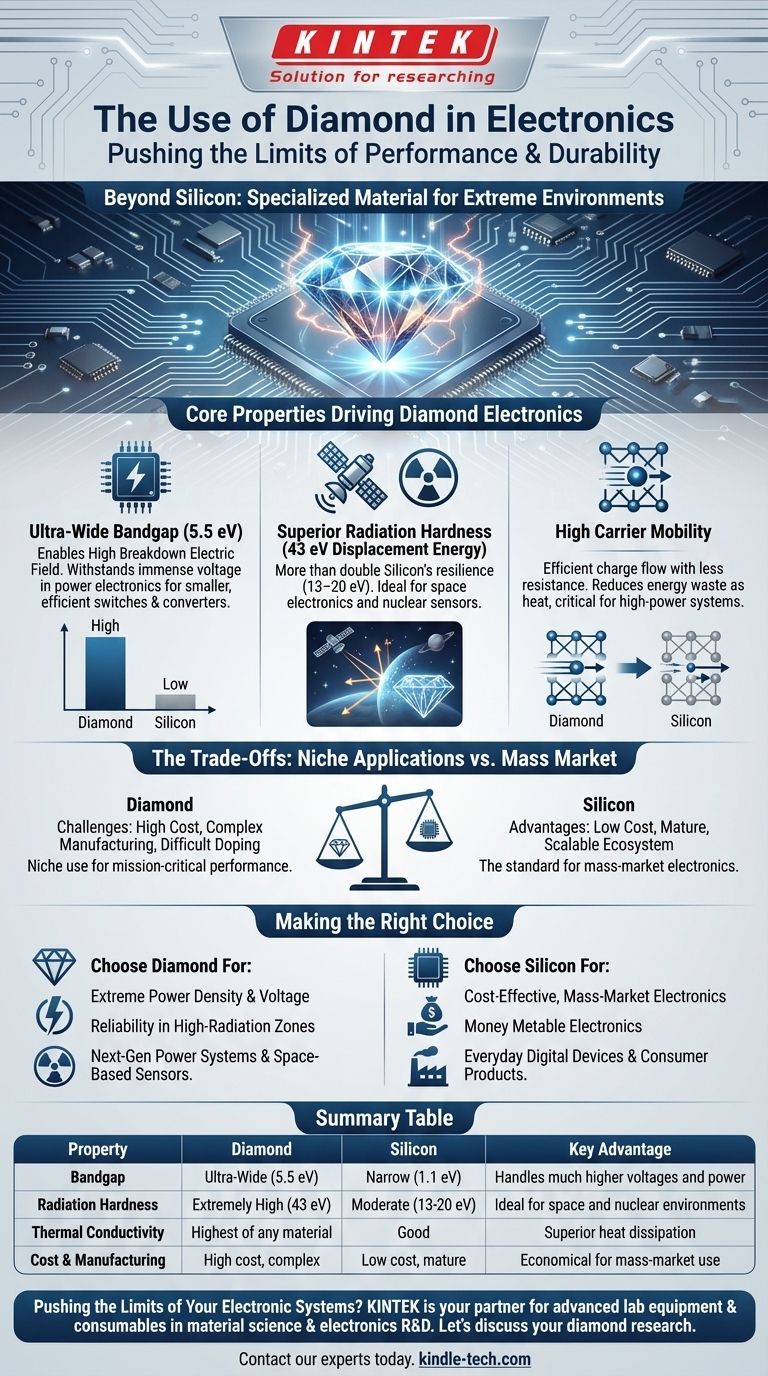
Ultra-Wide Bandgap for High-Power Applications

A material's bandgap determines how much energy is required to make it conduct electricity. Diamond has an "ultra-wide" bandgap.

This wide bandgap gives diamond an extremely high breakdown electric field. In practical terms, this means it can withstand much higher voltages than silicon before it fails and current leaks through.

This property is the foundation for its use in power electronics, enabling the creation of smaller, more efficient, and more powerful switches and converters.

Superior Radiation Hardness

Diamond is exceptionally resistant to damage from radiation. This is measured by its displacement energy—the energy required to knock an atom out of its place in the crystal lattice.

Diamond's displacement energy is 43 eV (electron volts), more than double that of silicon, which is only 13–20 eV.

This makes it an ideal material for outer space electronics, which are constantly bombarded with cosmic rays, and for radiation sensors and dosimeters used in medical and nuclear environments.

High Carrier Mobility for Efficiency

Carrier mobility refers to how quickly charge carriers (like electrons) can move through the semiconductor material when a voltage is applied.

Diamond possesses high carrier mobility, allowing electricity to flow with less resistance.

This leads to more efficient devices that waste less energy as heat, a critical factor in high-power systems where thermal management is a primary concern.

Understanding the Trade-offs

Despite its superior properties, diamond is not poised to replace silicon in all electronics. Its adoption is limited by significant practical and economic challenges.

The Challenge of Cost and Manufacturing

Producing large, perfectly pure, single-crystal diamond wafers suitable for electronics manufacturing is an incredibly difficult and expensive process.

Silicon, by contrast, benefits from decades of optimization, making its manufacturing mature, scalable, and vastly cheaper.

Difficulties in Doping

"Doping" is the process of intentionally introducing impurities into a semiconductor to control its electrical properties. Diamond's extremely dense and rigid crystal structure makes this process much more challenging than with silicon.

This complexity can limit the types of electronic components that can be reliably fabricated using diamond.

A Niche, Not Mainstream, Material

Due to these challenges, diamond remains a niche material. It is reserved for applications where its unique performance benefits are mission-critical and justify the high cost and manufacturing complexity.

Making the Right Choice for Your Goal

The decision to use diamond is a clear trade-off between ultimate performance and practical viability.

  • If your primary focus is extreme power density and voltage: Diamond is the superior choice for next-generation power systems where performance and size reduction outweigh cost.
  • If your primary focus is reliability in high-radiation zones: Diamond's intrinsic hardness makes it the essential material for space-based systems and sensors in nuclear or medical settings.
  • If your primary focus is cost-effective, mass-market electronics: Silicon remains the undisputed standard due to its mature manufacturing ecosystem and unparalleled economic efficiency.

Ultimately, diamond serves not as a replacement for silicon, but as a critical enabler for electronic systems that must operate far beyond conventional limits.

Summary Table:

Property Diamond Silicon Key Advantage
Bandgap Ultra-Wide (5.5 eV) Narrow (1.1 eV) Handles much higher voltages and power
Radiation Hardness Extremely High (43 eV) Moderate (13-20 eV) Ideal for space and nuclear environments
Thermal Conductivity Highest of any material Good Superior heat dissipation
Cost & Manufacturing High cost, complex Low cost, mature Silicon is economical for mass-market use

Pushing the Limits of Your Electronic Systems?

Diamond semiconductors are the solution for applications where extreme performance is non-negotiable. If your research or product development requires electronics that can withstand immense power, intense radiation, or extreme temperatures, KINTEK is your partner.

We specialize in providing advanced lab equipment and consumables for cutting-edge material science and electronics R&D. Let's discuss how our solutions can help you harness the unique properties of diamond for your most demanding projects.

Contact our experts today to explore the possibilities.

Visual Guide
What is the use of diamond in electronics? Powering Next-Generation High-Performance Systems Visual Guide

Related Products

People Also Ask

Related Products

High Precision Diamond Wire Cutting Machine Laboratory Saw Precision Wire EDM Cutting Machine

High Precision Diamond Wire Cutting Machine Laboratory Saw Precision Wire EDM Cutting Machine

The high precision diamond wire cutting machine is a versatile and precise cutting tool designed specifically for material researchers. It utilizes a continuous diamond wire cutting mechanism, enabling precise cutting of brittle materials such as ceramics, crystals, glass, metals, rocks, and various other materials.

12 Inch 24 Inch High Precision Automatic Diamond Wire Cutting Machine Laboratory Saw Precision Wire EDM Cutting Machine

12 Inch 24 Inch High Precision Automatic Diamond Wire Cutting Machine Laboratory Saw Precision Wire EDM Cutting Machine

The high precision automatic diamond wire cutting machine is a versatile cutting tool that uses a diamond wire to cut through a wide range of materials, including conductive and non-conductive materials, ceramics, glass, rocks, gems, jade, meteorites, monocrystalline silicon, silicon carbide, polycrystalline silicon, refractory bricks, epoxy boards, and ferrite bodies. It is especially suitable for cutting various brittle crystals with high hardness, high value, and easy to break.

Precision Wire Saw Laboratory Cutting Machine with 800mm x 800mm Workbench for Diamond Single Wire Circular Small Cutting

Precision Wire Saw Laboratory Cutting Machine with 800mm x 800mm Workbench for Diamond Single Wire Circular Small Cutting

Diamond wire cutting machines are mainly used for precision cutting of ceramics, crystals, glass, metals, rocks, thermoelectric materials, infrared optical materials, composite materials, biomedical materials and other material analysis samples. Especially suitable for precision cutting of ultra-thin plates with thickness up to 0.2mm.

CVD Diamond Optical Windows for Lab Applications

CVD Diamond Optical Windows for Lab Applications

Diamond optical windows: exceptional broad band infrared transparency, excellent thermal conductivity & low scattering in infrared, for high-power IR laser & microwave windows applications.

CVD Diamond Domes for Industrial and Scientific Applications

CVD Diamond Domes for Industrial and Scientific Applications

Discover CVD diamond domes, the ultimate solution for high-performance loudspeakers. Made with DC Arc Plasma Jet technology, these domes deliver exceptional sound quality, durability, and power handling.

CVD Diamond for Thermal Management Applications

CVD Diamond for Thermal Management Applications

CVD diamond for thermal management: High-quality diamond with thermal conductivity up to 2000 W/mK, ideal for heat spreaders, laser diodes, and GaN on Diamond (GOD) applications.

HFCVD Machine System Equipment for Drawing Die Nano-Diamond Coating

HFCVD Machine System Equipment for Drawing Die Nano-Diamond Coating

The nano-diamond composite coating drawing die uses cemented carbide (WC-Co) as the substrate, and uses the chemical vapor phase method ( CVD method for short ) to coat the conventional diamond and nano-diamond composite coating on the surface of the inner hole of the mold.

Microwave Plasma Chemical Vapor Deposition MPCVD Machine System Reactor for Lab and Diamond Growth

Microwave Plasma Chemical Vapor Deposition MPCVD Machine System Reactor for Lab and Diamond Growth

Get high-quality diamond films with our Bell-jar Resonator MPCVD machine designed for lab and diamond growth. Discover how Microwave Plasma Chemical Vapor Deposition works for growing diamonds using carbon gas and plasma.

CVD Diamond Dressing Tools for Precision Applications

CVD Diamond Dressing Tools for Precision Applications

Experience the Unbeatable Performance of CVD Diamond Dresser Blanks: High Thermal Conductivity, Exceptional Wear Resistance, and Orientation Independence.

CVD Diamond Cutting Tool Blanks for Precision Machining

CVD Diamond Cutting Tool Blanks for Precision Machining

CVD Diamond Cutting Tools: Superior Wear Resistance, Low Friction, High Thermal Conductivity for Non-Ferrous Materials, Ceramics, Composites Machining

CVD Diamond Wire Drawing Die Blanks for Precision Applications

CVD Diamond Wire Drawing Die Blanks for Precision Applications

CVD diamond wire drawing die blanks: superior hardness, abrasion resistance, and applicability in wire drawing various materials. Ideal for abrasive wear machining applications like graphite processing.

Laboratory Oscillating Orbital Shaker

Laboratory Oscillating Orbital Shaker

Mixer-OT orbital shaker uses brushless motor, which can run for a long time. It is suitable for vibration tasks of culture dishes, flasks and beakers.

Laboratory CVD Boron Doped Diamond Materials

Laboratory CVD Boron Doped Diamond Materials

CVD boron-doped diamond: A versatile material enabling tailored electrical conductivity, optical transparency, and exceptional thermal properties for applications in electronics, optics, sensing, and quantum technologies.

Custom CVD Diamond Coating for Lab Applications

Custom CVD Diamond Coating for Lab Applications

CVD Diamond Coating: Superior Thermal Conductivity, Crystal Quality, and Adhesion for Cutting Tools, Friction, and Acoustic Applications

Silicon Carbide (SIC) Ceramic Sheet Wear-Resistant Engineering Advanced Fine Ceramics

Silicon Carbide (SIC) Ceramic Sheet Wear-Resistant Engineering Advanced Fine Ceramics

Silicon carbide (sic) ceramic sheet is composed of high-purity silicon carbide and ultra-fine powder, which is formed by vibration molding and high-temperature sintering.

Reference Electrode Calomel Silver Chloride Mercury Sulfate for Laboratory Use

Reference Electrode Calomel Silver Chloride Mercury Sulfate for Laboratory Use

Find high-quality reference electrodes for electrochemical experiments with complete specifications. Our models offer resistance to acid and alkali, durability, and safety, with customization options available to meet your specific needs.

Optical Window Glass Substrate Wafer Quartz Plate JGS1 JGS2 JGS3

Optical Window Glass Substrate Wafer Quartz Plate JGS1 JGS2 JGS3

The quartz plate is a transparent, durable, and versatile component widely used in various industries. Made from high-purity quartz crystal, it exhibits excellent thermal and chemical resistance.

Professional Cutting Tools for Carbon Paper Cloth Diaphragm Copper Aluminum Foil and More

Professional Cutting Tools for Carbon Paper Cloth Diaphragm Copper Aluminum Foil and More

Professional tools for cutting lithium sheets, carbon paper, carbon cloth, separators, copper foil, aluminum foil, etc., with round and square shapes and different sizes of blades.

Silicon Carbide (SIC) Ceramic Plate for Engineering Advanced Fine Ceramics

Silicon Carbide (SIC) Ceramic Plate for Engineering Advanced Fine Ceramics

Silicon nitride (sic) ceramic is an inorganic material ceramic that does not shrink during sintering. It is a high-strength, low-density, high-temperature-resistant covalent bond compound.

Hexagonal Boron Nitride HBN Ceramic Ring

Hexagonal Boron Nitride HBN Ceramic Ring

Boron nitride ceramic (BN) rings are commonly used in high temperature applications such as furnace fixtures, heat exchangers and semiconductor processing.


Leave Your Message