Knowledge Resources What is the use of furnace in a laboratory? Essential Tool for Material Transformation
Author avatar

Tech Team · Kintek Solution

Updated 2 months ago

What is the use of furnace in a laboratory? Essential Tool for Material Transformation


In a modern laboratory, a furnace is far more than a simple oven. It is a critical instrument used for high-temperature thermal processing, designed to fundamentally alter the physical or chemical properties of a material. From creating advanced ceramics and treating metals to preparing samples for analysis, furnaces enable a vast range of scientific and industrial applications by applying precise and controlled heat.

The central purpose of a laboratory furnace is not just to heat a sample, but to execute a specific thermal process. Understanding your end goal—whether it's removing moisture, hardening a metal, or synthesizing a new compound—is the key to selecting and using the right type of furnace.
What is the use of furnace in a laboratory? Essential Tool for Material Transformation

The Core Principle: Controlled Thermal Processing

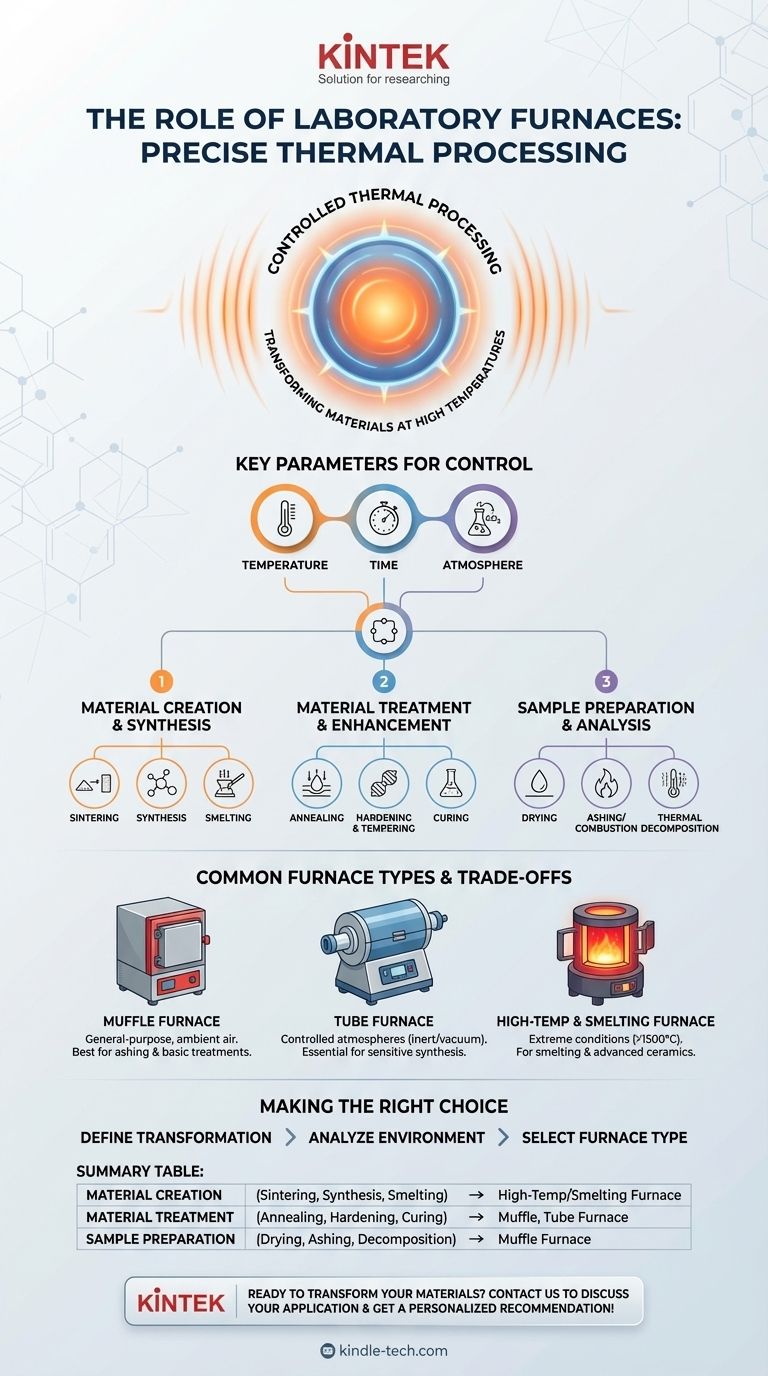
A furnace gives researchers and technicians precise control over a material's transformation. This is achieved by manipulating the key variables of any thermal process.

Changing a Material's Properties

Nearly every use of a laboratory furnace comes down to changing a material in a predictable way. This can mean making a metal harder, a ceramic denser, or breaking a compound down into its basic components.

Key Parameters: Temperature, Time, and Atmosphere

The outcome of a process is determined by temperature (how hot), time (how long), and atmosphere (the gases surrounding the sample). An open-air furnace behaves very differently from a vacuum or inert gas furnace, even at the same temperature.

Primary Applications Across Disciplines

The applications for laboratory furnaces are incredibly broad, spanning fields from metallurgy and materials science to chemistry and geology. They can be grouped into three main categories.

Material Creation and Synthesis

Many processes use heat to combine or compact raw ingredients into a finished material.

  • Sintering: Fusing powders together to create a solid, dense object, such as producing technical ceramics or parts via powder metallurgy.
  • Synthesis: Performing chemical reactions at high temperatures to create new inorganic or organic compounds.
  • Smelting: Extracting a metal from its ore by heating it beyond its melting point.

Material Treatment and Enhancement

These processes modify the properties of an existing material to improve its performance.

  • Annealing: Heating and slowly cooling a material (usually metal or glass) to remove internal stresses and increase ductility.
  • Hardening & Tempering: A two-step process to increase the hardness and toughness of metals.
  • Curing: Using heat to trigger a chemical reaction that solidifies a material, such as an epoxy or polymer.

Sample Preparation and Analysis

Furnaces are also essential tools for preparing samples for further testing.

  • Drying: Gently heating a sample to remove residual moisture without otherwise changing it.
  • Ashing / Combustion: Burning off all organic material at a high temperature to determine the amount of inorganic residue.
  • Thermal Decomposition: Breaking down a compound into simpler substances to analyze its composition.

Understanding the Trade-offs: Common Furnace Types

Different thermal processes require different types of furnaces. Choosing the wrong one can lead to failed experiments and damaged materials.

Muffle Furnaces: The General-Purpose Workhorse

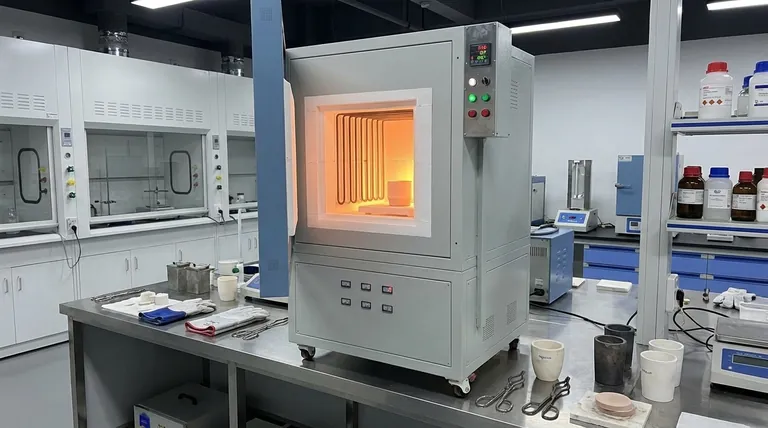
A muffle furnace is the most common type, featuring an insulated chamber that heats a sample in ambient air. It is ideal for general-purpose applications like ashing, basic heat treatments, and material testing where a controlled atmosphere is not needed.

Tube Furnaces: For Controlled Atmospheres

A tube furnace contains the sample within a cylindrical tube, which can be sealed and filled with a specific gas (like argon or nitrogen) or put under a vacuum. This is essential for preventing oxidation and for processes like the synthesis of air-sensitive compounds.

High-Temperature & Smelting Furnaces: For Extreme Conditions

These specialized units are built with advanced refractory materials and heating elements to safely reach extreme temperatures, often above 1500°C. They are primarily used for smelting metals, firing advanced ceramics, and conducting high-temperature materials research.

Making the Right Choice for Your Goal

To select the correct instrument, first define the transformation you need to achieve.

  • If your primary focus is routine sample preparation and analysis: A general-purpose muffle furnace for ashing, drying, or basic heat treatment is often sufficient.
  • If your primary focus is synthesizing materials or heat treating in a specific environment: A tube furnace is necessary for its ability to control the atmosphere with an inert gas or a vacuum.
  • If your primary focus is metallurgy or creating advanced ceramics: A specialized high-temperature or smelting furnace designed to reach extreme temperatures safely is required.

Ultimately, selecting the right furnace is about precisely matching the tool to the desired transformation of your material.

Summary Table:

Application Category Key Processes Common Furnace Type
Material Creation Sintering, Synthesis, Smelting High-Temperature/Smelting Furnace
Material Treatment Annealing, Hardening, Curing Muffle Furnace, Tube Furnace
Sample Preparation Drying, Ashing, Thermal Decomposition Muffle Furnace

Ready to transform your materials with precision?

At KINTEK, we specialize in providing the right laboratory furnace for your specific needs—whether it's a robust muffle furnace for routine ashing or a sophisticated tube furnace for sensitive synthesis under controlled atmospheres. Our experts will help you select the ideal equipment to achieve precise thermal processing, enhance your research outcomes, and boost lab efficiency.

Contact us today via our [#ContactForm] to discuss your application and get a personalized recommendation!

Visual Guide
What is the use of furnace in a laboratory? Essential Tool for Material Transformation Visual Guide

Related Products

People Also Ask

Related Products

1200℃ Muffle Furnace Oven for Laboratory

1200℃ Muffle Furnace Oven for Laboratory

Upgrade your lab with our 1200℃ Muffle Furnace. Achieve fast, precise heating with Japan alumina fibers and Molybdenum coils. Features TFT touch screen controller for easy programming and data analysis. Order now!

Vertical Laboratory Tube Furnace

Vertical Laboratory Tube Furnace

Elevate your experiments with our Vertical Tube Furnace. Versatile design allows for operation under various environments and heat treatment applications. Order now for precise results!

1700℃ Laboratory High Temperature Tube Furnace with Alumina Tube

1700℃ Laboratory High Temperature Tube Furnace with Alumina Tube

Looking for a high-temperature tube furnace? Check out our 1700℃ Tube Furnace with Alumina Tube. Perfect for research and industrial applications up to 1700C.

Laboratory Vacuum Tilt Rotary Tube Furnace Rotating Tube Furnace

Laboratory Vacuum Tilt Rotary Tube Furnace Rotating Tube Furnace

Discover the versatility of Laboratory Rotary Furnace: Ideal for calcination, drying, sintering, and high-temperature reactions. Adjustable rotating and tilting functions for optimal heating. Suitable for vacuum and controlled atmosphere environments. Learn more now!

1200℃ Split Tube Furnace with Quartz Tube Laboratory Tubular Furnace

1200℃ Split Tube Furnace with Quartz Tube Laboratory Tubular Furnace

KT-TF12 split tube furnace: high-purity insulation, embedded heating wire coils, and max. 1200C. Widely used for new materials and chemical vapour deposition.

1700℃ Muffle Oven Furnace for Laboratory

1700℃ Muffle Oven Furnace for Laboratory

Get superior heat control with our 1700℃ Muffle Furnace. Equipped with intelligent temperature microprocessor, TFT touch screen controller & advanced insulation materials for precise heating up to 1700C. Order now!

1400℃ Muffle Oven Furnace for Laboratory

1400℃ Muffle Oven Furnace for Laboratory

Get precise high-temperature control up to 1500℃ with KT-14M Muffle furnace. Equipped with a smart touch screen controller and advanced insulation materials.

High Temperature Muffle Oven Furnace for Laboratory Debinding and Pre Sintering

High Temperature Muffle Oven Furnace for Laboratory Debinding and Pre Sintering

KT-MD High temperature debinding and pre-sintering furnace for ceramic materials with various molding processes. Ideal for electronic components such as MLCC and NFC.

Lab-Scale Vacuum Induction Melting Furnace

Lab-Scale Vacuum Induction Melting Furnace

Get precise alloy composition with our Vacuum Induction Melting Furnace. Ideal for aerospace, nuclear energy, and electronic industries. Order now for effective smelting and casting of metals and alloys.

Multi-zone Laboratory Tube Furnace

Multi-zone Laboratory Tube Furnace

Experience precise, efficient thermal testing with our Multi Zone Tube Furnace. Independent heating zones and temperature sensors allow for controlled high-temperature gradient heating fields. Order now for advanced thermal analysis!

Laboratory Rapid Thermal Processing (RTP) Quartz Tube Furnace

Laboratory Rapid Thermal Processing (RTP) Quartz Tube Furnace

Get lightning-fast heating with our RTP Rapid Heating Tube Furnace. Designed for precise, high-speed heating and cooling with convenient sliding rail and TFT touch screen controller. Order now for ideal thermal processing!

Laboratory Muffle Oven Furnace Bottom Lifting Muffle Furnace

Laboratory Muffle Oven Furnace Bottom Lifting Muffle Furnace

Efficiently produce batches with excellent temperature uniformity using our Bottom Lifting Furnace. Features two electric lifting stages and advanced temperature control up to 1600℃.

Graphite Vacuum Furnace IGBT Experimental Graphitization Furnace

Graphite Vacuum Furnace IGBT Experimental Graphitization Furnace

IGBT experimental graphitization furnace, a tailored solution for universities and research institutions, with high heating efficiency, user-friendliness, and precise temperature control.

Small Vacuum Heat Treat and Tungsten Wire Sintering Furnace

Small Vacuum Heat Treat and Tungsten Wire Sintering Furnace

The small vacuum tungsten wire sintering furnace is a compact experimental vacuum furnace specially designed for universities and scientific research institutes. The furnace features a CNC welded shell and vacuum piping to ensure leak-free operation. Quick-connect electrical connections facilitate relocation and debugging, and the standard electrical control cabinet is safe and convenient to operate.

Vertical High Temperature Graphite Vacuum Graphitization Furnace

Vertical High Temperature Graphite Vacuum Graphitization Furnace

Vertical high temperature graphitization furnace for carbonization and graphitization of carbon materials up to 3100℃.Suitable for shaped graphitization of carbon fiber filaments and other materials sintered in a carbon environment.Applications in metallurgy, electronics, and aerospace for producing high-quality graphite products like electrodes and crucibles.

Controlled Nitrogen Inert Hydrogen Atmosphere Furnace

Controlled Nitrogen Inert Hydrogen Atmosphere Furnace

KT-AH Hydrogen atmosphere furnace - induction gas furnace for sintering/annealing with built-in safety features, dual housing design, and energy-saving efficiency. Ideal for lab and industrial use.

1700℃ Controlled Atmosphere Furnace Nitrogen Inert Atmosphere Furnace

1700℃ Controlled Atmosphere Furnace Nitrogen Inert Atmosphere Furnace

KT-17A Controlled atmosphere furnace: 1700℃ heating, vacuum sealing technology, PID temperature control, and versatile TFT smart touch screen controller for laboratory and industrial use.

Ultra-High Temperature Graphite Vacuum Graphitization Furnace

Ultra-High Temperature Graphite Vacuum Graphitization Furnace

The ultra-high temperature graphitization furnace utilizes medium frequency induction heating in a vacuum or inert gas environment. The induction coil generates an alternating magnetic field, inducing eddy currents in the graphite crucible, which heats up and radiates heat to the workpiece, bringing it to the desired temperature. This furnace is primarily used for graphitization and sintering of carbon materials, carbon fiber materials, and other composite materials.

1200℃ Controlled Atmosphere Furnace Nitrogen Inert Atmosphere Furnace

1200℃ Controlled Atmosphere Furnace Nitrogen Inert Atmosphere Furnace

Discover our KT-12A Pro Controlled atmosphere furnace - high precision, heavy duty vacuum chamber, versatile smart touch screen controller, and excellent temperature uniformity up to 1200C. Ideal for both laboratory and industrial application.

Graphite Vacuum Furnace Bottom Discharge Graphitization Furnace for Carbon Materials

Graphite Vacuum Furnace Bottom Discharge Graphitization Furnace for Carbon Materials

Bottom-out graphitization furnace for carbon materials, ultra-high temperature furnace up to 3100°C, suitable for graphitization and sintering of carbon rods and carbon blocks. Vertical design, bottom discharging, convenient feeding and discharging, high temperature uniformity, low energy consumption, good stability, hydraulic lifting system, convenient loading and unloading.


Leave Your Message



















