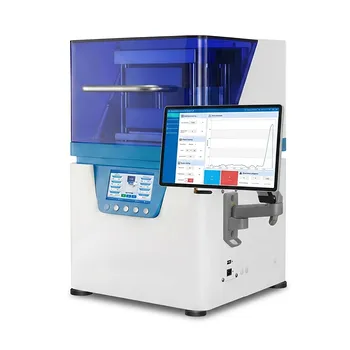
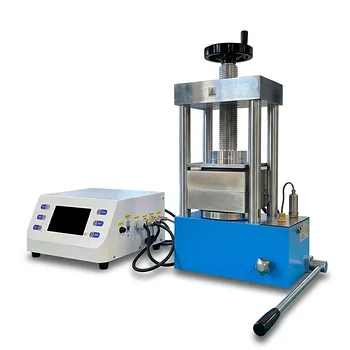
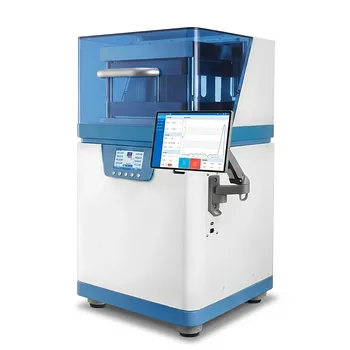
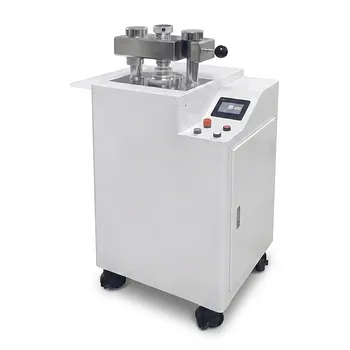
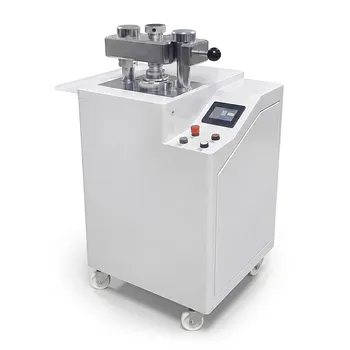
In the fabrication of Li5FeO4 cathode sheets, the laboratory hydraulic press acts as the primary tool for mechanical densification and interfacial bonding. By applying precise, high-pressure compaction, the press transforms loose mixtures of active materials, conductive agents, and binders into a dense, cohesive electrode film. This physical role is critical for ensuring the cathode remains structurally intact and electrically conductive during battery operation.
The laboratory hydraulic press bridges the gap between raw powder components and a functional electrode by eliminating internal voids and welding the material to the current collector. This process is essential for minimizing interfacial resistance and maximizing the volumetric energy density of the Li5FeO4 cell.
Achieving Structural Integrity and Adhesion
Bonding the Composite to the Current Collector
The hydraulic press applies controlled vertical pressure to compact the Li5FeO4 powder mixture onto an aluminum mesh or foil current collector. This process ensures that the active materials are securely bonded to the substrate, providing the mechanical foundation needed for long-term cycling.
Without this high-pressure physical molding, the coating would likely delaminate or peel away from the collector during the physical stresses of electrochemical testing.
Elimination of Internal Voids
The compression process eliminates internal gaps and air pockets between the Li5FeO4 particles, conductive additives, and binders. By removing these voids, the press creates a continuous, high-density pellet or sheet that is far more stable than a loose powder coating.
This compaction provides a physical foundation for continuous ionic and electronic conduction paths throughout the electrode structure.
Enhancing Electrochemical Performance
Reduction of Interfacial Contact Resistance
One of the most critical roles of the hydraulic press is the significant reduction of ohmic and interfacial contact resistance. By forcing the active material into intimate contact with the conductive carbon black and the aluminum current collector, the press establishes efficient electronic pathways.
This tight contact ensures that electrons can flow freely through the electrode, which is vital for maintaining performance during high-current charge and discharge cycles.
Maximizing Volumetric Energy Density
Applying precise linear pressure allows researchers to achieve high area loading, which increases the overall energy density of the battery. Compressing the material reduces the volume of the cathode without sacrificing the amount of active Li5FeO4 present.
This high-pressure molding is essential for transforming a porous, inefficient layer into a high-performance electrode capable of meeting modern energy storage requirements.
Understanding the Trade-offs
The Risk of Excessive Pressure
While high pressure is necessary for density, exceeding the material's structural limits can be counterproductive. Applying too much pressure may crush the active material particles or damage the delicate aluminum current collector, leading to premature failure.
Furthermore, over-compaction can reduce the porosity of the cathode to the point where electrolyte penetration is hindered, negatively impacting the battery's rate performance.
Insufficient Compaction Pitfalls
Conversely, using inadequate pressure results in high internal resistance and poor mechanical stability. A loosely compacted Li5FeO4 sheet will suffer from poor electronic contact, leading to rapid capacity fade and potential delamination during the initial cycles of testing.
How to Apply This to Your Project
Recommendations for Pressing Strategy
- If your primary focus is maximizing cycle life: Prioritize a pressure setting that ensures total adhesion of the Li5FeO4 to the aluminum mesh to prevent delamination during long-term testing.
- If your primary focus is high-rate performance: Optimize the pressure to balance high conductivity with enough residual porosity to allow for rapid electrolyte diffusion.
- If your primary focus is volumetric energy density: Use precision molds and higher static pressure to eliminate all possible voids and create the thinnest, most dense electrode possible.
The laboratory hydraulic press is the indispensable bridge that converts raw chemical components into a mechanically stable and electrochemically efficient Li5FeO4 electrode.
Summary Table:
| Physical Role | Key Benefit | Impact on Battery Performance |
|---|---|---|
| Mechanical Densification | Eliminates internal voids and air pockets | Increases volumetric energy density |
| Interfacial Bonding | Secures active material to current collector | Prevents delamination and structural failure |
| Contact Improvement | Reduces ohmic and interfacial resistance | Enhances electronic conductivity and rate performance |
| Structural Molding | Creates a cohesive, high-density film | Ensures long-term mechanical stability during cycling |
Elevate Your Battery Research with KINTEK Precision
Achieving the perfect balance of density and porosity is critical for high-performance Li5FeO4 cathode sheets. KINTEK specializes in high-precision laboratory equipment, offering a robust range of hydraulic presses (pellet, hot, and isostatic) tailored for advanced material research.
Our solutions ensure your electrodes benefit from superior interfacial bonding and minimal contact resistance, maximizing your cell's energy density and cycle life. Beyond presses, we provide a complete ecosystem for battery development, including high-temperature furnaces, crushing and milling systems, and specialized electrolytic cells.
Ready to optimize your electrode fabrication? Contact our technical experts today to find the ideal pressing solution for your laboratory needs!
References
- Hiroaki Kobayashi, Itaru Honma. Metastable Cubic Structure Exceeds Capacity Limit of Antifluorite Li<sub>5</sub>FeO<sub>4</sub> Cathode Using Small Polarized Oxygen Redox. DOI: 10.1002/aenm.202203441
This article is also based on technical information from Kintek Solution Knowledge Base .
Related Products
- Fully Automatic Heated Hydraulic Lab Press for Materials Sintering and Sample Preparation
- Heated Hydraulic Press Machine with Integrated Manual Heated Plates for Lab Use
- Manual Lab Heat Press
- Laboratory Manual Hydraulic Pellet Press for Lab Use
- Hydraulic Diaphragm Lab Filter Press for Laboratory Filtration
People Also Ask
- How is a laboratory hydraulic press used in the preparation of modified biochar samples for FTIR analysis? Expert Guide
- How does a laboratory heating hydraulic press contribute to the preparation of recycled graphite green bodies? - Optimize Density.
- How does the laboratory hydraulic press contribute to the preparation of solid targets for laser ablation?
- What role does a laboratory hydraulic press play in perovskite-MOF glass fabrication? Master Material Densification
- Why use a laboratory hydraulic press for Fe2O3-CoP conductivity? Achieve Precise Material Characterization