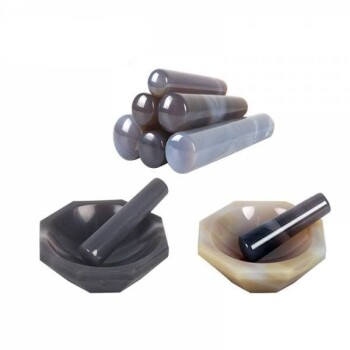
In the assembly of N-CoOx and activated carbon asymmetric supercapacitors, the agate mortar serves as a critical processing tool for preparing the negative electrode slurry. Its primary function is to mechanically grind the activated carbon, conductive agents, and binders into a single, cohesive mixture. This step is not merely about combination, but about achieving the high degree of microscopic uniformity necessary for the device to function effectively.
The physical consistency of the electrode slurry directly dictates the electrochemical efficiency of the device. Thorough mechanical mixing reduces internal resistance, which is a prerequisite for achieving high power density and long-term cycling stability.
The Mechanics of Slurry Preparation
Achieving Microscopic Uniformity
The assembly of an effective negative electrode begins with the raw materials: activated carbon (AC), conductive agents, and binders. Simply stirring these components together is insufficient for high-performance applications.
You must use an agate mortar to thoroughly grind these materials. This process breaks down agglomerates and ensures that the conductive agents are evenly distributed throughout the active carbon matrix.
The Function of the Agate Mortar
The agate mortar is chosen for its hardness and chemical inertness, preventing contamination during the vigorous grinding process.
By subjecting the mixture to manual or mechanical grinding in this vessel, you force the binder to coat the active particles evenly. This creates a structural network that holds the electrode together without blocking the electrochemical active sites.
Connecting Process to Performance
Reducing Internal Resistance
The primary electrochemical benefit of this physical mixing is the minimization of internal resistance.
When components are mixed at a high level of uniformity, electrons can move freely between the carbon particles and the current collector. Poorly mixed slurries create "dead zones" of high resistance, which act as bottlenecks for energy storage and release.
Enhancing Power Density
Power density refers to how quickly a device can deliver energy. Because thorough grinding reduces resistance, the device can discharge energy much faster.
The primary reference confirms that fine physical mixing is essential for improving the overall power density of the resulting electrochemical device.
Ensuring Cycling Stability
Stability refers to the device's ability to recharge and discharge repeatedly without degrading.
A uniform mixture ensures that mechanical stresses during charge cycles are distributed connectedly. This prevents the electrode material from delaminating or cracking, thereby securing the device's long-term cycling stability.
Understanding the Constraints
Manual Variability
While agate mortars are effective, they often rely on manual operation in laboratory settings.
This introduces a variable of human consistency; one batch may be ground slightly more thoroughly than another. This can lead to minor variances in performance between different device batches.
Scalability Limits
The agate mortar is a tool primarily suited for research and small-scale prototyping.
For large-scale manufacturing, this grinding process must be replicated by industrial ball milling or planetary mixing to achieve the same results. However, the principle remains the same: physical uniformity is non-negotiable.
Making the Right Choice for Your Goal
To maximize the performance of your asymmetric supercapacitor, consider how your mixing technique aligns with your specific objectives.
- If your primary focus is High Power Density: Ensure the conductive agents are ground aggressively to maximize contact points and minimize electrical resistance.
- If your primary focus is Long-term Stability: Focus on the uniform distribution of the binder during grinding to maintain structural integrity over thousands of cycles.
The effectiveness of your supercapacitor is often determined before the device is even assembled, in the physical quality of the electrode slurry.
Summary Table:
| Process Component | Role in Supercapacitor Assembly | Impact on Performance |
|---|---|---|
| Agate Mortar | Mechanical grinding of AC, binders, and agents | Ensures microscopic uniformity and material purity |
| Slurry Mixing | Breaking down agglomerates and coating particles | Minimizes internal resistance for faster electron flow |
| Binder Distribution | Creating a structural network within the matrix | Enhances long-term cycling stability and durability |
| Conductive Network | Even distribution of conductive agents | Boosts power density by eliminating high-resistance zones |
Elevate Your Energy Storage Research with KINTEK Precision
The performance of your N-CoOx and AC supercapacitors starts with the quality of your materials. KINTEK specializes in providing the high-performance laboratory equipment essential for advanced electrode preparation, including premium agate mortars, high-precision crushing and milling systems, and specialized hydraulic presses for pelletizing.
Whether you are optimizing for power density or long-term cycling stability, our comprehensive portfolio—from battery research tools to high-temperature furnaces—ensures your lab has the consistency and reliability required for breakthrough results.
Ready to minimize internal resistance and maximize efficiency? Contact KINTEK today to discover how our expert solutions can support your material science and energy storage goals.
References
- Qi Wang, Zhou Wang. Plasma-Engineered N-CoOx Nanowire Array as a Bifunctional Electrode for Supercapacitor and Electrocatalysis. DOI: 10.3390/nano12172984
This article is also based on technical information from Kintek Solution Knowledge Base .
Related Products
- Nature Agate Mortar and Pestle for Grinding and Mixing
- Laboratory Jar Mill with Agate Grinding Jar and Balls
People Also Ask
- Why are agate mortars and pestles used for grinding iron oxide? Ensure Sample Purity for XRD Analysis
- What is the function of an agate mortar and pestle? Ensure Purity in Halide Solid-State Electrolyte Synthesis
- What is the primary function of an agate mortar and pestle? Optimize VO2+ CaZn2(PO4)2 Nanopowder Pre-Treatment
- Why is an agate mortar and pestle required for grinding Zr3(Al1-xSix)C2? Ensure Maximum Sample Purity
- Why is an agate mortar and pestle preferred for grinding MAX phase? Ensure Sample Purity & Zero Contamination