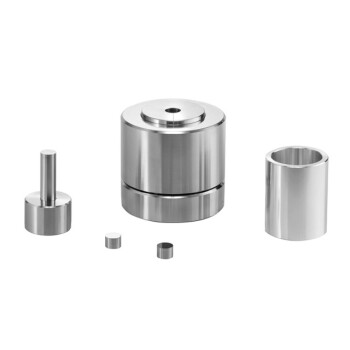
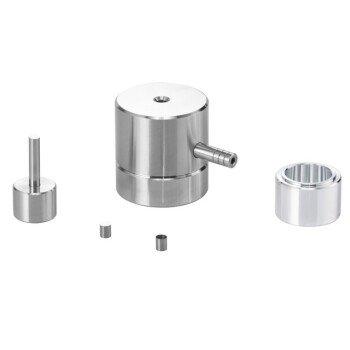
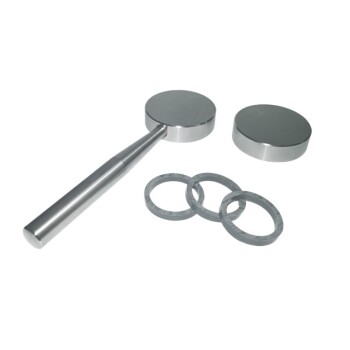
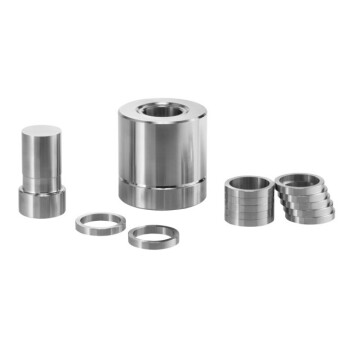
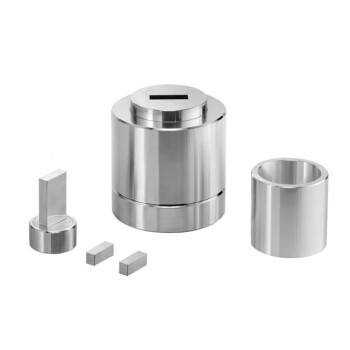
Graphite molds serve as the critical shaping and processing vessel in the fabrication of graphite film and copper (GFs/CFs) layered composites. They are responsible for housing the alternating layers of graphite and copper preforms, transmitting the necessary mechanical pressure, and ensuring structural stability while enduring processing temperatures as high as 1150°C.
The Core Insight Graphite molds act as more than just passive containers; they are active thermal components in the manufacturing process. Their high thermal conductivity ensures the uniform heat distribution required for consistent bonding, while their inherent self-lubricating properties prevent the copper layers from adhering to the mold, ensuring the final composite can be removed without damage.
The Functional Mechanics of the Mold
Precision Containment and Shaping
The primary function of the graphite mold is to define the geometry of the composite.
In the GFs/CFs process, the mold houses alternating layers of graphite film and copper. It must maintain high dimensional stability to ensure these layers align perfectly during the transition from loose preforms to a solid composite.
High-Temperature Structural Integrity
The fabrication process involves extreme thermal environments, specifically temperatures reaching 1150°C.
Standard metals would soften or deform under these conditions. Graphite retains its mechanical strength at these elevated temperatures, ensuring the mold does not collapse or warp while the composite inside is being processed.
Mechanical Pressure Transmission
Achieving a dense, high-quality composite requires significant mechanical pressure to eliminate interlayer gaps.
The graphite mold acts as the transmission medium, transferring force from the press (often a hydraulic ram) directly to the layered materials. It withstands this compressive force without fracturing, ensuring the pressure is applied evenly across the surface of the films.
Thermal Dynamics and Surface Chemistry
Uniform Heat Distribution
Graphite possesses exceptional thermal conductivity.
During the hot pressing process, the mold absorbs heat and distributes it evenly across the copper and graphite layers. This prevents localized "hot spots" or "cold spots," which is critical for achieving uniform melting and bonding throughout the composite structure.
Self-Lubrication and Demolding
One of the most valuable properties of graphite in this application is its self-lubricating nature.
At high temperatures, metallic copper becomes soft and sticky. Graphite is naturally non-stick and chemically inert regarding copper, preventing the metal from fusing to the mold walls. This facilitates easy demolding, allowing the finished composite to be removed cleanly without surface damage.
Understanding the Trade-offs
Oxidation Vulnerability
While graphite is thermally stable in a vacuum or inert gas, it is highly susceptible to oxidation in air at high temperatures.
If the protective vacuum environment is compromised, the mold can degrade rapidly. This necessitates strict control of the vacuum hot pressing environment to preserve the mold's lifespan and dimensional accuracy.
Mechanical Wear and Lifespan
Graphite is a consumable tooling material.
Despite its high-temperature strength, it is brittle compared to metals and faces gradual wear from repeated thermal cycling and mechanical pressure. Over time, the mold surfaces may erode, potentially affecting the surface finish or dimensional tolerances of the GFs/CFs composite.
Maximizing Composite Quality
To ensure the successful preparation of graphite film and copper composites, consider the following based on your specific processing goals:
- If your primary focus is Interfacial Bonding: Ensure the graphite mold design allows for uniform uniaxial pressure transmission to eliminate gaps between the copper and graphite layers.
- If your primary focus is Surface Finish: Rely on the high-purity and self-lubricating properties of the graphite to prevent copper adhesion, ensuring a clean release after sintering.
- If your primary focus is Process Efficiency: Utilize the high thermal conductivity of the mold to speed up heating cycles, but maintain a strict vacuum to prevent mold oxidation and extend tool life.
The graphite mold is the guarantor of the composite's structural integrity, bridging the gap between raw layered materials and a high-performance finished product.
Summary Table:
| Functional Aspect | Role in GFs/CFs Fabrication | Benefit to Composite |
|---|---|---|
| Structural Containment | Defines geometry and layer alignment | Precise dimensional stability and shape |
| Pressure Transmission | Transfers force from hydraulic press to layers | Eliminates gaps for a dense, high-quality bond |
| Thermal Conductivity | Distributes heat evenly at 1150°C | Prevents hot spots for uniform material bonding |
| Surface Chemistry | Self-lubricating and non-stick properties | Ensures easy demolding without surface damage |
| Thermal Stability | Retains mechanical strength at high temperatures | Maintains mold integrity during hot pressing |
Optimize Your Composite Fabrication with KINTEK
Maximize the precision of your GFs/CFs layered composites with KINTEK’s high-performance laboratory solutions. We specialize in the essential tools required for advanced material research, including high-temperature furnaces (vacuum, induction, and atmosphere) and precision hydraulic presses designed to work seamlessly with graphite tooling.
Whether you are refining interfacial bonding or seeking superior surface finishes, our comprehensive range of crushing, milling, and high-pressure equipment ensures your lab achieves peak efficiency. Partner with KINTEK today for reliable equipment and premium consumables—Contact our experts now to discuss your project requirements!
Related Products
- Carbon Graphite Plate Manufactured by Isostatic Pressing Method
- High Purity Pure Graphite Crucible for Evaporation
- Graphite Disc Rod and Sheet Electrode Electrochemical Graphite Electrode
- Carbon Graphite Boat -Laboratory Tube Furnace with Cover
- High Purity Pure Graphite Crucible for Electron Beam Evaporation
People Also Ask
- What is the process of isostatic graphite manufacturing? Achieve Unmatched Material Uniformity and Performance
- What is isostatic graphite? The Ultimate Material for High-Tech and High-Temperature Applications
- What is the density of isostatic graphite? Unlock Superior Performance for Demanding Applications
- How big is the isostatic pressing market? A Deep Dive into the $1.2B+ Advanced Manufacturing Enabler
- Why Use an Isostatic or High-Precision Hydraulic Press for Li/LLZO/Li Batteries? Master Solid-State Interfaces