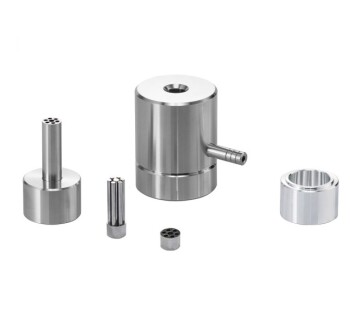
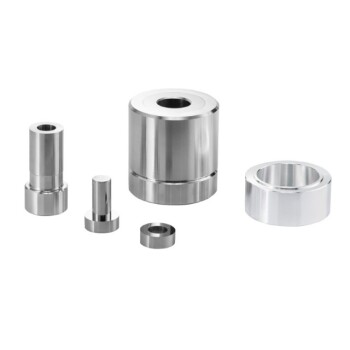
Graphite molds serve as the critical interface between the processing equipment and the composite material during vacuum hot pressing. They function simultaneously as a high-strength containment vessel for the Diamond/Al-Cu powder and as the primary medium for efficiently transmitting both thermal energy and mechanical pressure.
Core Insight: The unique value of graphite molds lies in their ability to maintain structural integrity and dimensional stability under extreme conditions (high temperature and high pressure). They enable the simultaneous application of heat and force required to plastically deform the aluminum matrix and eliminate porosity, ensuring a dense, homogeneous composite.
The Mechanics of Pressure and Shaping
Transmitting Uniaxial Force
The primary mechanical role of the graphite mold is to act as a force transmission medium. The hydraulic system applies significant uniaxial pressure (referenced as high as 67.7 to 70 MPa) to the mold.
The mold must withstand this load without failing, transferring the force directly to the Diamond/Al-Cu powder mixture. This pressure is essential for forcing the aluminum matrix to undergo plastic deformation, filling the voids between diamond particles to achieve high density.
Ensuring Geometric Precision
Graphite molds are responsible for fixing the powder into its final shape, such as a specific circular disk.
Because graphite possesses excellent high-temperature strength, it resists deformation even under heavy loads at sintering temperatures (around 650°C for these composites). This dimensional stability ensures the final sintered part maintains precise geometry and uniform thickness.
Thermal Dynamics and Material Quality
Facilitating Uniform Heating
Graphite is selected for its superior thermal conductivity. In vacuum hot pressing, the mold acts as a thermal bridge, transferring heat quickly and evenly from the heating elements to the internal composite powder.
This uniformity is critical. It ensures that the entire sample sinters at the same rate, preventing structural inconsistencies or internal stresses that could weaken the Diamond/Al-Cu composite.
Creating a Protective Environment
Beyond physical shaping, graphite plays a chemical role in the process. The graphite creates a "reducing atmosphere" within the immediate vicinity of the sample.
This environment helps scavenge residual oxygen present in the vacuum chamber. By doing so, the mold protects the metal powders (specifically the Aluminum and Copper) from oxidation, which is vital for maintaining the purity and bonding strength of the matrix.
Understanding the Trade-offs
The Necessity of Demolding Aids
While graphite is an excellent container, direct contact between the mold and the metal matrix at high temperatures can sometimes lead to sticking or unwanted chemical interactions.
To mitigate this, operators often employ an isolation layer (such as alumina) between the composite powder and the graphite mold. This facilitates the demolding process after sintering, ensuring the component can be removed without damage to the part or the mold.
Making the Right Choice for Your Project
When selecting mold materials and designing your sintering parameters, consider your specific performance targets:
- If your primary focus is Maximum Density: Prioritize graphite grades with the highest compressive strength to safely maximize the uniaxial pressure (up to 70 MPa) applied to the powder for pore elimination.
- If your primary focus is Dimensional Consistency: Ensure the mold design accounts for the specific thermal expansion characteristics of the graphite to maintain precise geometric tolerances at 650°C.
Ultimately, the graphite mold is not just a container, but an active participant in the sintering process that defines the structural integrity of the final composite.
Summary Table:
| Function | Description | Key Benefit |
|---|---|---|
| Pressure Transmission | Transfers uniaxial force (up to 70 MPa) to powder | Eliminates porosity and ensures high density |
| Thermal Conductivity | Acts as a thermal bridge from heating elements | Uniform sintering and reduced internal stress |
| Structural Support | Maintains shape under high temperature (650°C) | High geometric precision and dimensional stability |
| Chemical Protection | Creates a localized reducing atmosphere | Prevents oxidation of Aluminum and Copper powders |
Elevate Your Composite Manufacturing with KINTEK
Precision is non-negotiable in vacuum hot pressing. At KINTEK, we specialize in providing high-performance laboratory equipment and specialized consumables designed to withstand the rigors of advanced material research.
Whether you are developing Diamond/Al-Cu matrix composites or exploring new frontiers in material science, our comprehensive portfolio—including high-temperature vacuum furnaces, graphite molds, hydraulic pellet presses, and alumina consumables—ensures your lab achieves maximum density and structural integrity every time.
Ready to optimize your sintering process? Contact our technical experts today to discover how our tailored solutions can enhance your laboratory's efficiency and output.
Related Products
- 2200 ℃ Graphite Vacuum Heat Treat Furnace
- Ultra-High Temperature Graphite Vacuum Graphitization Furnace
- Vacuum Heat Treat and Pressure Sintering Furnace for High Temperature Applications
- Vacuum Heat Treat and Molybdenum Wire Sintering Furnace for Vacuum Sintering
- Horizontal High Temperature Graphite Vacuum Graphitization Furnace
People Also Ask
- Why do you heat treat in a vacuum? Achieve Perfect Surface Finish and Material Integrity
- What is the process of vacuum heat treating? Achieve Superior Hardening with a Clean, Bright Finish
- How does heat transmit in a vacuum? Mastering Thermal Radiation for Purity & Precision
- How does a vacuum heat treat furnace work? Achieve Pristine, Oxide-Free Metal Parts
- What is graphite heating? A Guide to Durable, High-Temp Industrial Furnace Solutions