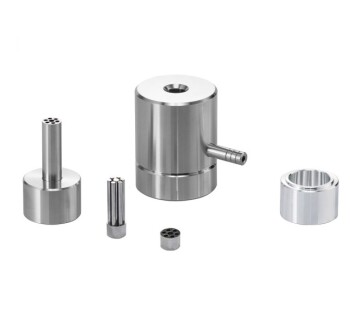
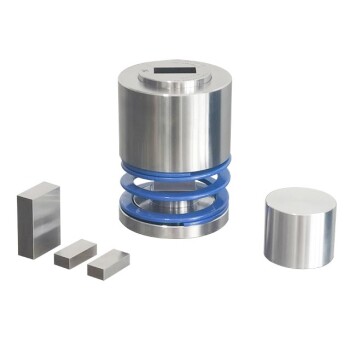
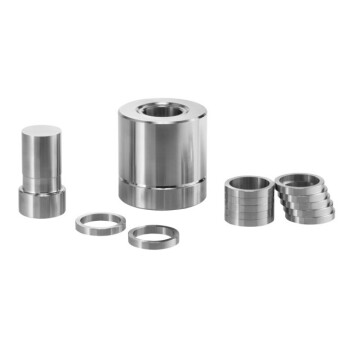
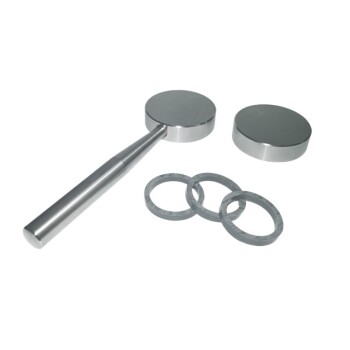
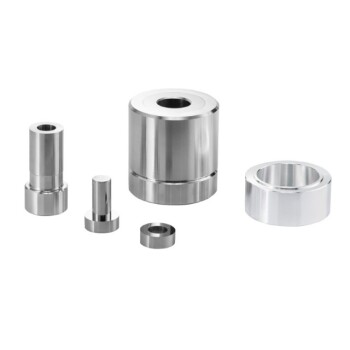
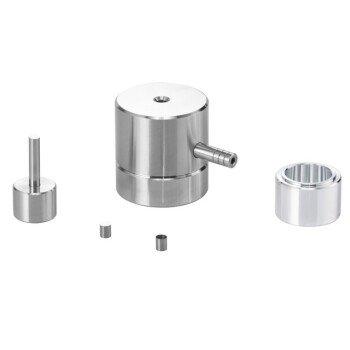
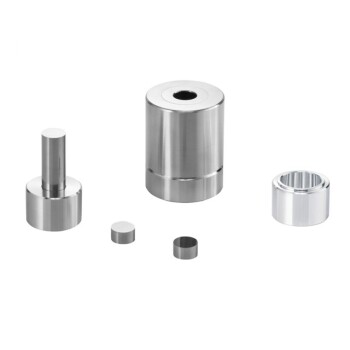
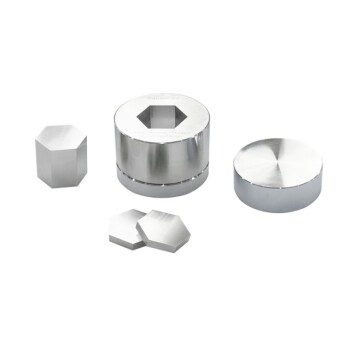
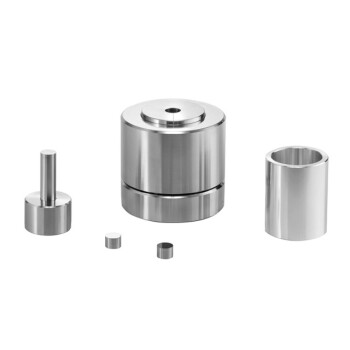
High-strength molds are the structural foundation for fabricating viable all-solid-state batteries. Their primary role is to define the exact geometric dimensions of electrolyte pellets and battery units while withstanding molding pressures of several hundred megapascals without undergoing elastic deformation.
Core Takeaway To achieve the high energy density promised by solid-state batteries, powders must be compressed into a dense, non-porous layer. High-strength molds ensure that the massive force applied during fabrication is transferred entirely to the powder—not lost to mold flexing—resulting in a crack-free, uniformly dense solid electrolyte.
The Physics of Pressure Transmission
The central challenge in pelletizing solid-state batteries is converting loose powder into a solid, cohesive unit. The mold is the critical variable in this equation.
Preventing Elastic Deformation
When compressing powder at pressures ranging from 200 to 450 MPa, standard materials often warp or expand.
High-strength molds are engineered to resist this elastic deformation.
If the mold walls expand even slightly outward under pressure, the force meant to compress the powder is dissipated. High-strength molds remain rigid, forcing the powder to consolidate rather than displace.
Achieving Uniform Density
A solid-state battery fails if there are density gradients within the electrolyte layer.
By maintaining absolute rigidity, the mold ensures that pressure is transmitted uniformly to every part of the powder sample.
This uniformity eliminates "soft spots" or porosity that could lead to dendrite formation or short circuits later in the battery's life.
Ensuring Surface Integrity
The interface between the electrolyte and the electrode determines battery performance.
High-strength molds produce a flat surface free of cracks.
This smoothness is essential for reducing interfacial resistance when the electrolyte is eventually stacked against lithium or sodium metal electrodes.
Material Compatibility and Chemical Stability
While rigidity is the primary physical requirement, the chemical interaction between the mold and the battery materials is equally critical.
The Role of PEEK Molds
For specific testing scenarios, PEEK (Polyether ether ketone) molds are utilized because they offer excellent electrical insulation.
They can withstand the high compression pressures (200-450 MPa) required for molding while preventing side reactions between the mold walls and active battery components.
The Role of PTFE for Sulfides
When working with sulfide-based electrolytes, chemical inertness is paramount.
Polytetrafluoroethylene (PTFE) molds or liners are used because they possess a low friction coefficient and high chemical inertness.
This prevents the powder from sticking to the mold walls, facilitates easy demolding, and eliminates the risk of impurity contamination that often occurs with metal molds.
Understanding the Trade-offs: Fabrication vs. Operation
It is vital to distinguish between the pressures required to make the battery and the pressures required to test it.
Fabrication Pressure (The "Mold" Phase)
The primary reference emphasizes pressures of several hundred megapascals.
This is a temporary, massive force used strictly to densify the powder into a pellet. The mold's job here is purely structural resistance.
Stack Pressure (The "Test" Phase)
Once the battery is fabricated, it often remains in a specialized test mold (often Stainless Steel) to maintain stack pressure.
This is a much lower, constant pressure (typically 1.5 MPa to 10+ MPa).
Its purpose is not to compress the powder, but to compensate for volume changes caused by lithium stripping and deposition during cycling.
The Pitfall: Do not confuse a mold designed for stack pressure (testing) with one designed for pelletizing (fabrication). A testing shell may not withstand the 400 MPa required to form the initial pellet.
Making the Right Choice for Your Goal
Selecting the correct mold depends on which stage of the battery lifecycle you are addressing.
- If your primary focus is fabrication quality (Pelletizing): Prioritize molds with maximum yield strength to prevent elastic deformation; this ensures high density and prevents cracking during the initial 200+ MPa compression.
- If your primary focus is electrochemical testing (Cycling): Prioritize molds with integrated pressure maintenance mechanisms (springs or pneumatic) that can hold a steady 1.5–10 MPa to stabilize interfaces during volume expansion.
- If your primary focus is chemical purity (Sulfide Electrolytes): Use molds made of or lined with PTFE or PEEK to prevent adhesion and fatal chemical side reactions.
The mold is not just a container; it is an active tool that dictates the structural integrity and electrochemical viability of your final cell.
Summary Table:
| Mold Feature | Primary Function | Material Examples | Target Pressure |
|---|---|---|---|
| High Rigidity | Prevents elastic deformation; ensures uniform powder consolidation. | High-Strength Alloys | 200 - 450 MPa |
| Chemical Inertness | Prevents side reactions and powder adhesion. | PTFE / PEEK | 200 - 450 MPa |
| Surface Smoothness | Eliminates cracks and reduces interfacial resistance. | Polished Steel / PTFE | 200 - 450 MPa |
| Pressure Maintenance | Sustains stack pressure to manage volume expansion during cycling. | Stainless Steel Shells | 1.5 - 10+ MPa |
Maximize Your Battery Research Precision with KINTEK
Transitioning from loose powder to high-performance solid-state cells requires equipment that can withstand extreme pressures without compromise. KINTEK specializes in providing the structural foundation for your energy research, offering high-strength pellet molds, hydraulic presses (pellet, hot, and isostatic), and specialized high-temperature high-pressure reactors.
Our portfolio is designed to meet the rigorous demands of battery scientists, including:
- Precision Molds & Consumables: High-quality PTFE products, ceramics, and crucibles for sulfide and oxide electrolytes.
- Advanced Processing: Crushing and milling systems, sieving equipment, and battery research tools.
- Thermal Control: Muffle and vacuum furnaces paired with ULT freezers and cooling solutions.
Whether you need to eliminate density gradients in your pellets or maintain stable stack pressure during cycling, KINTEK has the expertise and equipment to support your breakthrough.
Contact us today to find the perfect molding solution for your lab
Related Products
- Special Shape Press Mold for Lab
- Anti-Cracking Press Mold for Lab Use
- Round Bidirectional Press Mold for Lab
- Square Bidirectional Pressure Mold for Lab Use
- Isostatic Molding Pressing Molds for Lab
People Also Ask
- How to use a press mold? Master the Art of Creating Consistent Ceramic Forms
- What is the press mould method? A Guide to Consistent, Detailed Ceramic Forms
- Why are pressure molds with non-conductive resin inner walls required for battery testing? Ensure Data Accuracy
- What is the purpose of specialized pressure devices in sulfide solid-state batteries? Ensure Chemo-Mechanical Stability
- What is the function of press molds during the preparation of SiCf/Ti-43Al-9V composites? Achieve Structural Precision