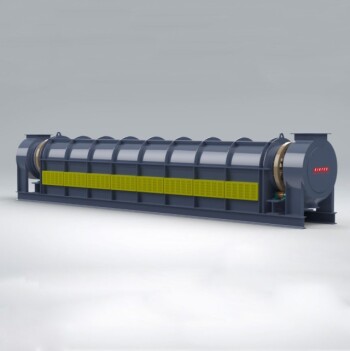
The Calcining Furnace serves as the critical transformative engine in the production of zirconia powder from zircon. It functions by applying high-temperature heat treatment to zirconium oxychloride precipitates, a process that drives off volatile components and converts these chemical precursors into stable oxide powders. This thermal processing step is the primary mechanism for establishing the material's final physical and chemical identity.
While chemical precipitation creates the raw ingredients, the Calcining Furnace defines the product's performance. It provides the precise control necessary to dictate the particle size, phase purity, and reactivity of the finished zirconia powder.
The Mechanism of Transformation
Processing Chemical Precursors
The raw input for the furnace is zirconium oxychloride precipitate. The furnace subjects these precipitates to a specific thermal environment. This heat treatment is not merely for drying; it is a chemical conversion process.
Eliminating Volatiles
A major function of the furnace is purification through heat. As the temperature rises, volatile components trapped within the precipitates are driven off. This ensures that the remaining material consists solely of the desired stable oxides.
Enabling Oxide Stability
The transition from a precursor to a usable ceramic powder requires stabilization. The furnace facilitates the actual transformation of the molecular structure. This turns the intermediate precipitates into robust, stable zirconia oxide powders ready for manufacturing applications.
Defining Final Powder Characteristics
Controlling Particle Size
The operating parameters of the furnace directly dictate the physical dimensions of the powder. The specific heating profile applied during calcination is the primary factor in determining the final particle size. This allows manufacturers to tailor the powder for specific industrial uses.
Establishing Phase Purity
Beyond size, the furnace ensures the chemical integrity of the material. By maintaining precise control over the heat, the furnace ensures the powder achieves high phase purity. This consistency is essential for the reliability of high-performance ceramic parts.
Determining Reactivity
The furnace controls how the powder will behave in subsequent processing steps. The heat treatment profile sets the powder's surface activity and chemical reactivity. This "reactivity" determines how well the powder will sinter or bond during later manufacturing stages.
Understanding the Critical Trade-offs
The Precision Challenge
The relationship between heat and quality is sensitive. The furnace enables precise control, but this implies that any deviation in the heating profile can ruin the batch. Inconsistent heating will lead to variability in particle size or incomplete phase transformation.
Balancing Properties
There is often an interplay between particle size and reactivity. Adjusting the furnace to achieve a specific particle size may inadvertently alter the powder's reactivity. Operators must carefully calibrate the heating profile to balance these competing material properties.
Optimization for Your Production Goals
To maximize the utility of your Calcining Furnace, you must align the heating profile with your specific end-product requirements.
- If your primary focus is Particle Size: Focus on calibrating the heating profile duration and intensity, as this is the primary factor governing physical growth.
- If your primary focus is Phase Purity: Ensure the furnace reaches and maintains the specific temperatures required to fully drive off volatiles and complete the oxide transformation.
- If your primary focus is Reactivity: fine-tune the heat treatment to leave the powder in a state that matches your downstream sintering or bonding requirements.
Mastering the Calcining Furnace profile is the single most effective way to guarantee the quality and consistency of your zirconia powder.
Summary Table:
| Key Transformation Role | Impact on Zirconia Powder |
|---|---|
| Thermal Conversion | Converts chemical precursors into stable zirconium oxide. |
| Purification | Drives off volatile components to ensure chemical integrity. |
| Particle Size Control | Calibrates heating profiles to dictate final physical dimensions. |
| Phase Purity | Ensures consistent material structure for high-performance use. |
| Reactivity Tuning | Sets the surface activity required for optimal sintering/bonding. |
Elevate Your Material Production with KINTEK Precision
Consistency in zirconia powder production starts with the right thermal equipment. KINTEK specializes in high-performance laboratory equipment and consumables, offering a wide range of high-temperature solutions including muffle, tube, and rotary furnaces specifically designed for precise calcination and oxide transformation.
Whether you are refining particle size for dental applications or ensuring phase purity for advanced ceramics, our expert-grade systems provide the thermal stability you need. Beyond furnaces, our portfolio includes high-temperature high-pressure reactors, crushing and milling systems, and ceramic crucibles to support your entire workflow.
Ready to optimize your calcination process? Contact our technical experts today to find the perfect solution for your production goals.
References
- James V. Jones, George M. Bedinger. Zirconium and hafnium. DOI: 10.3133/pp1802v
This article is also based on technical information from Kintek Solution Knowledge Base .
Related Products
- Electric Rotary Kiln Pyrolysis Furnace Plant Machine Calciner Small Rotary Kiln Rotating Furnace
- Electric Rotary Kiln Continuous Working Small Rotary Furnace Heating Pyrolysis Plant
- High Temperature Muffle Oven Furnace for Laboratory Debinding and Pre Sintering
- Vertical High Temperature Graphite Vacuum Graphitization Furnace
- Dental Porcelain Zirconia Sintering Ceramic Furnace Chairside with Transformer
People Also Ask
- What is a rotary kiln electric furnace? Achieve Superior Uniform Heating for Your Materials
- What are the characteristics of the slipping, slumping, and rolling modes of bed motion? Optimize Your Rotary Process
- What are the advantages of rotary kiln furnace? Achieve Superior Uniformity & Efficiency
- What is the temperature of a rotating kiln? It Depends on Your Material and Process Goal
- What are the principles of a rotary kiln? Master the Mechanics of High-Temperature Processing