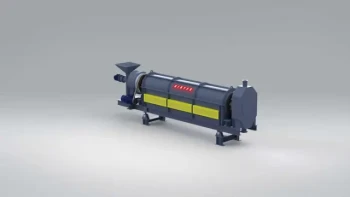
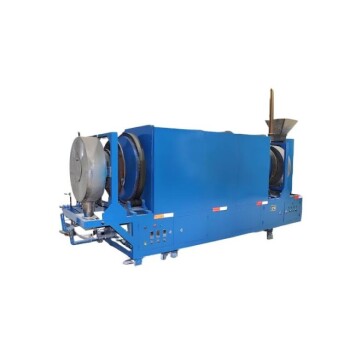
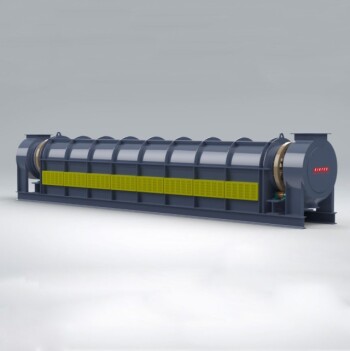
The primary advantage of using a rotary tube furnace for tungsten disulfide (WS2) synthesis is the creation of a dynamic heating environment. While fixed furnaces suffer from "static stacking"—where powder remains stationary, limiting exposure—the rotation of a rotary furnace causes the internal powder to tumble continuously. This motion ensures full contact between the tungsten oxide powder and sulfur vapor, resulting in WS2 with significantly higher crystallinity, more uniform particle size, and consistent phase composition.
Core Takeaway: The superior quality of WS2 powder produced in a rotary furnace stems from overcoming the heat and mass transfer limitations of static processing. Continuous tumbling exposes the entire surface area of the reactant powder, ensuring a complete and homogenous reaction.
The Mechanics of Superior Synthesis
Overcoming Static Limitations
In a conventional fixed tube furnace, the reactant powder sits in a static pile. This configuration restricts heat and gas flow to the outer layers of the pile, often leaving the inner material under-processed.
Enhancing Gas-Solid Contact
For WS2 synthesis, the reaction relies on the interaction between solid tungsten oxide and sulfur vapor. The rotary furnace’s tumbling action constantly refreshes the surface of the powder bed.
Optimizing Mass Transfer
This continuous movement ensures that the sulfur vapor can diffuse deeply and evenly into the powder bulk. The result is a complete chemical conversion without the gradients found in static batches.
Impact on Product Quality
Higher Crystallinity
The dynamic environment promotes uniform thermal energy distribution. This uniformity is critical for achieving the high crystallinity required for high-performance WS2 applications.
Consistent Phase Composition
Because every particle experiences the same processing conditions, the final output avoids the "mixed phase" issues common in static heating. The product achieves a consistent chemical structure throughout the batch.
Particle Size Uniformity
The mechanical agitation prevents particles from sintering together into large, irregular clumps. This leads to a narrower, more uniform particle size distribution suitable for advanced applications.
Efficiency and Process Control
Reduced Gas Consumption
Because the entire surface area of the sample is exposed to the processing atmosphere, gas diffusion is more efficient. This often allows for reduced consumption of process gases compared to static methods.
Increased Throughput
Rotary furnaces are designed for efficient heat transfer in short periods. This capability allows for faster batch processing or even continuous operation modes, significantly increasing production capacity.
Understanding the Operational Trade-offs
Mechanical Complexity
Unlike the simple setup of a fixed tube, a rotary furnace introduces moving parts and dynamic seals. Maintaining specific atmospheres (like Nitrogen, Argon, or Hydrogen) or vacuum conditions requires robust sealing mechanisms to prevent leaks during rotation.
Material Handling Considerations
While rotary furnaces minimize manual handling in continuous processes, the setup must allow for the furnace body to tilt. This tilt is necessary to control the flow of material and ensure even heating, adding a layer of operational adjustment not present in fixed horizontal tubes.
Making the Right Choice for Your Goal
To determine if a rotary furnace is the correct solution for your specific WS2 application, consider your primary constraints:
- If your primary focus is material quality: The rotary furnace is the superior choice for maximizing crystallinity and ensuring phase purity due to uniform gas-solid contact.
- If your primary focus is production scale: The ability to run continuous batches with efficient heat transfer makes the rotary furnace the logical choice for high-throughput requirements.
By shifting from static to dynamic processing, you move from merely heating reagents to actively engineering the microstructure of your final product.
Summary Table:
| Feature | Fixed Tube Furnace | Rotary Tube Furnace |
|---|---|---|
| Material State | Static Stacking (Stationary) | Dynamic Tumbling (Continuous) |
| Gas-Solid Contact | Surface Limited | Full Surface Exposure |
| Thermal Uniformity | Subject to Gradients | Highly Homogeneous |
| Product Quality | Potential Mixed Phases | High Crystallinity & Phase Purity |
| Throughput | Batch-limited | High/Continuous Potential |
| Particle Size | Irregular (Sintering Risk) | Uniform Distribution |
Elevate Your Advanced Material Synthesis with KINTEK
Transitioning from static to dynamic processing is the key to engineering high-performance Tungsten Disulfide (WS2). KINTEK specializes in precision laboratory equipment, offering high-performance rotary tube furnaces and vacuum systems designed to optimize gas-solid reactions.
Our comprehensive range—from high-temperature furnaces and CVD/PECVD systems to crushing, milling, and pellet presses—empowers researchers and manufacturers to achieve unparalleled phase purity and particle uniformity.
Ready to scale your production and enhance material crystallinity? Contact our technical experts today to find the perfect furnace solution for your lab’s specific needs.
References
- Nataša Gajić, Marija Korać. Synthesis of Tribological WS2 Powder from WO3 Prepared by Ultrasonic Spray Pyrolysis (USP). DOI: 10.3390/met9030277
This article is also based on technical information from Kintek Solution Knowledge Base .
Related Products
- Rotary Tube Furnace Split Multi Heating Zone Rotating Tube Furnace
- Laboratory Vacuum Tilt Rotary Tube Furnace Rotating Tube Furnace
- Vacuum Sealed Continuous Working Rotary Tube Furnace Rotating Tube Furnace
- Inclined Rotary Plasma Enhanced Chemical Vapor Deposition PECVD Equipment Tube Furnace Machine
- Electric Rotary Kiln Small Rotary Furnace for Activated Carbon Regeneration
People Also Ask
- What are the advantages of using a rotary tube furnace for MoVOx catalysts? Elevate Uniformity and Crystallinity
- Why is a rotary tube furnace preferred over a fixed tube furnace for the carbonization of asphaltenes? Superior Quality
- What is a rotary tube furnace? Achieve Superior Uniformity for Powders and Granules
- Why is a rotary tube furnace recommended for the calcination stage of potassium vanadium oxide catalysts? Optimize Purity
- What is a rotary furnace used for? Achieve Unmatched Process Uniformity and Control