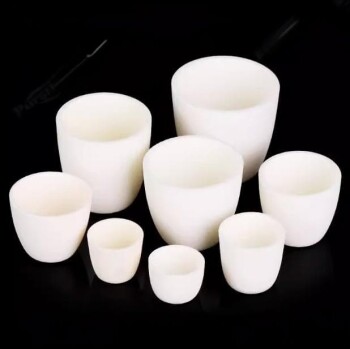
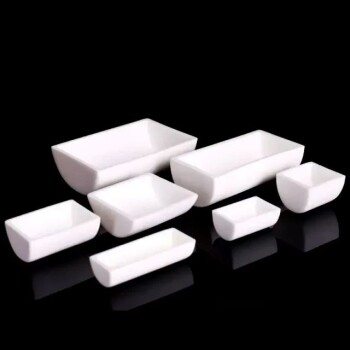
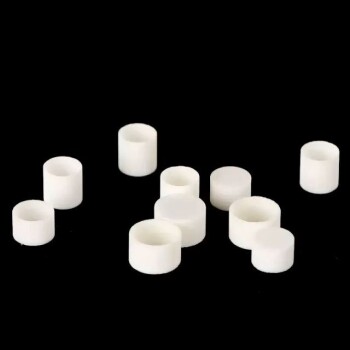
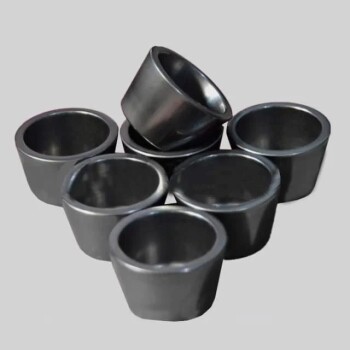
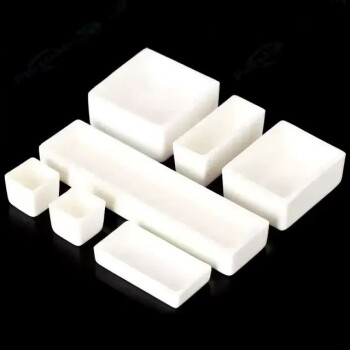
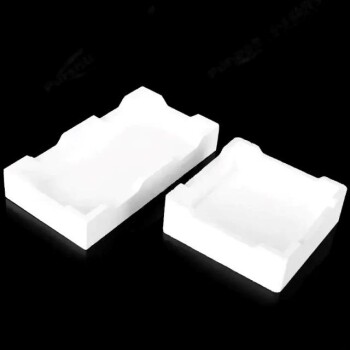
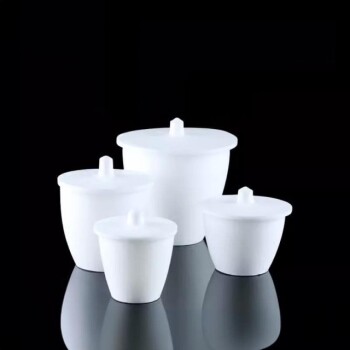
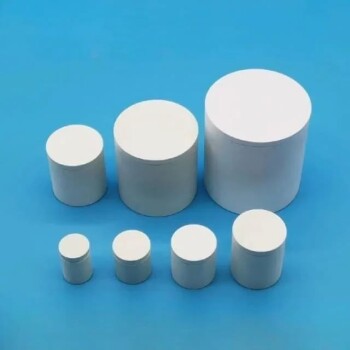
In Thermogravimetric Analysis (TGA), a corundum crucible functions as a chemically inert, high-temperature resistant vessel. Its primary role is to securely hold rock samples—typically around 50 mg—while subjecting them to extreme heat without interfering with the measurement. This ensures that any observed mass changes are attributed solely to the sample itself, specifically allowing for the accurate tracking of organic matter oxidation.
The corundum crucible provides a stable, non-reactive environment for high-temperature analysis, ensuring that mass loss data accurately reflects the organic content of the rock sample rather than experimental artifacts or container reactions.
The Critical Function of Stability
Enduring Extreme Thermal Ramps
TGA experiments for rock analysis require exposing samples to intense thermal stress. A corundum crucible is specifically selected to withstand aggressive temperature ramps, typically ranging from 30°C up to 850°C.
Maintaining Structural Integrity
At these elevated temperatures, standard laboratory containers might warp, degrade, or fail. Corundum maintains its physical structure throughout the heating cycle, ensuring the sample remains securely contained for the duration of the experiment.
Ensuring Data Accuracy
Chemical Inertness
The most vital property of the corundum crucible is its chemical inertness. It is designed not to react with the rock sample or the experimental atmosphere, even when subjected to peak temperatures.
Isolating Organic Matter Oxidation
Because the crucible itself is non-reactive, it contributes no mass change to the data. This allows analysts to attribute weight loss precisely to the oxidation of organic matter within the rock, rather than reaction byproducts involving the container.
Understanding the Trade-offs
Sample Volume Constraints
While highly stable, these crucibles are designed for micro-analysis, typically holding only around 50 mg of material. This necessitates that the small rock sample be perfectly representative of the larger geological formation, as the small volume leaves little margin for heterogeneity.
Making the Right Choice for Your Goal
To ensure the success of your TGA experiment, consider the following based on your specific analytical needs:
- If your primary focus is High-Temperature Analysis: Rely on corundum for experiments requiring stability up to 850°C, where other materials might degrade.
- If your primary focus is Data Precision: Use corundum to eliminate background noise, ensuring that all recorded mass loss is strictly derived from the sample's organic content.
By utilizing a corundum crucible, you ensure that your evaluation of organic matter is defined by the chemistry of the rock, not the limitations of your equipment.
Summary Table:
| Feature | Detail |
|---|---|
| Material | Corundum (Alumina) |
| Temperature Stability | 30°C to 850°C+ |
| Typical Sample Weight | ~50 mg |
| Key Property | Chemical Inertness |
| Analytical Benefit | Eliminates background mass changes |
Elevate Your Analytical Accuracy with KINTEK
Precision in Thermogravimetric Analysis starts with the right consumables. KINTEK provides high-performance corundum and ceramic crucibles designed to withstand extreme thermal ramps without compromising data integrity.
Our extensive portfolio supports your entire lab workflow, featuring:
- High-Temperature Furnaces: Muffle, tube, vacuum, and atmosphere furnaces for precise thermal processing.
- Reaction & Preparation: High-temperature high-pressure reactors, autoclaves, and hydraulic presses.
- Sample Processing: Crushing, milling, and sieving equipment for perfect sample representation.
- Lab Essentials: From ULT freezers and cold traps to specialized PTFE products and electrolytic cells.
Don't let equipment limitations skew your results. Contact KINTEK today to source the high-quality consumables and equipment your research deserves!
References
- Oleg V. Anikin, E.М. Abusalimov. Factors influencing hydrogen peroxide decomposition dynamics for thermochemical treatment of bottomhole zone. DOI: 10.1007/s13202-022-01507-z
This article is also based on technical information from Kintek Solution Knowledge Base .
Related Products
- Electron Beam Evaporation Coating Tungsten Crucible and Molybdenum Crucible for High Temperature Applications
- Electron Beam Evaporation Coating Gold Plating Tungsten Molybdenum Crucible for Evaporation
- Arc-Shaped Alumina Ceramic Crucible High Temperature Resistant for Engineering Advanced Fine Ceramics
- Electron Beam Evaporation Coating Oxygen-Free Copper Crucible and Evaporation Boat
- Engineering Advanced Fine Ceramics Alumina Al2O3 Crucible With Lid Cylindrical Laboratory Crucible
People Also Ask
- What is the container that holds the metal source material called in e-beam evaporation? Ensure Purity and Quality in Your Thin-Film Deposition
- What materials are used in electron beam evaporation? Master High-Purity Thin Film Deposition
- What is the voltage of e-beam evaporation? Achieve Precise Thin-Film Deposition
- What are the applications of e-beam evaporation? Achieve High-Purity Coatings for Optics & Electronics
- What is e-beam evaporation? Achieve High-Purity Thin Film Deposition for Your Lab