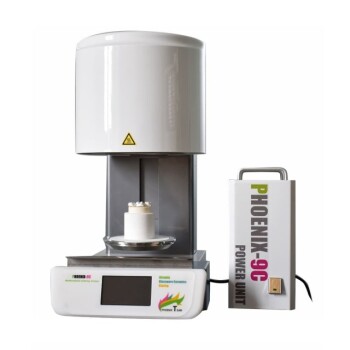
The horizontal tube furnace serves as the primary reactor for the synthesis of zinc oxide (ZnO) nanowires, providing the precise thermal environment required for material vaporization and subsequent deposition. It functions by heating source materials to high temperatures (typically 700°C to 950°C) to generate vapor, while simultaneously maintaining a stable gas flow to transport that vapor to a cooler substrate. This dual role of thermal regulation and transport management is what allows for the controlled, anisotropic growth of vertically aligned nanowire arrays.
Core Takeaway: A horizontal tube furnace acts as a controlled high-temperature environment that facilitates the vaporization of zinc sources and the precise deposition of nanowires via stable temperature gradients and regulated gas flow.
The Furnace as a Thermal Reaction Center
Facilitating Thermal Vaporization
The furnace provides the intense heat necessary to sublimate metallic zinc powder or induce the carbothermal reduction of zinc oxide mixed with carbon. By maintaining temperatures often exceeding 800°C, the furnace ensures a consistent supply of zinc vapor, which is the foundational building block for nanowire growth.
Managing Carbothermal Reduction
In many setups, the furnace enables the chemical reduction of ZnO precursor powders into a more volatile vapor phase. This controlled reaction occurs within the central heating zone, where the furnace’s thermal stability directly dictates the concentration and purity of the resulting vapor.
Precise Decomposition of Precursors
Beyond simple evaporation, the furnace facilitates the complete decomposition of organic precursors or metal-organic frameworks (like ZIF-8). This process ensures that the resulting ZnO crystals nucleate without organic impurities, leading to high-purity nanostructures.
Mass Transport and Atmosphere Regulation
Precision Gas Flow Dynamics
The horizontal configuration of the tube allows for a stable, linear gas stream (typically argon, oxygen, or water-carrying air) to move through the system. This carrier gas acts as a delivery vehicle, transporting the vaporized zinc from the high-temperature source to the lower-temperature deposition site.
Maintaining Chemical Purity
The furnace's sealed quartz tube provides a controlled atmosphere, protecting the reaction from external contaminants. By regulating the internal environment—whether through an inert argon shield or a specific oxygen concentration—the furnace allows for the formation of stable chemical bonds, such as the Zn–N bonds in carbon-coated variants.
Enhancing Vapor Transport
The velocity and stability of the airflow within the tube are critical for "oriented" synthesis. The furnace ensures that the gas flow field remains consistent, which prevents turbulence that could otherwise lead to irregular growth or poor morphological consistency in the nanorods.
The Importance of Spatial Temperature Gradients
Defining Nucleation and Growth Zones
A hallmark of the horizontal tube furnace is its ability to create a temperature gradient along the length of the tube. This allows researchers to place the source material in a high-temperature "hot zone" while positioning the substrate in a slightly cooler "growth zone" downstream.
Controlling Morphology and Alignment
By placing samples at different positions within these temperature gradients, scientists can induce various nanostructure morphologies. The specific temperature at the substrate site determines the growth intensity and ensures that nanowires grow in a vertically aligned, crystalline fashion.
Enabling the VLS Mechanism
In Vapor-Liquid-Solid (VLS) growth, the furnace provides the heat required to maintain a liquid catalyst droplet (like gold) on the substrate. The furnace's gradient allows the zinc vapor to dissolve into this droplet and then precipitate out as a solid nanowire, maintaining the growth direction and crystalline quality.
Understanding Technical Trade-offs
Thermal Uniformity vs. Throughput
While a longer furnace can accommodate more substrates, maintaining a perfectly linear temperature gradient becomes more difficult over larger distances. If the temperature fluctuates even slightly, the nanowires may exhibit variations in diameter or length across a single batch.
Quartz Tube Degradation and Contamination
High-temperature operations, especially those reaching 1300°C for related oxides, can cause the quartz tube to devitrify or release trace impurities over time. These impurities can inadvertently dope the ZnO nanowires, altering their electrical or optical properties in ways that may be difficult to reproduce.
Applying This Knowledge to Your Project
Recommendations for Synthesis Goals
- If your primary focus is high-purity, vertically aligned arrays: Use a multi-zone horizontal furnace to create a sharp, stable temperature gradient between the source and the substrate.
- If your primary focus is controlling nanowire morphology: Experiment with varying the flow rate of the carrier gas and the precise distance of the substrate from the central heating zone.
- If your primary focus is scaling up production: Prioritize a furnace with a wide "constant temperature zone" to ensure that multiple substrates experience identical growth conditions.
By masterfully controlling the thermal and atmospheric variables within a horizontal tube furnace, you can achieve the precise crystalline quality and morphological consistency required for advanced ZnO applications.
Summary Table:
| Function | Mechanism | Impact on ZnO NWs |
|---|---|---|
| Thermal Vaporization | Heats source materials (700°C-950°C) | Ensures consistent zinc vapor supply |
| Atmosphere Regulation | Controlled gas flow (Ar, O2) | Maintains purity and prevents growth turbulence |
| Temperature Gradient | Hot zone (source) vs. cool zone (substrate) | Defines nucleation sites and growth morphology |
| VLS Support | Maintains liquid catalyst droplets | Ensures crystalline quality and vertical alignment |
Elevate Your Nanomaterial Synthesis with KINTEK
Precision is the difference between irregular growth and high-performance nanowire arrays. KINTEK specializes in advanced laboratory solutions, providing the high-stability horizontal tube furnaces, CVD, and PECVD systems essential for controlled thermal evaporation and VLS growth.
Whether you are scaling production or refining morphology, our comprehensive portfolio—ranging from vacuum and atmosphere furnaces to high-pressure reactors, planetary ball mills, and hydraulic presses—is engineered to meet the rigorous demands of material science.
Unlock superior repeatability in your lab. Contact KINTEK today to consult with our experts on the ideal thermal configuration for your ZnO research and explore our full range of laboratory consumables.
References
- Pham Hong Thach, Tran Van Khai. Thermal Evaporation Synthesis, Optical and Gas-Sensing Properties of ZnO Nanowires. DOI: 10.3390/cryst13091380
This article is also based on technical information from Kintek Solution Knowledge Base .
Related Products
- Vertical Laboratory Tube Furnace
- Multi-zone Laboratory Tube Furnace
- Customer Made Versatile CVD Tube Furnace Chemical Vapor Deposition Chamber System Equipment
- Horizontal High Temperature Graphite Vacuum Graphitization Furnace
- Multi Heating Zones CVD Tube Furnace Machine Chemical Vapor Deposition Chamber System Equipment
People Also Ask
- What is the function of a laboratory vertical tube furnace in microalgae catalytic pyrolysis? Optimize Your Bio-Fuel.
- How does a laboratory tube furnace provide atmospheric control during the sintering of glass-ceramics? Achieve Precision
- Why is a laboratory tube furnace required for LMTP0.1/CA materials? Achieve Precise Carbon Coating & Crystal Growth
- How does a laboratory tube furnace provide precise temperature control? Expert Simulation for Steam Cracking
- How does the temperature control precision of a laboratory tube furnace affect the quality of grown single crystals?