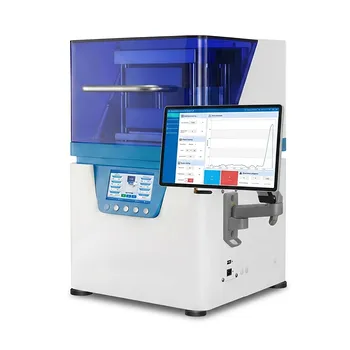
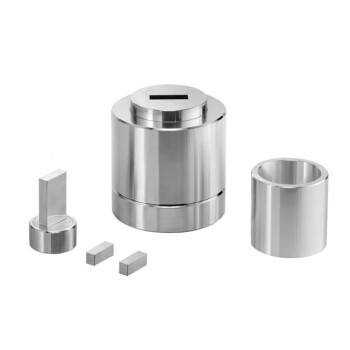
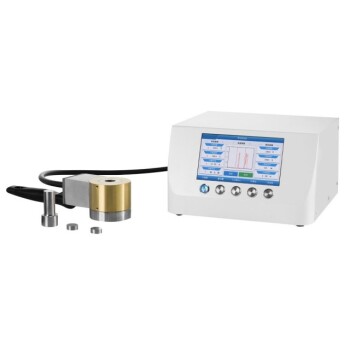
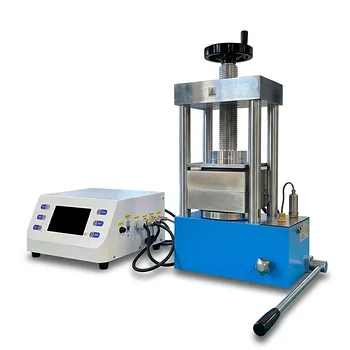
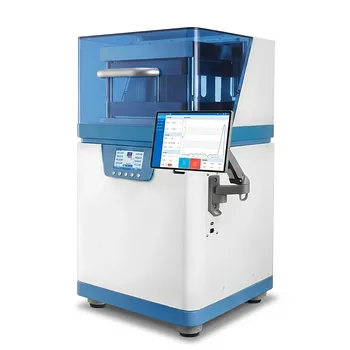
The laboratory hydraulic press is the essential instrument for applying high axial pressure to compact electrode and electrolyte materials into a dense, integrated structure. By subjecting powder composites to pressures often exceeding 370 MPa, the press facilitates "cold-press molding." This process significantly reduces contact resistance, eliminates internal porosity, and establishes the continuous solid-solid interfaces required for efficient ion transport.
Core Takeaway: A laboratory hydraulic press is used to overcome the inherent resistance of solid-state materials by mechanically forcing particles into intimate contact, thereby creating the high-density matrix and seamless interfaces necessary for a functioning battery.
Achieving High Density and Structural Integrity
Eliminating Internal Porosity
Solid-state battery materials typically begin as loose powders or coated slurries that contain significant air gaps. The hydraulic press applies uniaxial compression to eliminate these pores, ensuring the electrode becomes a dense, cohesive solid.
Enhancing Volumetric Energy Density
High-pressure compaction increases the amount of active material packed into a specific volume. This densification is critical for achieving the high energy density targets that make solid-state technology competitive with traditional liquid-electrolyte batteries.
Improving Current Collector Contact
Beyond powder compaction, the press is used to ensure the electrode layer maintains tight physical contact with the current collector (e.g., copper or aluminum foil). This reduces contact resistance at the foil interface, which optimizes the overall cycling performance and rate capability.
Establishing the Solid-Solid Interface
Reducing Interfacial Resistance
In the absence of a liquid electrolyte to "wet" the surfaces, solid particles must be mechanically forced together. The hydraulic press creates a tight solid-solid interface between the active material and the solid electrolyte, which is the primary mechanism for reducing internal resistance.
Facilitating Ion Transport Channels
By applying pressures such as 374 MPa to 380 MPa, the press creates continuous pathways for lithium-ion movement. Without this level of compaction, ions would be unable to jump across particle boundaries, effectively rendering the battery non-functional.
Inducing Plastic Deformation
Certain materials, such as Argyrodite-type sulfide electrolytes, undergo plastic deformation under high pressure. The laboratory hydraulic press exploits this property to "flow" the material into gaps, creating a defect-free layer that acts as a robust ion conductor.
Critical Role in Composite Fabrication
Bilayer and Multi-layer Molding
The press allows researchers to create bilayer structures by compressing the cathode mixture and solid electrolyte powder simultaneously. This ensures the two distinct layers are bonded at the atomic level, preventing delamination during battery operation.
Dendrite Inhibition
A highly densified electrolyte layer, produced by precise hydraulic pressing, serves as a physical barrier against lithium dendrites. By eliminating the voids where dendrites typically nucleate, the press helps prevent internal short circuits and enhances safety.
Pellet Substrate Formation
In many lab settings, the press is used to create electrolyte pellets (often at around 125 MPa) that serve as a mechanical substrate. These pellets provide the structural foundation upon which subsequent electrode layers are deposited or pressed.
Understanding the Trade-offs and Limitations
Pressure Over-Optimization
While high pressure is generally beneficial, exceeding the structural limits of the active materials can lead to particle fracturing. This can create new surfaces that increase resistance or degrade the chemical stability of the electrode.
Stress Concentration and Cracking
Uniaxial pressing can introduce internal residual stresses within the pellet or layer. If the pressure is released too quickly or if the mold is not perfectly aligned, the resulting electrode may suffer from micro-cracks or "capping" (layer separation).
Limitations of Cold Pressing
The hydraulic press typically operates at room temperature (cold pressing), which may not be sufficient for all material types. Some solid electrolytes require hot pressing to achieve theoretical density, meaning a standard hydraulic press without heating elements may leave residual grain boundary resistance.
How to Apply This to Your Battery Research
Making the Right Choice for Your Goal
To achieve the best results with a laboratory hydraulic press, you must tailor your pressure settings to the specific chemistry and morphology of your materials.
- If your primary focus is reducing interfacial resistance: Utilize pressures in the 350–400 MPa range to ensure maximum contact area between the cathode and sulfide-based electrolytes.
- If your primary focus is creating stable electrolyte substrates: Apply a moderate pressure (approx. 125 MPa) to create a flat, handleable pellet before depositing active layers.
- If your primary focus is slurry-coated electrode optimization: Use the press to compact the dried coating onto the foil to improve electrical contact and volumetric capacity without damaging the current collector.
The laboratory hydraulic press is the bridge between loose chemical components and a high-performance, integrated solid-state energy storage system.
Summary Table:
| Function | Key Benefit | Typical Pressure |
|---|---|---|
| Powder Compaction | Eliminates internal porosity and air gaps | >370 MPa |
| Interface Engineering | Establishes solid-solid contact for ion transport | 350–400 MPa |
| Pellet Substrate Formation | Creates stable mechanical foundations for layers | ~125 MPa |
| Densification | Increases volumetric energy density and conductivity | Varies by material |
| Structural Integrity | Inhibits dendrite growth and layer delamination | High Axial Pressure |
Elevate Your Battery Research with KINTEK Precision
Achieving the perfect solid-solid interface requires uncompromising pressure control. KINTEK specializes in high-performance laboratory equipment designed for the rigorous demands of energy storage R&D.
Whether you need manual, electric, or heated hydraulic presses (pellet, hot, isostatic) to optimize electrode densification, or high-temperature furnaces and battery research consumables to refine your materials, we provide the precision tools necessary to drive innovation.
Ready to optimize your electrode molding process? Contact our technical experts today to find the ideal solution for your laboratory.
References
- Yannik Rudel, Wolfgang G. Zeier. Investigating the Influence of the Effective Ionic Transport on the Electrochemical Performance of Si/C‐Argyrodite Solid‐State Composites. DOI: 10.1002/batt.202300211
This article is also based on technical information from Kintek Solution Knowledge Base .
Related Products
- Ball Press Mold for Lab
- Laboratory Hydraulic Press Lab Pellet Press for Button Battery
- Fully Automatic Heated Hydraulic Lab Press for Materials Sintering and Sample Preparation
- Assemble Square Lab Press Mold for Laboratory Applications
- Laboratory Hydraulic Press Split Electric Lab Pellet Press
People Also Ask
- What are the advantages of using a laboratory hydraulic press for hot pressing? Achieve Peak Nano-Composite Density
- How to use a press mold? Master the Art of Creating Consistent Ceramic Forms
- What is the press mould method? A Guide to Consistent, Detailed Ceramic Forms
- What is the purpose of specialized pressure devices in sulfide solid-state batteries? Ensure Chemo-Mechanical Stability
- Why are pressure molds with non-conductive resin inner walls required for battery testing? Ensure Data Accuracy