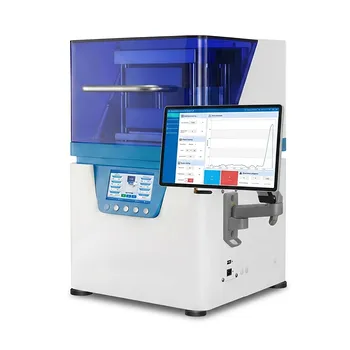
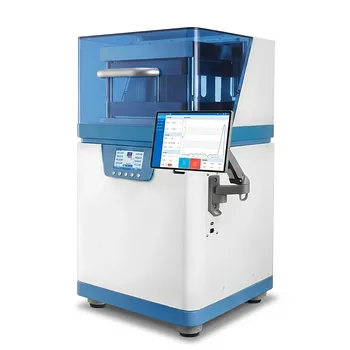
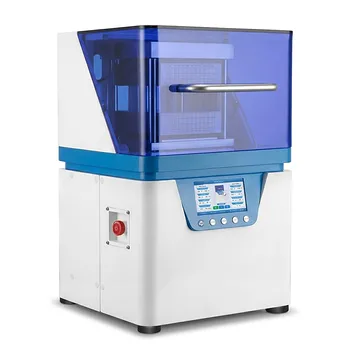
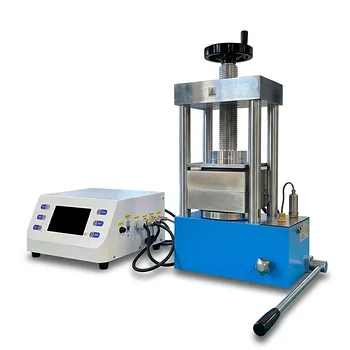
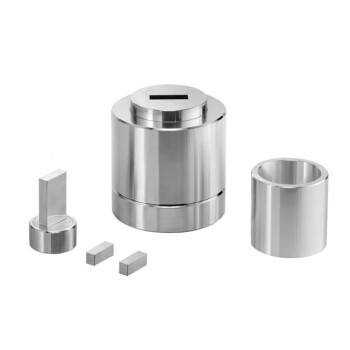
The laboratory hydraulic press is the critical bridge between raw MIEC powder synthesis and the creation of high-density ceramic targets.
It applies precise uniaxial pressure to compress oxide powders into robust "green bodies" with sufficient mechanical strength for handling. This compaction minimizes macro-porosity and maximizes particle-to-particle contact, ensuring the resulting target possesses the uniform density and structural integrity required for subsequent high-temperature sintering and Pulsed Laser Deposition (PLD).
For Mixed Ionic-Electronic Conductors (MIEC), the hydraulic press is not merely a shaping tool but a densification catalyst. By establishing high packing density at the green body stage, it ensures the chemical uniformity and mechanical stability essential for advanced thin-film deposition.
Enhancing Material Density and Microstructure
Minimizing Internal Macro-porosity
High pressure—often ranging from 71 MPa to 775 MPa—forces MIEC oxide particles to rearrange and pack tightly within a mold. This process eliminates large air pockets that would otherwise lead to structural defects or low density during the sintering phase.
Maximizing Particle Contact for Diffusion
By reducing the physical distance between powder particles, the hydraulic press creates the necessary environment for diffusion-controlled solid-state reactions. This enhanced contact is vital when the green body is fired in a furnace to achieve a fully dense, polycrystalline structure.
Establishing Green Strength
The press provides the initial mechanical bonding required to transform loose powder into a "green body." This strength is necessary to ensure the specimen can be handled and moved into a sintering furnace without crumbling or cracking.
Ensuring Target Integrity for Thin-Film Deposition
Precision for Pulsed Laser Deposition (PLD)
MIEC targets, such as LSF (Lanthanum Strontium Ferrite) or LSCrMn, must be exceptionally dense to serve as stable particle sources during laser ablation. The hydraulic press ensures the target can withstand the thermal shock of a laser without generating micro-cracks that would degrade the quality of the epitaxial layers.
Achieving Uniform Chemical Composition
Precise control over the hydraulic output prevents density gradients across the target's diameter. A uniform density ensures that the ionic and electronic conductivity remains consistent throughout the material, which is critical for the performance of the final electrochemical device.
Standardization of Test Specimens
Using specialized precision molds, the press produces standardized shapes, such as cylindrical pellets or ring-shaped specimens. This geometric consistency is vital for accurate measurements of electrical properties using tools like Vector Network Analyzers.
Understanding the Trade-offs
Pressure Sensitivity and "Capping"
While high pressure increases density, exceeding the material's limit can cause internal stress fractures or "capping," where the top of the pellet delaminates. Researchers must calibrate the specific unit pressure to the specific MIEC powder chemistry to avoid these defects.
Uniaxial vs. Isostatic Limitations
Uniaxial pressing in a hydraulic press can sometimes lead to non-uniform density between the edges and the center of the sample. To mitigate this, many processes require homogenized powders and specialized lubricants to ensure the pressure is distributed as evenly as possible.
How to Apply This to Your Research
To optimize MIEC target preparation, match your hydraulic press settings to your specific material goals and deposition requirements.
- If your primary focus is Pulsed Laser Deposition (PLD): Utilize higher compaction pressures (typically 70 MPa or above) to maximize target density and ensure a stable particle source during ablation.
- If your primary focus is ceramic membrane supports: Carefully balance the hydraulic pressure with the concentration of pore-forming agents to manage the final pore size distribution and porosity.
- If your primary focus is solid-state reaction kinetics: Focus on achieving maximum particle contact at moderate pressures to facilitate efficient ion diffusion during the initial firing stage.
Mastering the compaction phase via a hydraulic press is the definitive step in transforming raw MIEC powders into high-performance functional ceramics.
Summary Table:
| Key Function | Impact on MIEC Ceramic Targets | Typical Pressure Range |
|---|---|---|
| Powder Compaction | Transforms raw powder into robust "green bodies" with high packing density. | 71 MPa – 775 MPa |
| Porosity Control | Minimizes macro-porosity and internal air pockets to prevent structural defects. | Variable based on material |
| Diffusion Catalyst | Maximizes particle-to-particle contact to facilitate solid-state reactions. | High Compaction |
| Structural Integrity | Ensures targets withstand thermal shock during Pulsed Laser Deposition (PLD). | High Compaction |
| Geometric Precision | Produces standardized pellet or ring shapes for accurate electrical testing. | Mold Dependent |
Elevate Your Material Research with KINTEK Precision
Achieving the perfect density for MIEC ceramic targets requires more than just pressure—it requires precision. KINTEK specializes in high-performance laboratory equipment designed to bridge the gap between powder synthesis and advanced thin-film deposition.
Whether you are performing Pulsed Laser Deposition (PLD) or researching electrochemical devices, our comprehensive range of hydraulic presses (pellet, hot, isostatic), crushing and milling systems, and high-temperature furnaces ensures your targets possess the uniform density and structural integrity necessary for world-class results. We also provide essential high-temperature high-pressure reactors, ceramics, and crucibles to support your entire workflow.
Ready to optimize your compaction process? Contact KINTEK today to discover how our tailored laboratory solutions can enhance your research efficiency and material performance!
References
- Alexander Schmid, Jürgen Fleig. A High Temperature Harvestorer Based on a Photovoltaic Cell and an Oxygen Ion Battery. DOI: 10.1021/acsaem.3c02494
This article is also based on technical information from Kintek Solution Knowledge Base .
Related Products
- Laboratory Hydraulic Press Split Electric Lab Pellet Press
- Fully Automatic Heated Hydraulic Lab Press for Materials Sintering and Sample Preparation
- Automatic Laboratory Hot Press 400x400 mm with Programmable High Temperature and Hydraulic Force Control
- Laboratory Hydraulic Press Lab Pellet Press Machine for Glove Box
- Laboratory Manual Hydraulic Pellet Press for Lab Use
People Also Ask
- What role does a laboratory hydraulic press play in platinum recovery research? Enhancing Sample Precision
- What are the specific applications of a lab hydraulic press in biochar evaluation? Optimize density and data accuracy.
- What are the roles of a laboratory hydraulic press and stainless steel molds in the preparation of graphite samples?
- What is the role of a laboratory hydraulic press in electrode prep? Maximize Energy Density & Sealing Precision
- Why must a laboratory hydraulic press equipped with cylindrical molds be used when preparing BZY green bodies? High Density