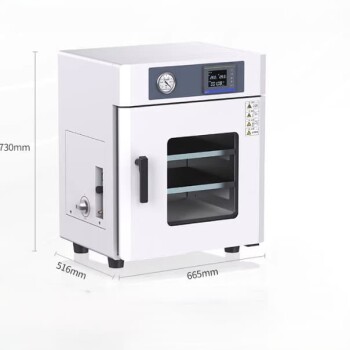
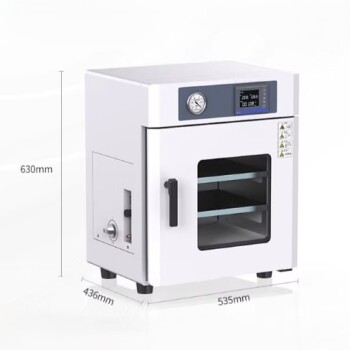
The laboratory vacuum drying oven is the critical tool used to remove volatile solvents and moisture from Nano-LiFePO4/C electrode sheets during the fabrication process. By operating under reduced pressure, the oven allows for the thorough evaporation of N-methylpyrrolidone (NMP) and trace water at relatively low temperatures, typically around 60°C to 80°C for extended periods.
The primary role of the vacuum drying oven is to solidify the electrode slurry into a stable, dry film while protecting the sensitive Nano-LiFePO4/C structure from thermal degradation and oxidation. This step is essential to prevent internal chemical reactions that would otherwise compromise the battery's cycle life and safety.
Removing Residual Solvents and Trace Moisture
Eliminating the NMP Solvent
During the coating process, active materials are mixed with a solvent called N-methylpyrrolidone (NMP) to create a slurry. The vacuum oven provides the heat and low-pressure environment necessary to evaporate this solvent completely, transforming the wet slurry into a solid electrode layer.
Preventing Electrolyte Decomposition
Even trace amounts of moisture can be catastrophic for lithium-ion batteries. If water remains in the electrode, it can react with the electrolyte salt (LiPF6) to form hydrofluoric acid (HF), which corrodes the internal components and significantly reduces the battery's lifespan.
Protecting Material Integrity via Vacuum
Lowering the Boiling Point
The vacuum environment significantly reduces the boiling point of organic solvents and water. This allows the drying process to occur at lower temperatures, which is vital for maintaining the delicate nano-scale architecture of the LiFePO4/C particles.
Preventing High-Temperature Oxidation
Nano-LiFePO4/C materials are susceptible to oxidation when exposed to high heat in the presence of oxygen. By removing air from the chamber, the vacuum oven ensures that the carbon coating and the active material remain chemically stable during the 12-hour heating cycle.
Ensuring Structural Stability and Adhesion
Promoting Strong Film Adhesion
As the solvent evaporates, the active materials, conductive agents, and binders settle onto the current collector. Controlled drying in a vacuum oven ensures a uniform and strongly adherent electrode film, preventing delamination during battery cycling.
Maintaining Porous Electrode Structure
For nano-materials, preserving the micropore structure is essential for fast ion transport. The low-temperature thermal stress provided by a vacuum environment prevents the collapse of these structures, ensuring the battery maintains high power density.
Understanding the Trade-offs and Pitfalls
Temperature vs. Material Stability
While higher temperatures (such as 120°C) can accelerate drying, they increase the risk of damaging the binder's polymer chain or oxidizing the carbon coating. Users must balance the speed of production with the specific thermal limits of their binder and active material.
Vacuum Depth and Solvent Recovery
A weak vacuum may leave residual NMP trapped in the deep pores of the nano-material, leading to poor electrochemical performance. Conversely, extremely rapid evacuation can sometimes cause "skinning," where the surface dries too quickly and traps solvent underneath, leading to a brittle electrode.
Applying This to Your Electrode Production
How to Optimize Your Drying Process
- If your primary focus is Maximum Cycle Life: Prioritize a longer drying time (12+ hours) at a lower temperature (60°C) under high vacuum to ensure the absolute removal of moisture without stressing the material.
- If your primary focus is High-Throughput Testing: Use a moderate temperature of 80°C with a multi-stage vacuum pull to accelerate solvent removal while monitoring for any signs of electrode cracking or peeling.
- If your primary focus is Material Purity: Ensure the oven is purged with an inert gas like Nitrogen before the vacuum cycle to further minimize the risk of oxidation for sensitive LiFePO4/C composites.
The vacuum drying oven is not merely a heater, but a precision environment that ensures the chemical and structural readiness of Nano-LiFePO4/C electrodes for high-performance battery applications.
Summary Table:
| Process Step | Core Function | Benefit to Nano-LiFePO4/C |
|---|---|---|
| Solvent Removal | Evaporates NMP at low pressure | Solidifies slurry into a stable, dry film |
| Moisture Extraction | Eliminates trace water | Prevents HF formation and internal corrosion |
| Thermal Protection | Lowers boiling points | Preserves delicate nano-scale architecture |
| Inert Environment | Removes atmospheric oxygen | Prevents oxidation of the carbon coating |
Elevate Your Battery Research with KINTEK
Precision is the backbone of high-performance energy storage. KINTEK specializes in advanced laboratory equipment designed for the rigorous demands of Nano-LiFePO4/C electrode production. Whether you need high-precision vacuum drying ovens to ensure material integrity, crushing and milling systems for particle refinement, or hydraulic pellet presses for electrode preparation, we provide the tools that drive innovation.
Our comprehensive portfolio includes:
- High-Temperature Furnaces: Muffle, tube, vacuum, and atmosphere models for advanced sintering.
- Battery Research Essentials: Electrolytic cells, electrodes, high-pressure reactors, and specialized consumables like PTFE and ceramics.
- Sample Preparation: Homogenizers, shakers, and cooling solutions including ULT freezers and freeze dryers.
Don’t let residual moisture or oxidation compromise your cell performance. Our experts are ready to help you select the ideal equipment configuration to maximize your laboratory's efficiency and results.
Contact KINTEK Today for a Professional Consultation
References
- Haozhi Duan, Shuxia Yuan. Solution Combustion Synthesis of High-Performance Nano-LiFePO4/C Cathode Material from Cost-Effective Mixed Fuels. DOI: 10.3390/ma16227155
This article is also based on technical information from Kintek Solution Knowledge Base .
Related Products
- 56L Vertical Laboratory Vacuum Drying Oven
- 23L Laboratory Vacuum Drying Oven
- Laboratory Scientific Electric Heating Blast Drying Oven
- Benchtop Laboratory Vacuum Freeze Dryer
- Dental Porcelain Zirconia Sintering Ceramic Vacuum Press Furnace
People Also Ask
- Why is a laboratory vacuum drying oven recommended for rice straw residues? Protect Your Biomass Integrity
- What role does a laboratory vacuum drying oven play in the preparation of modified multi-walled carbon nanotubes?
- What is the importance of using a laboratory vacuum drying oven? Preserving Slow-Release Microcapsule Integrity
- Why is a Laboratory Vacuum Drying Oven recommended for PBAT microspheres? Protect Sensitive Polymer Integrity
- What role does a laboratory vacuum drying oven play in processing nanoparticle powder samples? Protect Sample Integrity