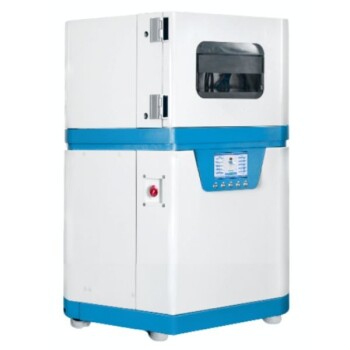
The primary role of a laboratory vacuum oven in the post-treatment of Waterborne Polyurethane Urea (WBPUU) films is to facilitate the complete removal of residual water and trace solvents through a controlled environment of heat and negative pressure. This process is critical for converting a raw cast layer into a structurally sound, dense, and stable material.
Core Takeaway While standard drying removes surface moisture, a vacuum oven addresses the internal structure of the film. By combining negative pressure with uniform heating (e.g., 60°C), the process forces the elimination of micro-bubbles and relieves internal stresses, allowing polymer chains to rearrange into a dense, high-performance configuration.
Mechanisms of Film Stabilization
To understand the necessity of this equipment, one must look beyond simple drying. The vacuum oven performs three distinct physical functions that standard air drying cannot achieve efficiently.
Acceleration of Solvent Migration
WBPUU films retain water and solvents deep within their matrix.
The vacuum oven applies negative pressure, which lowers the boiling point of these trapped liquids.
This allows moisture to migrate to the surface and evaporate rapidly without requiring excessive temperatures that could damage the polymer.
Elimination of Micro-Bubbles
During the casting and initial drying phases, air and solvent vapors often become trapped, creating microscopic voids.
The vacuum environment actively pulls these gases out of the film.
Removing these micro-bubbles is essential for ensuring the film has uniform density and optical clarity.
Relief of Internal Stresses
As films dry and shrink, mechanical tension builds up within the material.
If left untreated, these internal stresses can lead to cracking, warping, or eventual delamination.
The controlled environment of the vacuum oven relaxes the material, neutralizing these forces before the film fully sets.
Structural Enhancement
The ultimate goal of using a vacuum oven is not just removal of volatiles, but the physical reorganization of the material itself.
Promoting Polymer Chain Rearrangement
For a WBPUU film to exhibit its best mechanical properties, the molecules must be aligned correctly.
The combination of thermal energy and vacuum promotes the rearrangement of polymer chains.
This molecular shuffling allows the chains to pack more tightly, resulting in a more cohesive structure.
Achieving High Density
A film treated in ambient conditions may remain porous or "fluffy" at a microscopic level.
The vacuum post-treatment consolidates the material.
This results in a stable, dense film sample that accurately represents the material's true potential.
Critical Considerations and Trade-offs
While the vacuum oven is a powerful tool, it must be applied with precision to avoid damaging the sample.
The Necessity of Uniform Heating
The process relies on uniform heating to be effective.
Uneven temperature distribution can cause differential drying, where one part of the film cures faster than another.
This can re-introduce stress or cause the film to warp, negating the benefits of the vacuum.
Balancing Temperature and Pressure
The primary reference suggests a specific temperature, such as 60°C.
Deviating significantly from the optimal temperature presents risks.
Too much heat can degrade the urea groups, while insufficient vacuum may fail to remove the deepest trapped solvents, leaving the film chemically unstable.
Making the Right Choice for Your Goal
When configuring your post-treatment process for WBPUU films, consider your specific performance targets.
- If your primary focus is Optical and Structural Homogeneity: Prioritize the vacuum strength to ensure the complete extraction of micro-bubbles which scatter light and weaken the matrix.
- If your primary focus is Mechanical Durability: Ensure the thermal cycle is sufficient (e.g., maintaining 60°C) to allow full polymer chain rearrangement for maximum density.
Ultimately, the vacuum oven is not merely a drying tool, but a structural engineering device essential for creating a defect-free WBPUU film.
Summary Table:
| Post-Treatment Mechanism | Physical Impact on WBPUU Film | Critical Benefit |
|---|---|---|
| Negative Pressure | Lowers solvent boiling points | Accelerates deep-matrix moisture removal |
| Degassing Environment | Extracts trapped air and vapors | Eliminates micro-bubbles for optical clarity |
| Uniform Thermal Energy | Relaxes molecular tension | Relieves internal stresses to prevent cracking |
| Vacuum Consolidation | Facilitates chain rearrangement | Achieves high density and mechanical stability |
Elevate Your Polymer Research with KINTEK Precision
Achieving the perfect WBPUU film requires more than just heat—it demands a meticulously controlled environment. KINTEK specializes in high-performance laboratory equipment, including advanced vacuum ovens designed for uniform heating and precise pressure control to ensure your materials reach their full structural potential.
From high-temperature furnaces and high-pressure reactors to specialized PTFE and ceramic consumables, KINTEK provides the comprehensive tools needed for cutting-edge battery research, chemical synthesis, and material science.
Ready to eliminate defects and enhance your film density?
Contact our experts today to find the perfect laboratory solution!
References
- Arantzazu Santamaria‐Echart, Arantxa Eceiza. Development of waterborne polyurethane-ureas added with plant extracts: Study of different incorporation routes and their influence on particle size, thermal, mechanical and antibacterial properties. DOI: 10.1016/j.porgcoat.2018.01.006
This article is also based on technical information from Kintek Solution Knowledge Base .
Related Products
- 56L Vertical Laboratory Vacuum Drying Oven
- 23L Laboratory Vacuum Drying Oven
- Laboratory Scientific Electric Heating Blast Drying Oven
- Laboratory Sterilizer Lab Autoclave Pulsating Vacuum Desktop Steam Sterilizer
- High Temperature Muffle Oven Furnace for Laboratory Debinding and Pre Sintering
People Also Ask
- Why is a laboratory vacuum drying oven recommended for rice straw residues? Protect Your Biomass Integrity
- What role does a laboratory vacuum drying oven play in the preparation of modified multi-walled carbon nanotubes?
- What is the importance of using a laboratory vacuum drying oven? Preserving Slow-Release Microcapsule Integrity
- Why is a Laboratory Vacuum Drying Oven recommended for PBAT microspheres? Protect Sensitive Polymer Integrity
- What role does a laboratory vacuum drying oven play in processing nanoparticle powder samples? Protect Sample Integrity