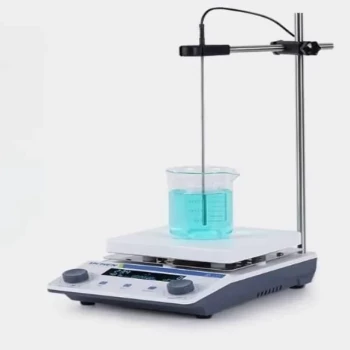
In the Carbonyl Method, the magnetic stirring reactor acts as the primary driver for chemical homogeneity. It ensures thorough contact between platinum salt precursors and solvents within a controlled carbon monoxide (CO) atmosphere. By maintaining continuous fluid motion, the reactor eliminates concentration gradients, allowing for the stable formation of specific carbonyl coordination compounds required for high-quality nanocatalysts.
Core Takeaway The magnetic stirring reactor is not merely for mixing; it is a tool for stabilizing reaction kinetics. By maintaining a uniform chemical environment, it enables the precise synthesis of complex precursors like $[Pt_3(CO)_6]_n^{2-}$, which serves as the essential foundation for subsequent catalyst loading.
Achieving Chemical Homogeneity
Eliminating Concentration Gradients
In static solutions, reactants can settle or cluster, leading to uneven reaction rates. The magnetic stirrer drives continuous macroscopic movement of the fluid.
This forced convection ensures that platinum salts are evenly distributed throughout the solvent. It prevents localized areas of high or low concentration, which is critical for consistent chemical behavior.
Facilitating Gas-Liquid Interaction
The Carbonyl Method relies on a reaction under a carbon monoxide (CO) atmosphere. The stirring mechanism plays a vital role in this multiphase interaction.
By agitating the liquid, the stirrer constantly renews the surface area exposed to the gas. This ensures that the CO is effectively integrated into the solution to react with the platinum precursors.
The Formation of Precursors
Stabilizing Complex Coordination Compounds
The ultimate goal of this phase is the formation of specific platinum carbonyl complexes, such as $[Pt_3(CO)_6]_n^{2-}$.
Uniform stirring creates the stable thermodynamic conditions necessary for these delicate structures to form. Without this stability, the reaction could yield inconsistent byproducts rather than the desired coordination compounds.
Preparing for Catalyst Loading
The quality of the final nanocatalyst depends entirely on the quality of the precursor solution.
The magnetic reactor ensures that the precursor solution serves as a uniform "foundation." This homogeneity is a prerequisite for the subsequent step of loading the platinum onto support materials, ensuring the final catalyst particles are evenly dispersed.
Understanding the Trade-offs
The Risk of Inadequate Mixing
If the stirring speed is insufficient, diffusion becomes the limiting factor. This can lead to "dead zones" within the reactor where the reaction creates different chemical species than intended.
Inadequate mixing results in a heterogeneous solution. This lack of uniformity will propagate to the final product, resulting in nanocatalysts with poor particle size distribution or inconsistent catalytic activity.
Mechanical vs. Chemical Control
While the stirrer provides mechanical assistance, it is not a substitute for precise temperature control.
The stirrer creates the environment for uniformity, but the rate of the reaction is still dictated by thermal conditions. The operator must ensure the stirring mechanism does not introduce excess heat via friction or motor transfer, which could destabilize the temperature-sensitive carbonyl complexes.
Making the Right Choice for Your Goal
When configuring your reactor for the Carbonyl Method, consider your specific endpoints:
- If your primary focus is Structural Uniformity: Prioritize a consistent, moderate stirring speed to ensure the $[Pt_3(CO)_6]_n^{2-}$ complex forms evenly across the entire solution volume.
- If your primary focus is Reaction Efficiency: Ensure the stirring is vigorous enough to maximize the gas-liquid interface between the solvent and the CO atmosphere without splashing.
Control the motion of your precursors today to guarantee the performance of your catalyst tomorrow.
Summary Table:
| Feature | Role in Carbonyl Method | Impact on Catalyst Quality |
|---|---|---|
| Homogenization | Eliminates concentration gradients of Pt salts | Uniform particle size distribution |
| Multiphase Interaction | Maximizes CO gas-to-liquid interface | Efficient formation of $[Pt_3(CO)_6]_n^{2-}$ |
| Kinetic Stability | Maintains stable thermodynamic environment | Prevents byproduct formation |
| Convection Control | Overcomes diffusion limitations | Consistent catalytic activity levels |
Elevate Your Nanocatalyst Synthesis with KINTEK Precision
Precise control over reaction kinetics is non-negotiable for high-performance catalyst development. KINTEK specializes in advanced laboratory equipment designed to meet the rigorous demands of chemical research. From high-performance magnetic stirring reactors and high-pressure autoclaves to precision crushing systems and temperature-controlled furnaces, we provide the tools necessary to ensure perfect chemical homogeneity.
Whether you are synthesizing complex platinum carbonyls or scaling up battery research, KINTEK’s comprehensive portfolio of reactors, electrolytic cells, and high-temperature equipment delivers the reliability your lab deserves.
Ready to optimize your synthesis process? Contact KINTEK today for a tailored solution!
References
- Aldo Saul Gago, Nicolás Alonso‐Vante. Tailoring nanostructured catalysts for electrochemical energy conversion systems. DOI: 10.1515/ntrev-2012-0013
This article is also based on technical information from Kintek Solution Knowledge Base .
Related Products
- Laboratory Small Constant Temperature Heated Magnetic Stirrer Heater and Stirrer
- Custom PTFE Teflon Parts Manufacturer for Magnetic Stirring Bar
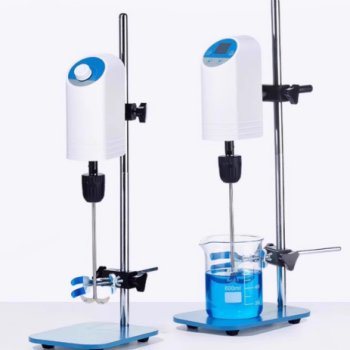
- High Performance Laboratory Stirrers for Diverse Applications
- Mini SS High Pressure Autoclave Reactor for Laboratory Use
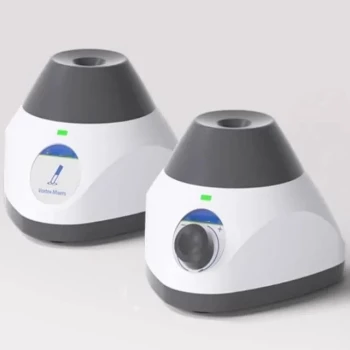
- Laboratory Vortex Mixer Orbital Shaker Multifunctional Rotation Oscillation Mixer
People Also Ask
- What role does a magnetic stirrer with heating play in ZnO nanoparticle synthesis? Precision Control for Quality Results
- What role does a constant temperature heating magnetic stirrer play in MFC-HAp synthesis? Achieve Material Homogeneity
- What is the function of a laboratory magnetic stirrer in Ni–Cr–P electrodeposition? Optimize Ion Transport & Coating
- Why is a laboratory magnetic stirrer required for benzoic acid esters? Boost Reaction Speed & Yield with High RPM
- What role does a laboratory magnetic stirrer play in TiO2 and TiO2-Ag sol preparation? Master Chemical Kinetics