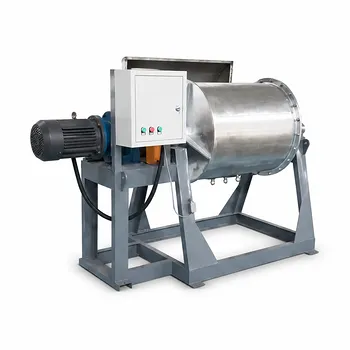
A planetary ball mill serves as the primary engine for high-energy grinding and homogenization in the raw material processing stage. Its role is to generate intense impact and shear forces that forcibly mix cerium dioxide (CeO2) with dopants like yttrium oxide (Y2O3), while simultaneously refining the particles down to the micrometer scale.
The planetary ball mill acts as a necessary bridge between raw powder and the final material structure; it creates the uniform mechanical mixing required to facilitate high-temperature solid-state reactions and ensures high dopant dispersion within the matrix.
The Mechanics of High-Energy Grinding
Generating Intense Physical Forces
The planetary ball mill operates by subjecting materials to high-energy mechanical stress.
By utilizing specific rotational speeds, such as 500 rpm, the machine generates significant kinetic energy.
Impact and Shear Action
This energy translates into intense impact and shear forces acting upon the raw materials.
These forces are strong enough to break down particle agglomerates and force distinct materials to integrate.
Achieving Material Uniformity
Integrating the Dopant
The process involves the simultaneous processing of cerium dioxide and yttrium oxide (Y2O3).
The ball mill forcibly mixes these two distinct powders. This transforms separate raw ingredients into a homogenous composite mixture.
Micrometer-Scale Refinement
Beyond simple mixing, the mill performs a critical sizing function.
It refines the raw particles down to the micrometer scale. This reduction in size increases the surface area available for subsequent reactions.
Preparing for Solid-State Reactions
Ensuring High Dispersion
The mechanical mixing provided by the ball mill is essential for the quality of the final product.
It ensures a high dispersion of dopants within the cerium dioxide matrix, preventing "hot spots" or uneven concentrations of yttrium oxide.
Facilitating Thermal Processing
This uniform mixture is the prerequisite for successful high-temperature solid-state reactions.
By ensuring the materials are intimately mixed and sized correctly, the process yields a microsphere structure with a uniform particle size distribution.
Critical Process Parameters
The Necessity of Specific Speeds
This process is not passive; it requires precise control over energy input.
The primary reference highlights the use of specific speeds, such as 500 rpm, indicating that sufficient energy must be applied to achieve the necessary impact forces.
The Risk of Inadequate Mixing
Without this high-energy grinding, the raw materials would lack the necessary contact points.
This would likely lead to incomplete solid-state reactions and a final structure lacking the required uniformity.
Making the Right Choice for Your Goal
To maximize the effectiveness of your material preparation, consider your specific objectives regarding the ball milling stage:
- If your primary focus is Chemical Homogeneity: Prioritize the duration and intensity of the mixing phase to ensure the yttrium oxide is thoroughly dispersed within the cerium dioxide matrix.
- If your primary focus is Structural Reactivity: Focus on the refinement capability to ensure particles reach the micrometer scale, optimizing the surface area for high-temperature reactions.
The planetary ball mill effectively transforms raw, disparate powders into a refined, uniform precursor ready for advanced thermal processing.
Summary Table:
| Process Function | Mechanism | Technical Outcome |
|---|---|---|
| High-Energy Grinding | Intense impact & shear forces at 500+ rpm | Breakage of agglomerates and particle size reduction |
| Homogenization | Simultaneous mixing of CeO2 and Y2O3 | Uniform dopant dispersion within the matrix |
| Sizing Function | Mechanical refinement | Micrometer-scale particles for high surface area |
| Pre-Reaction Prep | Mechanical alloying | Facilitation of high-temperature solid-state reactions |
Elevate Your Material Synthesis with KINTEK Precision
Achieving perfect dopant dispersion in cerium dioxide microspheres requires more than just mixing—it requires the high-energy performance of KINTEK’s advanced planetary ball mills.
Whether you are refining particles to the micrometer scale or preparing precursors for high-temperature solid-state reactions, KINTEK provides the specialized laboratory equipment you need. From our high-performance crushing and milling systems to our high-temperature furnaces and hydraulic presses, we empower researchers to produce materials with unrivaled uniformity.
Ready to optimize your lab’s efficiency and material quality? Contact KINTEK experts today to find the perfect solution for your research!
References
- И. А. Иванов, Аrtem L. Kozlovskiy. Study of the Effect of Y2O3 Doping on the Resistance to Radiation Damage of CeO2 Microparticles under Irradiation with Heavy Xe22+ Ions. DOI: 10.3390/cryst11121459
This article is also based on technical information from Kintek Solution Knowledge Base .
Related Products
- High Energy Planetary Ball Mill for Laboratory Horizontal Tank Type Milling Machine
- Laboratory Planetary Ball Mill Rotating Ball Milling Machine
- High-Energy Omnidirectional Planetary Ball Mill Milling Machine for Laboratory
- High Energy Planetary Ball Mill Milling Machine for Laboratory
- Laboratory Horizontal Planetary Ball Mill Milling Machine
People Also Ask
- What is the role of a planetary ball mill in sulfide-based solid-state batteries? Engineer High-Performance Cathodes
- What are the parameters of a planetary ball mill? Master Speed, Time, and Media for Perfect Grinding
- What is the function of a planetary ball mill for nanostructured eutectic steel? Essential Prep for High-Strength Alloys
- What role does a planetary ball mill play in the preparation of NASICON-type solid electrolytes like LATP and LAGP?
- What is the function of a planetary ball mill in solid-state electrolyte prep? Milling vs. SDS Methods Explained