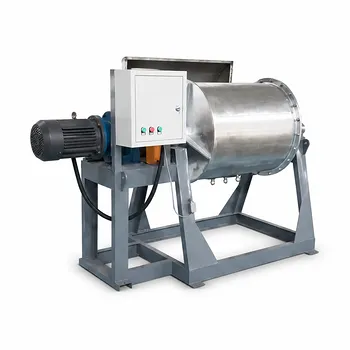
The planetary ball mill serves as the primary engine for mechanical alloying during the preparation of FeCrAlY-Al2O3 composite powders. By utilizing high-speed rotation and high-energy impact, it forces nano-scale ceramic particles (Al2O3) to embed directly into micro-scale alloy powders, ensuring a uniform dispersion that simple mixing cannot achieve.
The core function of the planetary ball mill in this context is to overcome the natural agglomeration of nanomaterials. Through high-energy mechanical impact, it physically anchors nano-particles into the alloy matrix, ensuring the structural homogeneity required for effective thermal spraying.
Achieving Mechanical Alloying Through High-Energy Impact
The preparation of FeCrAlY-Al2O3 coatings requires more than simple blending; it requires mechanical alloying. The planetary ball mill generates the kinetic energy necessary to bond two materials with vastly different physical characteristics.
Generating Intense Kinetic Forces
The device operates by rotating jars around a central axis while the jars themselves spin in the opposite direction. This creates high-speed centrifugal forces.
The resulting movement causes the grinding balls to impact the raw materials with significant energy. This impact is the driving force that alters the physical state of the powder mixture.
Deep Mixing of Dissimilar Scales
The challenge in this specific composite is mixing nano-scale Al2O3 (ceramic) with micro-scale FeCrAlY (metal alloy).
Standard mixers often leave these distinct phases separated. The planetary ball mill utilizes its high-energy environment to facilitate a "deep mix," ensuring the ceramic and metal phases are intimately combined at the microscopic level.
Overcoming Nanomaterial Agglomeration
One of the most persistent challenges in working with nano-ceramics like Al2O3 is their tendency to clump together, or agglomerate. The planetary ball mill is the specific solution to this problem.
Breaking Down Particle Clusters
Nano-particles have high surface energy, causing them to stick together in clusters that can compromise coating performance.
The impact and shear forces generated by the grinding balls physically shatter these agglomerates. This ensures that the Al2O3 remains as individual nano-particles rather than large, inconsistent clumps.
Embedding Particles into the Matrix
Once the agglomerates are broken, the mill does not simply leave the particles floating side-by-side.
The mechanical force effectively embeds the nano-particles into the softer micro-scale alloy powder. This physical anchoring creates a true composite particle, preventing the materials from separating during later handling or processing.
Ensuring Uniformity for Thermal Spraying
The ultimate goal of this milling process is to prepare a feedstock suitable for thermal spraying. The quality of the final coating is directly dependent on the uniformity of the raw material.
Creating a Homogeneous Feedstock
Thermal spraying requires a consistent flow of material to create a uniform coating thickness and density.
By utilizing mechanical alloying, the planetary ball mill ensures that every grain of powder contains the correct ratio of FeCrAlY to Al2O3. This eliminates "pockets" of pure ceramic or pure metal in the final coating.
Enhancing Coating Consistency
A uniform composition in the raw powder leads to a uniform microstructure in the deposited coating.
This process ensures that the beneficial properties of the nano-ceramics—such as hardness and wear resistance—are evenly distributed throughout the entire coating layer.
Understanding the Trade-offs and Critical Controls
While planetary ball milling is essential for this composite, it introduces specific variables that must be managed to avoid degrading the material.
Risk of Impurity Contamination
The same high-energy impact that mixes the powder causes wear on the grinding balls and jars.
If not monitored, material from the grinding media can contaminate the feedstock. It is critical to select grinding media that is compatible with the FeCrAlY-Al2O3 system to minimize chemical interference.
Managing Energy Input
There is a balance between sufficient alloying and excessive deformation.
Insufficient milling time or speed will fail to embed the nano-particles, leading to separation. Conversely, excessive milling can work-harden the alloy powder or alter its particle size distribution too drastically, potentially affecting flowability during thermal spraying.
Making the Right Choice for Your Goal
The planetary ball mill is not just a mixer; it is a synthesis tool that dictates the quality of your final composite.
- If your primary focus is Coating Homogeneity: Prioritize milling parameters that maximize the embedding of nano-particles to prevent phase separation during spraying.
- If your primary focus is Nanomaterial Efficiency: Ensure the milling energy is high enough to break down all Al2O3 agglomerates, maximizing the active surface area of the ceramic phase.
By leveraging the high-energy impact of planetary ball milling, you transform distinct raw powders into a unified composite system, laying the foundation for superior coating durability.
Summary Table:
| Feature | Function in FeCrAlY-Al2O3 Preparation | Impact on Coating Quality |
|---|---|---|
| High-Energy Impact | Facilitates mechanical alloying of metal and ceramic | Ensures structural homogeneity |
| Agglomerate Breaking | Shatters nano-Al2O3 clusters into individual particles | Maximizes active surface area |
| Phase Embedding | Anchors nano-ceramics into the micro-alloy matrix | Prevents separation during spraying |
| Particle Uniformity | Creates a consistent composite feedstock | Guarantees even hardness & wear resistance |
Elevate Your Material Research with KINTEK Precision
Precision in nano-ceramic coatings starts with the right equipment. KINTEK specializes in high-performance planetary ball mills, crushing and milling systems, and sieving equipment designed to overcome agglomeration and achieve perfect mechanical alloying.
Whether you are developing advanced coatings or researching battery technologies, our comprehensive range—including high-temperature furnaces, hydraulic presses, and high-pressure reactors—provides the reliability your lab needs.
Ready to optimize your feedstock uniformity? Contact our technical experts today to find the ideal milling solution for your specific application!
References
- Qingyu Li, Jijun Yang. Microstructure, Mechanical Properties, and Lead–Bismuth Eutectic Corrosion Behaviors of FeCrAlY-Al2O3 Nanoceramic Composite Coatings. DOI: 10.3390/coatings14040393
This article is also based on technical information from Kintek Solution Knowledge Base .
Related Products
- High Energy Planetary Ball Mill for Laboratory Horizontal Tank Type Milling Machine
- Laboratory Planetary Ball Mill Rotating Ball Milling Machine
- High-Energy Omnidirectional Planetary Ball Mill Milling Machine for Laboratory
- High Energy Planetary Ball Mill Milling Machine for Laboratory
- Laboratory Horizontal Planetary Ball Mill Milling Machine
People Also Ask
- What is the role of a planetary ball mill in sulfide-based solid-state batteries? Engineer High-Performance Cathodes
- What are the parameters of a planetary ball mill? Master Speed, Time, and Media for Perfect Grinding
- What is the function of a planetary ball mill for nanostructured eutectic steel? Essential Prep for High-Strength Alloys
- What role does a planetary ball mill play in the preparation of NASICON-type solid electrolytes like LATP and LAGP?
- What is the function of a planetary ball mill in solid-state electrolyte prep? Milling vs. SDS Methods Explained