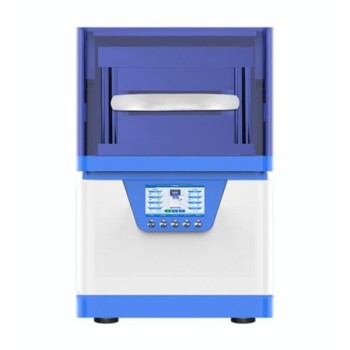
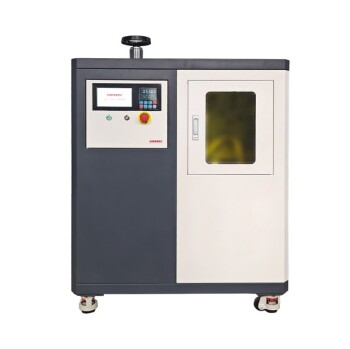
In the fabrication of thallium bromide (TlBr) crystals, the precision hot press functions as the primary mechanism for structural densification and crystallographic alignment. By applying a continuous pressure of approximately 30 kN within a strict temperature window of 455°C to 465°C, the device transforms high-purity raw material into a unified, high-density semiconductor block suitable for radiation detection.
Core Takeaway The hot press utilizes a process called thermo-mechanical coupling to simultaneously eliminate internal micropores and guide specific crystal orientation. This consolidation is the deciding factor in producing TlBr detectors that exhibit the high gamma-ray attenuation and energy resolution required for photon counting.
The Thermo-Mechanical Coupling Process
Precise Application of Heat and Pressure
The core function of the hot press is to create an environment where thermal energy and mechanical force act synergistically.
The system applies a massive axial pressure of 30 kN while maintaining a stable temperature range of 455°C to 465°C.
Consolidation of Zone-Refined Material
This process typically operates on high-purity, zone-refined TlBr powder or raw material.
Over a duration of approximately 2 hours, the machine compresses these materials within a specific mold. This transforms loose or porous input material into a solid, dimensionally precise block.
Structural Transformation and Defect Removal
Elimination of Internal Porosity
One of the most critical roles of the hot press is the removal of structural voids.
The continuous pressure forces the material to undergo dense consolidation, effectively squeezing out internal pore defects. This results in a material with tight inter-granular bonding and high physical density.
Guiding Crystal Orientation
Beyond simple compression, the hot press acts as a guide for the material's internal lattice.
By controlling the stress field during the heating phase, the press induces specific crystal orientations. This alignment is essential for ensuring consistency across the semiconductor material, preventing random defects that could impede charge transport.
Impact on Detector Performance
Enhancing Gamma-Ray Attenuation
The density achieved through hot pressing directly correlates to the material's stopping power.
A fully densified TlBr crystal possesses a superior gamma-ray attenuation coefficient. This allows the final detector to capture high-energy photons more effectively, increasing overall detection efficiency.
Optimizing Energy Resolution
The structural integrity provided by the hot press improves the electronic characteristics of the crystal.
By minimizing defects and aligning the crystal structure, the process enhances the current-voltage characteristics of the device. This leads to excellent energy resolution, which is vital for precise photon-counting applications.
Critical Considerations in Process Control
The Necessity of Parameter Stability
The "precision" in precision hot press is not a marketing term; it is a manufacturing requirement.
If the pressure deviates from 30 kN or the temperature fluctuates outside the 455-465°C window, the material may fail to reach full densification. Incomplete sintering results in residual porosity, which severely degrades detector performance.
Managing the Stress Field
While pressure is necessary, how that pressure is applied matters.
The hot press must maintain a controlled stress field to suppress defect formation during crystal growth. Uneven pressure distribution can introduce new structural flaws rather than fixing existing ones.
Making the Right Choice for Your Goal
To maximize the performance of TlBr semiconductor detectors, you must prioritize the stability of your sintering parameters.
- If your primary focus is Detection Efficiency: Ensure the hot press maintains maximum pressure (30 kN) to achieve full densification and the highest possible gamma-ray attenuation coefficient.
- If your primary focus is Energy Resolution: Prioritize precise temperature stability (455-465°C) and stress field control to optimize crystal orientation and minimize electrical defects.
The hot press is not merely a molding tool, but the defining instrument that governs the ultimate sensitivity and accuracy of the TlBr detector.
Summary Table:
| Parameter | Targeted Value | Impact on TlBr Semiconductor |
|---|---|---|
| Pressure | 30 kN (Axial) | Eliminates internal porosity and ensures dense consolidation |
| Temperature | 455°C – 465°C | Facilitates thermo-mechanical coupling and structural transformation |
| Process Time | ~2 Hours | Ensures full material densification and dimension precision |
| Structural Goal | Guided Orientation | Minimizes defects to enhance charge transport and energy resolution |
| Functional Result | High Density | Maximizes gamma-ray attenuation for superior photon counting |
Elevate Your Material Research with KINTEK Precision
High-performance TlBr semiconductor fabrication demands absolute stability. KINTEK specializes in advanced laboratory equipment, providing the precision hydraulic hot presses and high-temperature furnaces necessary to achieve perfect densification and crystallographic alignment.
Whether you are developing radiation detectors, advancing battery research, or exploring ceramic sintering, our comprehensive range of high-pressure reactors, crushing systems, and cooling solutions provides the reliability your lab requires.
Ready to optimize your energy resolution and detection efficiency? Contact KINTEK today to discuss our custom solutions for your semiconductor and material science applications!
References
- Katarina Rajković, Sanja Jeremić. Fatty acids profiles of Juglans nigra l. leaf. DOI: 10.21175/rad.abstr.book.2023.7.1
This article is also based on technical information from Kintek Solution Knowledge Base .
Related Products
- Automatic Laboratory Heat Press Machine
- Automatic Heated Hydraulic Press Machine with Heated Plates for Laboratory Hot Press 25T 30T 50T
- 30T 40T Split Automatic Heated Hydraulic Press Machine with Heated Plates for Laboratory Hot Press
- Automatic High Temperature Heated Hydraulic Press Machine with Heated Plates for Lab
- Manual High Temperature Heated Hydraulic Press Machine with Heated Plates for Lab
People Also Ask
- What are the core advantages of using a laboratory hot press to produce Bi2Se3? Achieve 93% Density & High Conductivity
- Why is a laboratory hot press necessary for all-solid-state battery assembly? Reduce Impedance and Enhance Performance
- How does a three-stage pressure program affect rice husk particleboards? Optimize Bond Strength & Stability
- What is the primary function of a laboratory hot press in MEA assembly? Optimize Fuel Cell Bonding & Performance
- How does a laboratory hot press improve alloy performance? Optimize Liquid Phase Sintering for High-Strength Materials