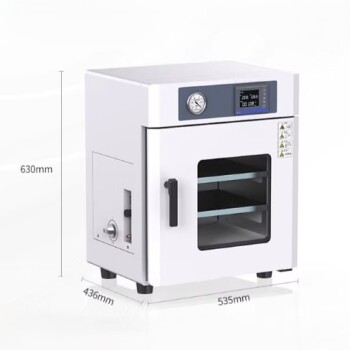
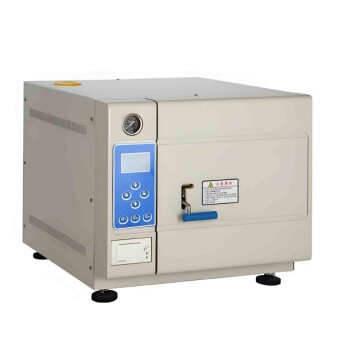
A precision laboratory oven acts as the critical external thermal regulator in the hydrothermal synthesis of copper sulfate nanocrystals. Its primary function is to maintain the hydrothermal autoclave system at a preset, unwavering temperature (commonly around 100°C), which stabilizes reaction kinetics and ensures the uniform growth of nanostructures.
The oven provides the thermal stability necessary to drive the chemical reaction, while the autoclave utilizes that heat to create a high-pressure environment. Together, they allow for the direct growth of high-quality nanocrystals on substrates like Fluorine-doped Tin Oxide (FTO), a feat difficult to achieve with standard methods.
The Mechanics of Thermal Regulation
Stabilizing Reaction Kinetics
The fundamental role of the oven is to eliminate thermal fluctuations. By keeping the environment at a precise constant temperature, the oven ensures that the chemical reactions occurring inside the autoclave proceed at a steady, predictable rate.
Driving the High-Pressure Environment
While the oven provides the heat, it is the sealed nature of the autoclave that translates this thermal energy into pressure. As the oven heats the solution above its boiling point, the pressure inside the autoclave rises significantly.
Enhancing Solubility
This heat-induced pressure increases the solubility of the reactants. It lowers the energy barrier required for nucleation, allowing copper sulfate crystals to form under conditions that standard atmospheric heating cannot support.
The Impact on Crystal Quality
Controlling Nucleation Rates
Precision heating is directly responsible for controlling how fast new crystals form (nucleation). If the oven temperature drifts, the nucleation rate becomes erratic, leading to a mix of crystal sizes and shapes.
Ensuring Uniform Growth
Once crystals begin to form, the oven’s stability governs their growth phase. A constant temperature ensures that copper sulfate nanocrystals grow evenly, resulting in a synthesized product with consistent structural integrity and quality.
Understanding the Trade-offs
Thermal Lag
It is important to recognize that a precision oven controls the external environment of the autoclave. Due to the thickness of the stainless steel autoclave walls, there is a delay (thermal lag) between the oven reaching its set point and the internal solution reaching equilibrium.
Indirect Pressure Control
The oven controls temperature directly, but pressure only indirectly. Changes in the oven's temperature will drastically alter the internal pressure of the autoclave. Therefore, a high-precision oven is actually a safety and control mechanism to prevent dangerous pressure spikes.
Making the Right Choice for Your Goal
To maximize the quality of your copper sulfate nanocrystals, consider how the oven's capabilities align with your specific objectives:
- If your primary focus is Crystal Uniformity: Prioritize an oven with tight temporal stability (e.g., ±0.1°C) to ensure nucleation and growth rates remain constant throughout the synthesis.
- If your primary focus is Substrate Integration (FTO): Ensure the oven has excellent spatial uniformity so that the entire FTO substrate within the autoclave experiences the same thermal conditions for even coating.
- If your primary focus is Safety: Select an oven with over-temperature protection, as thermal runaway can lead to excessive pressure buildup within the sealed autoclave system.
Precision in temperature control is the variable that transforms a volatile chemical reaction into a repeatable manufacturing process.
Summary Table:
| Role of Laboratory Oven | Impact on Nanocrystal Synthesis | Key Benefit |
|---|---|---|
| Thermal Regulation | Stabilizes reaction kinetics and eliminates fluctuations | Consistent nucleation rates |
| Pressure Generation | Drives high-pressure environment inside the autoclave | Enhanced reactant solubility |
| Spatial Uniformity | Ensures even heating across substrates (like FTO) | Uniform crystal growth and coating |
| Safety Control | Prevents thermal runaway and pressure spikes | Protected equipment and environment |
Elevate Your Material Synthesis with KINTEK Precision
High-quality nanocrystal synthesis demands unwavering thermal stability. At KINTEK, we specialize in providing the high-performance laboratory equipment essential for your most sensitive research. Whether you are conducting hydrothermal synthesis with our high-pressure reactors and autoclaves or require the ultra-precise temperature control of our specialized laboratory ovens and muffle furnaces, our solutions are engineered for excellence.
From crushing and milling systems for precursor preparation to advanced high-temperature high-pressure reactors, KINTEK supports your entire laboratory workflow. Ensure repeatable results and superior crystal integrity for your copper sulfate and nanostructure research today.
Ready to optimize your synthesis process? Contact our laboratory specialists now to find the perfect precision heating solution for your needs!
References
- Chinedu Christian Ahia, Edson L. Meyer. Development of cupric sulphate nanocrystals on fluorine-doped tin oxide substrates using hydrothermal technique. DOI: 10.1007/s10854-023-10839-3
This article is also based on technical information from Kintek Solution Knowledge Base .
Related Products
- 56L Vertical Laboratory Vacuum Drying Oven
- 23L Laboratory Vacuum Drying Oven
- Laboratory Scientific Electric Heating Blast Drying Oven
- 1700℃ Muffle Oven Furnace for Laboratory
- Automatic Laboratory Heat Press Machine
People Also Ask
- Why is a laboratory vacuum drying oven recommended for rice straw residues? Protect Your Biomass Integrity
- What role does a laboratory vacuum drying oven play in the preparation of modified multi-walled carbon nanotubes?
- What is the importance of using a laboratory vacuum drying oven? Preserving Slow-Release Microcapsule Integrity
- Why is a Laboratory Vacuum Drying Oven recommended for PBAT microspheres? Protect Sensitive Polymer Integrity
- What role does a laboratory vacuum drying oven play in processing nanoparticle powder samples? Protect Sample Integrity