The Saturated Calomel Electrode (SCE) serves as a critical, stable reference point within a Microbial Electrolysis Cell (MEC). Placed strategically between the anode and cathode, it enables the real-time measurement of independent "half-potentials" rather than just the total cell voltage. This distinction is essential for isolating the performance of the anode from the cathode during operation.
Core Insight: By providing a stable baseline, the SCE allows researchers to deconstruct the cell's total voltage into specific anodic and cathodic behaviors. This data is the key to identifying reaction bottlenecks and optimizing the kinetics required for efficient detoxification.
The Mechanics of Kinetic Monitoring
Isolating Half-Potentials
In a standard two-electrode setup, you only measure the voltage difference between the anode and cathode. This creates a "black box" where you cannot tell which electrode is performing poorly.
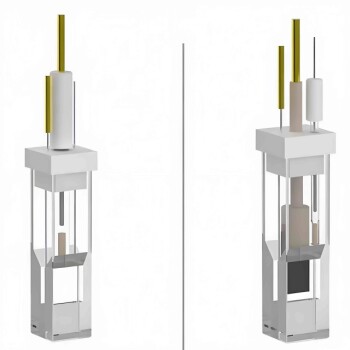
By inserting an SCE between the two main electrodes, you create a three-electrode system. This allows you to measure the half-potential of the anode and the cathode independently against the fixed potential of the SCE.
Analyzing Reaction Kinetics
The primary function of this setup is to reveal the kinetic characteristics of the specific reactions occurring in the cell.
Specifically, the SCE allows for the monitoring of anodic oxidation (where organic matter is broken down) and cathodic reduction (where hydrogen is produced or pollutants are reduced). Understanding the speed and efficiency of these individual half-reactions is vital for troubleshooting performance issues.
The Role of Stability in Data Accuracy
Providing a Fixed Reference
For kinetic data to be valid, the reference point must not fluctuate. The SCE acts as this stable anchor.
As noted in electrochemical principles, the reference electrode is designed to maintain a constant potential. It serves as the yardstick against which the fluctuating potentials of the working electrodes (anode or cathode) are measured.
Preventing Signal Drift
High-precision data acquisition systems rely on the SCE to attribute voltage changes to the chemistry of the MEC, not the measurement tool.
To ensure this stability, the system is designed so that negligible current flows through the SCE. If significant current were to pass through it, the reference potential would shift (polarize), rendering the real-time data regarding anodic and cathodic behavior inaccurate.
Optimizing for Detoxification
Fine-Tuning Operating Parameters
The ultimate goal of using an SCE in this context is process optimization. By visualizing the real-time kinetics, operators can adjust the MEC's operating parameters dynamically.
Achieving Maximum Detoxification
The primary reference highlights that this monitoring is specifically vital for achieving the "best detoxification results."
If the SCE data reveals that anodic oxidation is sluggish, researchers know to focus on improving the microbial biofilm or anode surface. Conversely, if cathodic reduction is the limiting factor, efforts can be directed toward the cathode catalyst.
Understanding the Trade-offs
Complexity of Setup
Implementing an SCE transforms a simple circuit into a complex three-electrode configuration. This requires more sophisticated data acquisition hardware capable of logging high-precision, multi-channel inputs.
Placement Precision
The physical placement of the SCE is non-trivial. It must be positioned carefully between the anode and cathode to minimize uncompensated resistance (IR drop) in the electrolyte, which can distort the measured half-potentials.
Making the Right Choice for Your Goal
To effectively utilize an SCE in your Microbial Electrolysis Cell project, consider your primary objective:
- If your primary focus is Research and Diagnostics: Use the SCE to isolate anodic vs. cathodic kinetics to determine which half-reaction is the bottleneck in your system.
- If your primary focus is Process Efficiency: Use real-time SCE data to dynamically adjust operating parameters (such as applied voltage) to maximize detoxification rates without wasting energy.
The SCE transitions your system from simple operation to precise, data-driven optimization.
Summary Table:
| Feature | Role in MEC Monitoring | Impact on Performance |
|---|---|---|
| Reference Potential | Provides a fixed baseline for measurements | Ensures data accuracy and prevents signal drift |
| Half-Potential Isolation | Separates anode and cathode behavior | Identifies bottlenecks in oxidation or reduction |
| Kinetic Analysis | Measures real-time reaction speeds | Enables precise tuning of detoxification processes |
| Three-Electrode Setup | Transforms cell into a diagnostic system | Allows for advanced process control and optimization |
Elevate Your Electrochemical Research with KINTEK
Precision in monitoring requires high-quality hardware. KINTEK specializes in advanced laboratory equipment, including high-precision electrolytic cells, electrodes, and specialized electrochemical tools designed for demanding research environments like MEC optimization. Whether you are troubleshooting reaction kinetics or scaling up detoxification systems, our comprehensive range of high-temperature furnaces, hydraulic presses, and specialized consumables provides the reliability your data deserves.
Ready to optimize your lab's efficiency? Contact us today to find the perfect solution for your research!
References
- Xianshu Liu, Luyan Zhang. The Detoxification and Degradation of Benzothiazole from the Wastewater in Microbial Electrolysis Cells. DOI: 10.3390/ijerph13121259
This article is also based on technical information from Kintek Solution Knowledge Base .
Related Products
- Reference Electrode Calomel Silver Chloride Mercury Sulfate for Laboratory Use
- Copper Sulfate Reference Electrode for Laboratory Use
- Customizable PEM Electrolysis Cells for Diverse Research Applications
- Thin-Layer Spectral Electrolysis Electrochemical Cell
- Super Sealed Electrolytic Electrochemical Cell
People Also Ask
- What is the function of a reference electrode? Master Precision in Three-Electrode Reactor Reconstruction
- What is the recommended maintenance for the filling solution of a reference electrode? A Guide to Stable & Accurate Readings
- Which electrode is used as a ground reference? Master the Key to Accurate Electrochemical Measurements
- What is the reference electrode in potentiometry? The Key to Stable & Accurate Measurements
- Which electrode is used as a reference? A Guide to Accurate Electrochemical Measurements