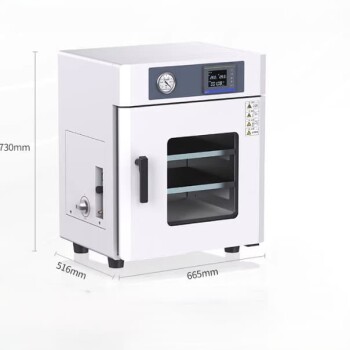
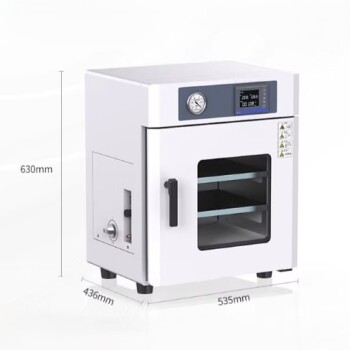
In the synthesis of SiHfCNO ceramic precursors, the vacuum drying oven serves as a critical tool for low-temperature solvent removal. By operating under negative pressure, the oven lowers the boiling point of solvents like ethanol and isopropanol, allowing them to evaporate rapidly at temperatures as low as 60°C. This specific environment ensures the precursor polymer remains chemically stable and free from unintended thermal degradation before it reaches the cross-linking stage.
The vacuum drying oven acts as a safeguard for the precursor's chemical integrity, facilitating thorough solvent extraction at low temperatures to prevent polymer breakdown. It bridges the gap between liquid synthesis and solid-state processing by delivering high-quality, pure raw materials.
Preserving Chemical and Structural Integrity
Lowering Solvent Boiling Points
A vacuum environment significantly reduces the ambient pressure, which in turn lowers the boiling point of liquid media used during synthesis. For SiHfCNO precursors, this allows solvents such as ethanol or isopropanol to be removed efficiently without requiring high heat. This rapid evaporation is essential for transitioning the mixture from a liquid or slurry state into a dried raw material.
Preventing Thermal Degradation
The primary advantage of using a vacuum oven is the ability to dry materials at a controlled low temperature, typically around 60°C. High-temperature drying in a standard oven could trigger the premature or unintended thermal degradation of the precursor polymer. By keeping the thermal load low, the vacuum oven ensures the polymer structure remains intact for subsequent cross-linking processes.
Mitigating Oxidation and Moisture Absorption
The vacuum chamber provides an air-isolated environment that protects the sensitive SiHfCNO precursors from reacting with oxygen or atmospheric moisture. Preventing pre-oxidation is vital for maintaining the purity of the raw materials, which directly impacts the quality of the final ceramic after pyrolysis. This isolation ensures that no atmospheric impurities are adsorbed during the drying phase.
Optimizing Physical Characteristics
Preventing Particle Agglomeration
Vacuum drying provides a uniform thermal field that helps maintain the dispersion of the precursor components. This controlled heating prevents the secondary agglomeration of powders that often occurs when moisture or residual solvents linger in the material. By avoiding clumping, the oven ensures the resulting powder maintains the fluidity and uniformity required for molding or sieving.
Ensuring Molecular Dispersion
In complex precursor systems, maintaining a highly dispersed molecular state is critical to avoid phase separation during high-temperature treatment. The negative pressure environment facilitates efficient degassing, removing trapped gasses that could create voids or irregularities. This leads to a more homogenous precursor, which is a prerequisite for producing high-performance SiHfCNO ceramics.
Understanding the Trade-offs
Equipment Costs and Maintenance
While a vacuum drying oven provides superior material protection, it requires a higher initial investment compared to standard atmospheric ovens. The inclusion of vacuum pumps and specialized seals also necessitates a more rigorous maintenance schedule to ensure consistent pressure levels.
Processing Time and Volume Limits
Achieving a deep vacuum and uniform heat transfer in a low-pressure environment can sometimes lead to longer cycle times for large batches. Furthermore, the physical size of the vacuum chamber often limits the volume of material that can be processed at once, which may impact throughput in high-volume production settings.
How to Apply This to Your Project
Recommendations for Success
- If your primary focus is Chemical Purity: Prioritize the use of a high-vacuum environment to eliminate the risk of pre-oxidation and ensure all residual solvents are removed at the lowest possible temperature.
- If your primary focus is Structural Uniformity: Use a vacuum oven with a programmable thermal field to ensure slow, even heating, which prevents particle agglomeration and preserves the dispersion of the polymer.
- If your primary focus is Process Scalability: Balance the vacuum depth with temperature settings to optimize drying speed, ensuring the precursor remains below its thermal degradation threshold while maximizing throughput.
By precisely controlling the drying environment, you ensure the SiHfCNO precursor is perfectly prepared for the critical cross-linking and pyrolysis phases that follow.
Summary Table:
| Feature | Role in SiHfCNO Preparation | Impact on Final Material |
|---|---|---|
| Low-Temp Evaporation | Removes solvents like ethanol at ~60°C | Prevents unintended polymer degradation |
| Vacuum Environment | Lowers boiling points & isolates from air | Mitigates oxidation and moisture absorption |
| Uniform Thermal Field | Ensures even heat distribution | Prevents particle agglomeration & clumping |
| Degassing Action | Removes trapped gases under negative pressure | Eliminates voids for a homogenous structure |
Elevate Your Advanced Material Synthesis with KINTEK
Precise control over the drying phase is vital for the integrity of SiHfCNO precursors. KINTEK specializes in high-performance laboratory equipment designed to meet the rigorous demands of advanced ceramics research.
Whether you need precision vacuum drying ovens for solvent removal, high-temperature furnaces (tube, muffle, or CVD) for pyrolysis, or crushing and milling systems for powder processing, KINTEK provides the reliable tools your lab requires.
Why choose KINTEK?
- Comprehensive Range: From high-pressure reactors to specialized ceramics and crucibles.
- Expert Support: Tailored solutions for battery research, material science, and industrial scaling.
- Quality Assurance: Durable equipment designed for consistent, reproducible results.
Ready to optimize your research outcomes? Contact KINTEK today to discuss your specific application needs with our technical team!
References
- Rahul Anand, Shantanu K. Behera. Structural evolution and oxidation resistance of polysilazane‐derived SiCN–HfO <sub>2</sub> ceramics. DOI: 10.1111/jace.19358
This article is also based on technical information from Kintek Solution Knowledge Base .
Related Products
- 56L Vertical Laboratory Vacuum Drying Oven
- 23L Laboratory Vacuum Drying Oven
- Laboratory Scientific Electric Heating Blast Drying Oven
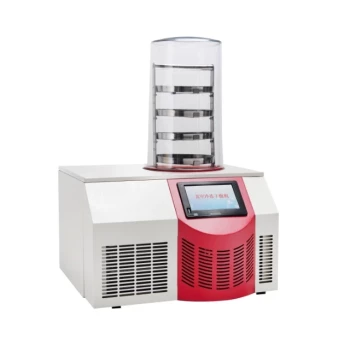
- Benchtop Laboratory Vacuum Freeze Dryer
- Dental Porcelain Zirconia Sintering Ceramic Vacuum Press Furnace
People Also Ask
- Why is a laboratory vacuum drying oven recommended for rice straw residues? Protect Your Biomass Integrity
- What role does a laboratory vacuum drying oven play in the preparation of modified multi-walled carbon nanotubes?
- What is the importance of using a laboratory vacuum drying oven? Preserving Slow-Release Microcapsule Integrity
- Why is a Laboratory Vacuum Drying Oven recommended for PBAT microspheres? Protect Sensitive Polymer Integrity
- What role does a laboratory vacuum drying oven play in processing nanoparticle powder samples? Protect Sample Integrity