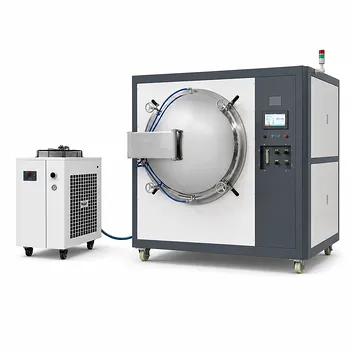
A vacuum hot press furnace functions as a critical precision tool for consolidating amorphous powders, leveraging a specific combination of thermal control and mechanical force. By applying pressure while heating the material to its supercooled liquid region—just above the glass transition temperature—it forces loose powder to bond into a solid, dense mass without reaching the higher temperatures that would destroy its amorphous structure.
Core Takeaway The unique value of a vacuum hot press furnace is its ability to separate densification from high thermal loads. By substituting mechanical pressure for excessive heat, it allows you to achieve near-full density in Bulk Metallic Glass (BMG) while strictly maintaining the material's metastable, non-crystalline state.
The Mechanism of BMG Consolidation
Targeting the Supercooled Liquid Region
The furnace must precisely regulate temperature to reach the supercooled liquid region. This is a specific thermal window located slightly above the material's glass transition temperature ($T_g$) but well below its crystallization point.
In this narrow window, the amorphous powder softens into a viscous state. This allows for manipulation and forming without melting the material or triggering the nucleation of crystals.
Pressure-Assisted Densification
While the material is in this softened state, the furnace applies significant mechanical pressure (often axial). This pressure is the primary driver for eliminating internal pores between powder particles.
The application of force promotes plastic flow and atomic diffusion. This mechanical assist allows the material to reach high density levels (often exceeding 96%) rapidly, which is difficult to achieve through heat alone.
Oxidation Prevention via Vacuum
Maintaining a high-vacuum environment is non-negotiable for BMG processing. The vacuum prevents the oxidation of the metal powders during the heating cycle.
Oxides are detrimental because they act as nucleation sites. If oxides form on particle surfaces, they can trigger unwanted crystallization, compromising the amorphous nature of the final bulk product.
Critical Process Advantages
Preserving the Amorphous Structure
The primary challenge in BMG fabrication is avoiding crystallization. A vacuum hot press furnace enables consolidation at lower temperatures than conventional sintering methods.
By utilizing pressure to drive density rather than relying solely on thermal energy, the process inhibits excessive grain growth. This ensures the final composite retains the specific nanocrystalline or amorphous characteristics inherent to the original powder.
Enhanced Mechanical Properties
The combination of heat and pressure results in a composite with superior mechanical integrity. The process creates strong bonding between particles, leading to a dense structure with minimal defects.
This structural uniformity is essential for optimizing properties such as hardness and bending strength. In some contexts, the directional pressure field can even induce preferred grain alignment, further enhancing transport or mechanical properties along specific axes.
Understanding the Trade-offs
The Thermal Risk Window
While the furnace provides precise control, the margin for error is slim. If the temperature deviates even slightly above the supercooled liquid region, the material will undergo rapid crystallization.
Once crystallized, the material loses the unique properties of a metallic glass (such as high elasticity and strength). Therefore, thermal profiling must be exact.
Geometry and Scalability
Vacuum hot pressing is inherently a batch process that applies uniaxial pressure. This generally limits the geometry of the final BMG to simple shapes like discs or cylinders.
Complex geometries often require post-processing or alternative forming methods, as the pressure distribution in a hot press is primarily directional.
Making the Right Choice for Your Goal
When evaluating the use of a vacuum hot press for your BMG project, consider your primary performance metrics:
- If your primary focus is Structural Integrity: The simultaneous application of heat and pressure is the most reliable method to eliminate porosity and achieve near-theoretical density.
- If your primary focus is Material Purity: The vacuum capability is your most critical asset, ensuring no oxides form to degrade the glass-forming ability of the alloy.
- If your primary focus is Microstructure Control: Use the pressure capability to minimize thermal exposure time, thereby preventing the grain growth that converts BMGs into standard crystalline metals.
By balancing pressure application with precise thermal limits, you transform volatile amorphous powders into robust, high-performance engineering materials.
Summary Table:
| Process Component | Role in BMG Consolidation | Key Benefit |
|---|---|---|
| Thermal Control | Targets supercooled liquid region (above $T_g$) | Prevents crystallization while softening powder |
| Mechanical Force | Provides axial pressure for densification | Eliminates porosity and reaches near-full density |
| Vacuum Environment | Eliminates oxygen during heating | Prevents oxide formation and nucleation sites |
| Pressure-Assisted Flow | Promotes plastic flow and atomic diffusion | Enables low-temperature, rapid consolidation |
Elevate Your BMG Research with KINTEK Precision
Unlock the full potential of amorphous materials with KINTEK’s high-performance vacuum hot press furnaces. Whether you are consolidating Bulk Metallic Glass (BMG) or developing advanced composites, our laboratory equipment is engineered to provide the precise thermal profiling and mechanical force required to maintain metastable states while achieving theoretical density.
Why choose KINTEK?
- Comprehensive Laboratory Solutions: From advanced vacuum and atmosphere furnaces to hydraulic presses and crushing systems, we provide the end-to-end tools needed for material science.
- Specialized Expertise: We support researchers with high-temperature, high-pressure reactors, autoclaves, and essential consumables like ceramics and crucibles.
- Reliable Performance: Achieve superior structural integrity and purity in every batch.
Ready to enhance your lab's efficiency and material quality? Contact our technical experts today to find the perfect solution for your research needs." needs!"
Related Products
- Vacuum Hot Press Furnace Heated Vacuum Press Machine Tube Furnace
- 600T Vacuum Induction Hot Press Furnace for Heat Treat and Sintering
- Vacuum Hot Press Furnace Machine Heated Vacuum Press
- Vacuum Hot Press Furnace Machine for Lamination and Heating
- Vacuum Heat Treat and Pressure Sintering Furnace for High Temperature Applications
People Also Ask
- What advantages does a vacuum hot press furnace provide for LSLBO ceramic electrolytes? Achieve 94% Relative Density
- What role does a Vacuum Hot Press (VHP) furnace play in the densification of austenitic stainless steel 316 composites?
- What are the advantages of using a vacuum hot pressing furnace? Superior Densification for 2024Al/Gr/SiC Composites
- What are the advantages of a vacuum hot press furnace for LTPO solid electrolytes? Boost Density and Conductivity
- What core processing conditions does a vacuum hot press furnace provide? Achieve High-Density Cu-SiC/Diamond Composites