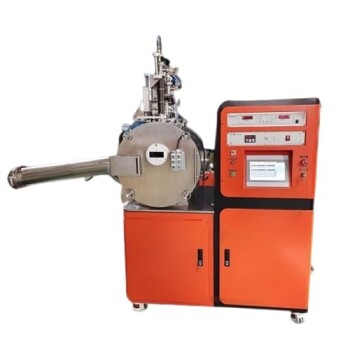
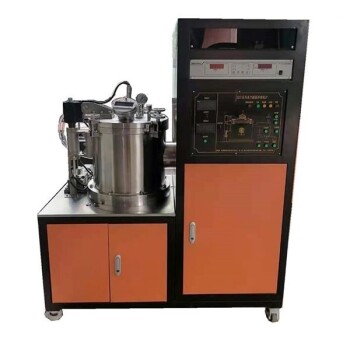
A vacuum induction melting (VIM) furnace functions as the primary synthesis tool for creating high-purity High-Entropy Alloys (HEAs) specifically designed for nuclear fusion environments. By utilizing induction current heating within a vacuum or inert gas environment, it melts and mixes multiple active metal elements while strictly preventing oxidation. This ensures the material achieves the chemical homogeneity required for the extreme conditions of a fusion reactor.
Core Takeaway In the context of nuclear fusion, material failure is not an option. The vacuum induction melting furnace is essential not just for melting metal, but for creating the non-equilibrium thermodynamic states and complex grain boundary structures that allow HEAs to withstand neutron irradiation and high-temperature stress.
The Critical Role of Atmosphere Control
Preventing Element Oxidation
High-Entropy Alloys consist of multiple principal elements, many of which are "active" metals that react aggressively with oxygen. If these elements oxidize during the melting process, the alloy's mechanical properties are compromised immediately.
The VIM furnace operates under a vacuum or inert gas protection. This isolation effectively blocks oxygen, ensuring that every element in the mix remains metallic and functional.
Ensuring Homogeneity
HEAs rely on the thorough mixing of diverse elements to function correctly. A standard furnace may leave composition gradients, creating weak points in the material.
The induction currents in a VIM furnace provide inherent stirring of the molten pool. This results in the thorough mixing of various metal elements, ensuring the final ingot has a uniform composition throughout.
Enabling Fusion-Ready Microstructures
Achieving Non-Equilibrium Thermodynamic States
Materials used in nuclear fusion applications require unique properties often found outside of standard equilibrium states. The primary reference notes that VIM processes are fundamental to obtaining these "high-performance non-equilibrium thermodynamic states."
By controlling the melting and solidification environment precisely, engineers can lock in these specific states, which are necessary for the material's performance under stress.
Creating Complex Grain Boundary Structures
The resistance of a material to the harsh environment of a fusion reactor—specifically neutron irradiation—often depends on its grain structure. The VIM process facilitates the formation of complex grain boundary structures.
These structures are critical for arresting cracks and managing the accumulation of defects caused by high-energy neutrons.
Enhancing Material Purity
Supplementary data indicates that vacuum induction melting significantly reduces internal impurities and gas content. In high-temperature environments, impurities act as initiation sites for failure.
By removing volatile impurities and gases, VIM produces alloys with superior stability and corrosion resistance, a principle that applies to both standard superalloys and advanced HEAs.
Understanding the Trade-offs
Operational Complexity and Cost
While VIM offers superior quality, the selection of the furnace atmosphere is dictated by cost and specific service demands. The process is more resource-intensive than conventional melting.
Sensitivity to Process Parameters
The "proper selection of a furnace atmosphere" is critical. The choice between a vacuum or a specific inert gas depends entirely on the material design and required manufacturing steps; an incorrect choice can lead to suboptimal phase formation.
Making the Right Choice for Your Goal
To determine if VIM is the correct processing route for your fusion reactor material, consider your specific performance targets:
- If your primary focus is Irradiation Resistance: Prioritize VIM to establish the complex grain boundary structures and high purity required to mitigate neutron embrittlement.
- If your primary focus is Chemical Stability: Use VIM to ensure complete homogenization of active elements and to prevent the formation of oxide inclusions that weaken the matrix.
The vacuum induction melting furnace is not merely a heating vessel; it is a precision instrument for engineering the microstructure of the next generation of nuclear materials.
Summary Table:
| Feature | Role in HEA Preparation | Impact on Fusion Performance |
|---|---|---|
| Atmosphere Control | Prevents oxidation of active metal elements | Ensures high purity and mechanical integrity |
| Induction Stirring | Promotes chemical homogeneity | Eliminates weak points and composition gradients |
| Microstructure Control | Creates complex grain boundary structures | Enhances resistance to neutron irradiation |
| Vacuum Environment | Removes volatile impurities and gases | Improves stability and corrosion resistance |
Elevate Your Nuclear Materials Research with KINTEK
Precision is paramount when engineering materials for the extreme conditions of nuclear fusion. KINTEK specializes in advanced laboratory equipment, providing the high-performance vacuum induction melting furnaces and induction melting systems required to synthesize high-purity High-Entropy Alloys with superior homogeneity.
From high-temperature furnaces and vacuum systems to crushing and milling equipment, KINTEK offers the comprehensive tools needed to achieve non-equilibrium thermodynamic states and complex microstructures. Whether you are developing irradiation-resistant alloys or high-stability ceramics, our team is ready to support your laboratory's success.
Ready to optimize your alloy synthesis? Contact KINTEK today for expert equipment solutions!
References
- Patricia Jovičević-Klug, Michael Rohwerder. Sustainable New Technology for the Improvement of Metallic Materials for Future Energy Applications. DOI: 10.3390/coatings13111822
This article is also based on technical information from Kintek Solution Knowledge Base .
Related Products
- Lab-Scale Vacuum Induction Melting Furnace
- Vacuum Induction Melting Spinning System Arc Melting Furnace
- Vacuum Heat Treat Furnace and Levitation Induction Melting Furnace
- Vacuum Arc Induction Melting Furnace
- Non Consumable Vacuum Arc Induction Melting Furnace
People Also Ask
- How do vacuum induction or arc melting furnaces facilitate the synthesis of U-Al-C MAX phases? Precision Heat & Purity
- What types of metals are typically processed in a vacuum induction melting furnace? High-Purity Alloys for Critical Applications
- What is the primary function of a vacuum induction melting furnace in Ni-Mo-Cr-Fe master alloy prep? Ensure High Purity
- Why use VIM for rare earth steel? Essential Precision for Melting Reactive Lanthanum and Cerium
- What is the function of a vacuum induction melting furnace? Essential Guide for High-Purity FeCrAl Alloy Production