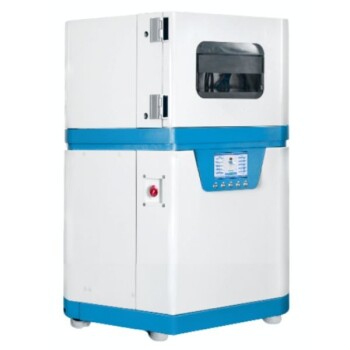
A vacuum hot-press furnace lowers the required sintering temperature for boron carbide by applying simultaneous axial mechanical pressure during the heating process. While conventional sintering requires extreme heat exceeding 2300°C, the addition of pressure (typically around 20 MPa) allows for effective densification at significantly lower temperatures, such as 1850°C.
Core Takeaway Boron carbide is notoriously difficult to sinter due to its strong covalent bonding. A vacuum hot-press furnace solves this by substituting thermal energy with mechanical energy; the applied pressure forces particle rearrangement and plastic flow, achieving high densities (>90%) at reduced temperatures while the vacuum environment prevents oxidation.
The Challenge: Why Boron Carbide Resists Sintering
The Barrier of Covalent Bonding
Boron carbide ceramics are defined by strong covalent bonds (approximately 94% covalent character). This atomic structure creates a material with exceptionally low diffusion coefficients.
The Temperature Requirement
Because the atoms resist movement, standard "pressureless" sintering methods must rely on extreme thermal energy to drive densification. This typically requires temperatures between 2250°C and 2300°C.
The Density Limit
Even at these extreme temperatures, pressureless sintering is often inefficient. It frequently results in a relative density of only 80–87% and can lead to rapid grain growth, which compromises the material's mechanical properties.
How Pressure Overcomes the Temperature Barrier
Mechanical Driving Force
A vacuum hot-press furnace introduces a second source of energy: axial mechanical pressure. By applying pressure ranging from 20 to 100 MPa simultaneously with heat, the furnace physically forces ceramic particles into tighter contact.
Promoting Plastic Flow
This applied pressure triggers particle rearrangement and macroscopic plastic flow. These mechanisms allow material transport to occur much more readily than they would under thermal influence alone.
Lowering the Thermal Threshold
Because the mechanical pressure assists in closing pores and moving particles, the thermal requirement is significantly reduced. The process can lower the necessary sintering temperature by 100–200°C, enabling successful sintering around 1850°C.
The Critical Role of the Vacuum Environment
Preventing Oxidation
Boron carbide is susceptible to oxidation at high temperatures. The vacuum environment eliminates oxygen, ensuring the material retains its chemical purity during the heating cycle.
Removing Volatile Impurities
The vacuum actively assists in the removal of adsorbed gases and volatile byproducts, specifically boron oxide (B2O3). Removing these impurities reduces gas resistance within the pores.
Purifying Grain Boundaries
By extracting volatiles, the vacuum purifies the grain boundaries. This ensures better bonding between grains, which is essential for achieving high final density and superior mechanical performance.
Operational Trade-offs
Complexity vs. Results
While hot-pressing yields superior results, it is inherently more complex than pressureless sintering. It requires precise control over three variables simultaneously: temperature, mechanical pressure, and vacuum atmosphere.
Geometry Limitations
The application of uniaxial pressure generally limits the geometry of the parts being produced. While it creates near-theoretical density, the process is best suited for simpler shapes compared to the geometric freedom of pressureless sintering.
Making the Right Choice for Your Goal
To maximize the performance of your boron carbide components, consider these specific outcomes:
- If your primary focus is Maximum Density: Utilize vacuum hot-pressing to achieve relative densities exceeding 90% (up to near-theoretical limits) by mechanically eliminating open and closed porosity.
- If your primary focus is Mechanical Strength: Rely on the hot-press method to inhibit grain coarsening, producing a fine-grained microstructure that offers superior flexural strength compared to pressureless sintered parts.
- If your primary focus is Process Efficiency: Leverage the pressure-assisted mechanism to reduce sintering temperatures by up to 200°C and shorten the overall densification time.
The synergy of vacuum and pressure transforms boron carbide from a material that is difficult to process into a high-performance ceramic with superior density and structural integrity.
Summary Table:
| Feature | Pressureless Sintering | Vacuum Hot-Press Sintering |
|---|---|---|
| Sintering Temperature | 2250°C - 2300°C | ~1850°C |
| Mechanical Pressure | None (Ambient) | 20 - 100 MPa |
| Relative Density | 80% - 87% | >90% (Near-theoretical) |
| Grain Structure | Prone to coarsening | Fine-grained (Controlled) |
| Atmosphere Control | Variable | High Vacuum (Prevents Oxidation) |
| Key Mechanism | Thermal Diffusion | Particle Rearrangement & Plastic Flow |
Elevate Your Material Research with KINTEK Precision Engineering
Don't let the extreme sintering requirements of boron carbide and other advanced ceramics limit your laboratory's potential. KINTEK specializes in high-performance vacuum hot-press furnaces and hydraulic presses designed to provide the precise mechanical force and thermal control needed to achieve near-theoretical density at lower temperatures.
Whether you are focusing on battery research, high-temperature ceramics, or advanced metallurgy, our comprehensive portfolio—ranging from CVD/PECVD systems to isostatic presses and high-temperature reactors—ensures your lab is equipped for success.
Ready to optimize your sintering process? Contact our technical experts today to find the perfect solution for your specific application and discover how KINTEK can enhance your material properties and process efficiency.
Related Products
- Vacuum Hot Press Furnace Heated Vacuum Press Machine Tube Furnace
- 600T Vacuum Induction Hot Press Furnace for Heat Treat and Sintering
- Vacuum Hot Press Furnace Machine Heated Vacuum Press
- Vacuum Hot Press Furnace Machine for Lamination and Heating
- Vacuum Heat Treat and Pressure Sintering Furnace for High Temperature Applications
People Also Ask
- What advantages does a vacuum hot press furnace provide for LSLBO ceramic electrolytes? Achieve 94% Relative Density
- What role does a Vacuum Hot Press (VHP) furnace play in the densification of austenitic stainless steel 316 composites?
- What are the advantages of using a vacuum hot pressing furnace? Superior Densification for 2024Al/Gr/SiC Composites
- What are the advantages of a vacuum hot press furnace for LTPO solid electrolytes? Boost Density and Conductivity
- What core processing conditions does a vacuum hot press furnace provide? Achieve High-Density Cu-SiC/Diamond Composites