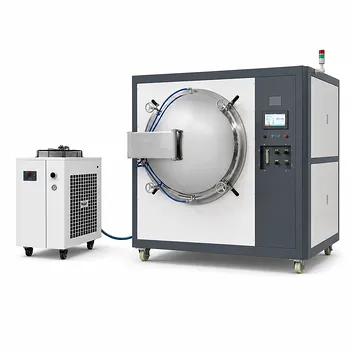
The primary advantage of using a vacuum hot pressing furnace for Al2O3-TiC laminated ceramics is the ability to achieve near-theoretical density through the simultaneous application of high temperature and mechanical pressure.
While cold press sintering separates the forming and heating stages, vacuum hot pressing combines them to force particle rearrangement and plastic flow. This process typically yields a relative density of approximately 98.9%, effectively eliminating interlayer pores and significantly enhancing both hardness and flexural strength.
Core Takeaway By applying mechanical pressure (e.g., 30 MPa) directly during the sintering phase, vacuum hot pressing provides a driving force for densification that temperature alone cannot achieve. This results in a structurally superior, non-porous ceramic laminate with optimized grain boundaries, outperforming the results of conventional cold press sintering.
The Mechanics of Superior Densification
Simultaneous Heat and Pressure
The defining difference of vacuum hot pressing is the application of axial pressure while the material is heated. In the production of Al2O3-TiC, this involves temperatures up to 1750°C combined with significant pressure, such as 30 MPa.
Overcoming Diffusion Barriers
Cold press sintering relies almost entirely on thermal energy to close pores, which is often insufficient for complex composites like Al2O3-TiC. Hot pressing introduces plastic flow and rearranges particles mechanically. This accelerates grain boundary diffusion, forcing material into voids that would otherwise remain empty.
Eliminating Interlayer Porosity
For laminated ceramics, the bond between layers is the most critical structural weakness. Vacuum hot pressing physically compresses these layers together during the sintering window. This eliminates the interlayer pores common in cold-pressed samples, ensuring the laminate acts as a single, cohesive unit rather than a stack of loosely bonded plates.
Microstructural and Chemical Advantages
Achieving Near-Full Density
The pressure-assisted mechanism allows the ceramic to reach approximately 98.9% relative density. This is a significant leap over pressureless methods, where residual porosity often compromises the material's mechanical integrity. Higher density directly correlates to increased hardness and fracture toughness.
Environmental Control via Vacuum
The vacuum environment is essential for composites containing Titanium Carbide (TiC). TiC is susceptible to oxidation at high temperatures, which degrades material performance. The vacuum atmosphere protects the chemical stability of the TiC phase, ensuring the final product maintains its intended composition and properties.
Controlling Grain Growth
Because pressure aids densification, the process can often be completed more efficiently or at slightly lower effective temperatures than pressureless sintering requires. This prevents excessive grain growth. Maintaining a fine-grained microstructure is vital for maximizing the mechanical strength of the ceramic.
Understanding the Trade-offs
Equipment Complexity and Cost
While the material results are superior, vacuum hot pressing requires significantly more complex and expensive equipment than cold press sintering. The machinery must withstand high forces and high temperatures simultaneously while maintaining a vacuum.
Throughput Limitations
Hot pressing is inherently a batch process. Unlike cold pressing, which can rapidly form green bodies for continuous sintering in a tunnel kiln, hot pressing restricts production speed. It is best reserved for high-performance applications where material properties justify the higher manufacturing cost and lower throughput.
Geometrical Constraints
The uniaxial pressure applied in hot pressing limits the geometric complexity of the parts. It is ideal for simple shapes like plates, discs (such as the laminated ceramics in question), or cylinders. Complex, near-net-shape components are often difficult to manufacture without extensive post-process machining.
Making the Right Choice for Your Project
The decision between vacuum hot pressing and cold press sintering depends entirely on the performance requirements of your final application.
- If your primary focus is maximum mechanical strength: Choose vacuum hot pressing to achieve >98% density and eliminate fatal flaws like interlayer porosity.
- If your primary focus is cost-efficiency for non-critical parts: Choose cold press sintering, accepting that the final product will have lower density and reduced hardness.
For Al2O3-TiC laminates intended for high-stress environments, vacuum hot pressing is not just an alternative; it is the requisite method for ensuring structural reliability.
Summary Table:
| Feature | Vacuum Hot Pressing | Cold Press Sintering |
|---|---|---|
| Relative Density | ~98.9% (Near-theoretical) | Significantly Lower |
| Mechanism | Simultaneous Heat + Pressure | Separate Forming & Sintering |
| Microstructure | Fine-grained, no interlayer pores | Residual porosity common |
| Atmosphere | Vacuum (Prevents TiC oxidation) | Varies (often less controlled) |
| Strength | Superior Flexural & Hardness | Standard/Basic |
| Best For | High-performance Al2O3-TiC laminates | Low-cost, non-critical parts |
Elevate Your Material Performance with KINTEK
Don't let interlayer porosity compromise your research or production. KINTEK specializes in advanced vacuum hot pressing systems and isostatic presses designed to achieve superior densification for complex Al2O3-TiC laminates and advanced ceramics.
From high-temperature vacuum furnaces and CVD systems to precision hydraulic presses and specialized consumables like ceramics and crucibles, we provide the complete laboratory solution for your most demanding applications. Our technical experts are ready to help you optimize your sintering process for maximum hardness and structural reliability.
Ready to achieve near-theoretical density?
Contact KINTEK Today to Discuss Your Project
Related Products
- Vacuum Hot Press Furnace Heated Vacuum Press Machine Tube Furnace
- 600T Vacuum Induction Hot Press Furnace for Heat Treat and Sintering
- Vacuum Hot Press Furnace Machine Heated Vacuum Press
- Vacuum Hot Press Furnace Machine for Lamination and Heating
- Vacuum Heat Treat and Pressure Sintering Furnace for High Temperature Applications
People Also Ask
- What advantages does a vacuum hot press furnace provide for LSLBO ceramic electrolytes? Achieve 94% Relative Density
- What role does a Vacuum Hot Press (VHP) furnace play in the densification of austenitic stainless steel 316 composites?
- What are the advantages of using a vacuum hot pressing furnace? Superior Densification for 2024Al/Gr/SiC Composites
- What are the advantages of a vacuum hot press furnace for LTPO solid electrolytes? Boost Density and Conductivity
- What core processing conditions does a vacuum hot press furnace provide? Achieve High-Density Cu-SiC/Diamond Composites